

19 Magnetoelectric Near Fields
555
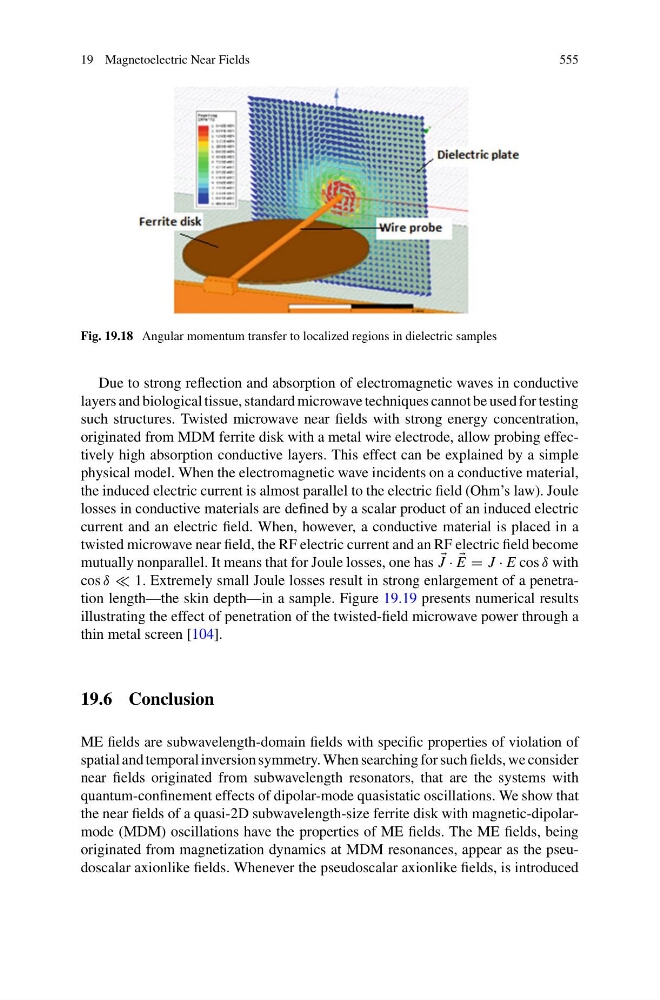
Fig. 19.18 Angular momentum transfer to localized regions in dielectric samples
Due to strong reflection and absorption of electromagnetic waves in conductive
layers and biological tissue, standard microwave techniques cannot be used for testing
such structures. Twisted microwave near fields with strong energy concentration,
originated from MDM ferrite disk with a metal wire electrode, allow probing effectively high absorption conductive layers. This effect can be explained by a simple
physical model. When the electromagnetic wave incidents on a conductive material,
the induced electric current is almost parallel to the electric field (Ohm’s law). Joule
losses in conductive materials are defined by a scalar product of an induced electric
current and an electric field. When, however, a conductive material is placed in a
twisted microwave near field, the RF electric current and an RF electric field become
mutually nonparallel. It means that for Joule losses, one has
J ·
E = J · E cos δ with
cos δ 1. Extremely small Joule losses result in strong enlargement of a penetration length—the skin depth—in a sample. Figure 19.19 presents numerical results
illustrating the effect of penetration of the twisted-field microwave power through a
thin metal screen [104].
19.6 Conclusion
ME fields are subwavelength-domain fields with specific properties of violation of
spatial and temporal inversion symmetry. When searching for such fields, we consider
near fields originated from subwavelength resonators, that are the systems with
quantum-confinement effects of dipolar-mode quasistatic oscillations. We show that
the near fields of a quasi-2D subwavelength-size ferrite disk with magnetic-dipolarmode (MDM) oscillations have the properties of ME fields. The ME fields, being
originated from magnetization dynamics at MDM resonances, appear as the pseudoscalar axionlike fields. Whenever the pseudoscalar axionlike fields, is introduced