

554
E. Kamenetskii
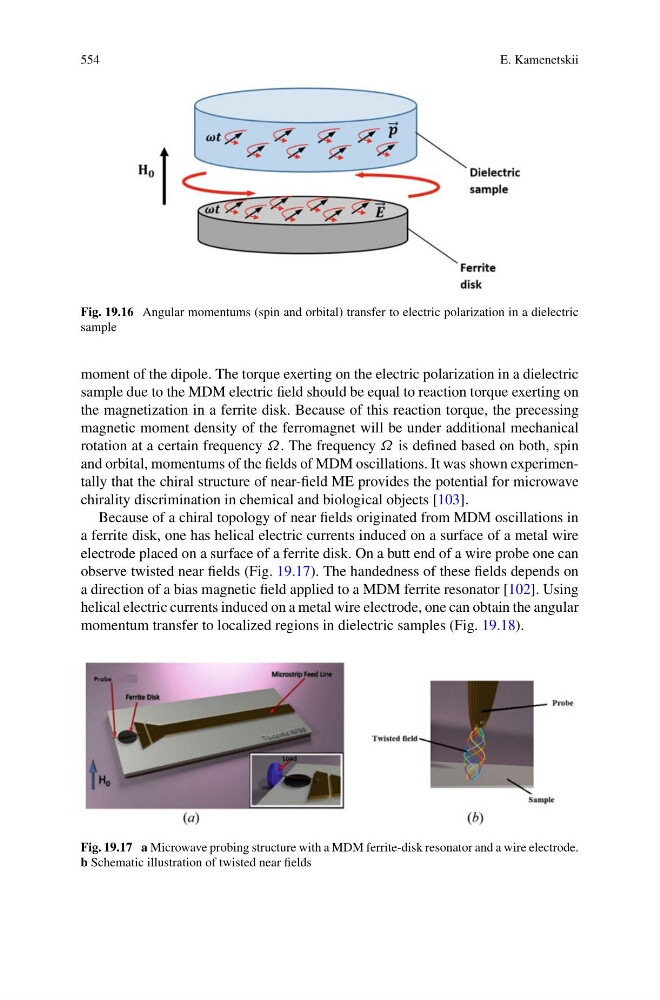
Fig. 19.16 Angular momentums (spin and orbital) transfer to electric polarization in a dielectric
sample
moment of the dipole. The torque exerting on the electric polarization in a dielectric
sample due to the MDM electric field should be equal to reaction torque exerting on
the magnetization in a ferrite disk. Because of this reaction torque, the precessing
magnetic moment density of the ferromagnet will be under additional mechanical
rotation at a certain frequency Ω. The frequency Ω is defined based on both, spin
and orbital, momentums of the fields of MDM oscillations. It was shown experimentally that the chiral structure of near-field ME provides the potential for microwave
chirality discrimination in chemical and biological objects [103].
Because of a chiral topology of near fields originated from MDM oscillations in
a ferrite disk, one has helical electric currents induced on a surface of a metal wire
electrode placed on a surface of a ferrite disk. On a butt end of a wire probe one can
observe twisted near fields (Fig. 19.17). The handedness of these fields depends on
a direction of a bias magnetic field applied to a MDM ferrite resonator [102]. Using
helical electric currents induced on a metal wire electrode, one can obtain the angular
momentum transfer to localized regions in dielectric samples (Fig. 19.18).
Fig. 19.17 a Microwave probing structure with a MDM ferrite-disk resonator and a wire electrode.
b Schematic illustration of twisted near fields