

546
E. Kamenetskii
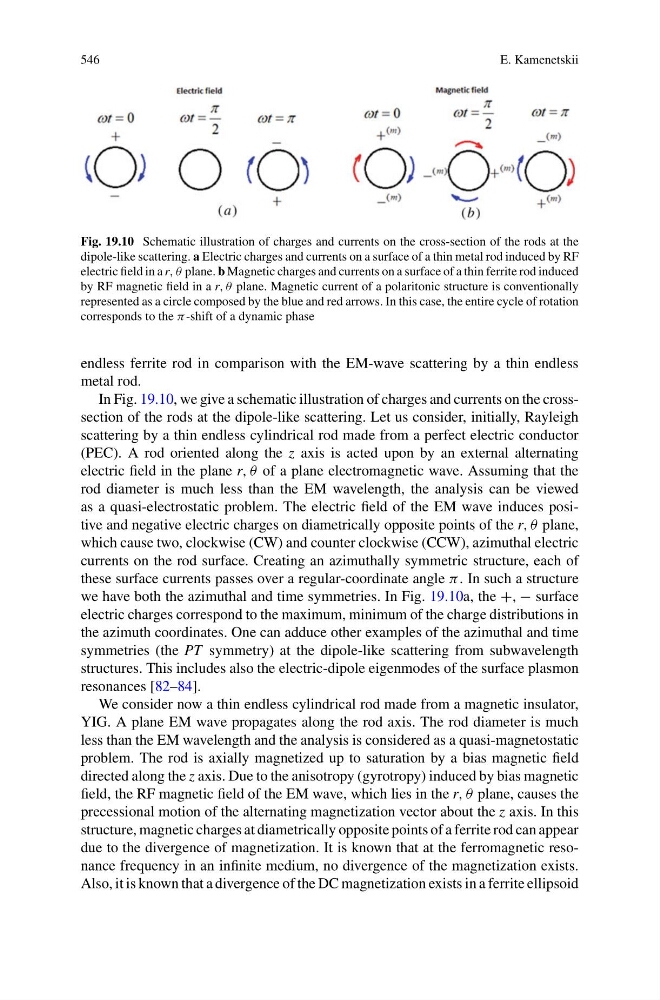
Fig. 19.10 Schematic illustration of charges and currents on the cross-section of the rods at the
dipole-like scattering. a Electric charges and currents on a surface of a thin metal rod induced by RF
electric field in a r, θ plane. b Magnetic charges and currents on a surface of a thin ferrite rod induced
by RF magnetic field in a r, θ plane. Magnetic current of a polaritonic structure is conventionally
represented as a circle composed by the blue and red arrows. In this case, the entire cycle of rotation
corresponds to the π -shift of a dynamic phase
endless ferrite rod in comparison with the EM-wave scattering by a thin endless
metal rod.
In Fig. 19.10, we give a schematic illustration of charges and currents on the crosssection of the rods at the dipole-like scattering. Let us consider, initially, Rayleigh
scattering by a thin endless cylindrical rod made from a perfect electric conductor
(PEC). A rod oriented along the z axis is acted upon by an external alternating
electric field in the plane r, θ of a plane electromagnetic wave. Assuming that the
rod diameter is much less than the EM wavelength, the analysis can be viewed
as a quasi-electrostatic problem. The electric field of the EM wave induces positive and negative electric charges on diametrically opposite points of the r, θ plane,
which cause two, clockwise (CW) and counter clockwise (CCW), azimuthal electric
currents on the rod surface. Creating an azimuthally symmetric structure, each of
these surface currents passes over a regular-coordinate angle π . In such a structure
we have both the azimuthal and time symmetries. In Fig. 19.10a, the +, − surface
electric charges correspond to the maximum, minimum of the charge distributions in
the azimuth coordinates. One can adduce other examples of the azimuthal and time
symmetries (the PT symmetry) at the dipole-like scattering from subwavelength
structures. This includes also the electric-dipole eigenmodes of the surface plasmon
resonances [82–84].
We consider now a thin endless cylindrical rod made from a magnetic insulator,
YIG. A plane EM wave propagates along the rod axis. The rod diameter is much
less than the EM wavelength and the analysis is considered as a quasi-magnetostatic
problem. The rod is axially magnetized up to saturation by a bias magnetic field
directed along the z axis. Due to the anisotropy (gyrotropy) induced by bias magnetic
field, the RF magnetic field of the EM wave, which lies in the r, θ plane, causes the
precessional motion of the alternating magnetization vector about the z axis. In this
structure, magnetic charges at diametrically opposite points of a ferrite rod can appear
due to the divergence of magnetization. It is known that at the ferromagnetic resonance frequency in an infinite medium, no divergence of the magnetization exists.
Also, it is known that a divergence of the DC magnetization exists in a ferrite ellipsoid
E. Kamenetskii
Fig. 19.10 Schematic illustration of charges and currents on the cross-section of the rods at the
dipole-like scattering. a Electric charges and currents on a surface of a thin metal rod induced by RF
electric field in a r, θ plane. b Magnetic charges and currents on a surface of a thin ferrite rod induced
by RF magnetic field in a r, θ plane. Magnetic current of a polaritonic structure is conventionally
represented as a circle composed by the blue and red arrows. In this case, the entire cycle of rotation
corresponds to the π -shift of a dynamic phase
endless ferrite rod in comparison with the EM-wave scattering by a thin endless
metal rod.
In Fig. 19.10, we give a schematic illustration of charges and currents on the crosssection of the rods at the dipole-like scattering. Let us consider, initially, Rayleigh
scattering by a thin endless cylindrical rod made from a perfect electric conductor
(PEC). A rod oriented along the z axis is acted upon by an external alternating
electric field in the plane r, θ of a plane electromagnetic wave. Assuming that the
rod diameter is much less than the EM wavelength, the analysis can be viewed
as a quasi-electrostatic problem. The electric field of the EM wave induces positive and negative electric charges on diametrically opposite points of the r, θ plane,
which cause two, clockwise (CW) and counter clockwise (CCW), azimuthal electric
currents on the rod surface. Creating an azimuthally symmetric structure, each of
these surface currents passes over a regular-coordinate angle π . In such a structure
we have both the azimuthal and time symmetries. In Fig. 19.10a, the +, − surface
electric charges correspond to the maximum, minimum of the charge distributions in
the azimuth coordinates. One can adduce other examples of the azimuthal and time
symmetries (the PT symmetry) at the dipole-like scattering from subwavelength
structures. This includes also the electric-dipole eigenmodes of the surface plasmon
resonances [82–84].
We consider now a thin endless cylindrical rod made from a magnetic insulator,
YIG. A plane EM wave propagates along the rod axis. The rod diameter is much
less than the EM wavelength and the analysis is considered as a quasi-magnetostatic
problem. The rod is axially magnetized up to saturation by a bias magnetic field
directed along the z axis. Due to the anisotropy (gyrotropy) induced by bias magnetic
field, the RF magnetic field of the EM wave, which lies in the r, θ plane, causes the
precessional motion of the alternating magnetization vector about the z axis. In this
structure, magnetic charges at diametrically opposite points of a ferrite rod can appear
due to the divergence of magnetization. It is known that at the ferromagnetic resonance frequency in an infinite medium, no divergence of the magnetization exists.
Also, it is known that a divergence of the DC magnetization exists in a ferrite ellipsoid