

19 Magnetoelectric Near Fields
545
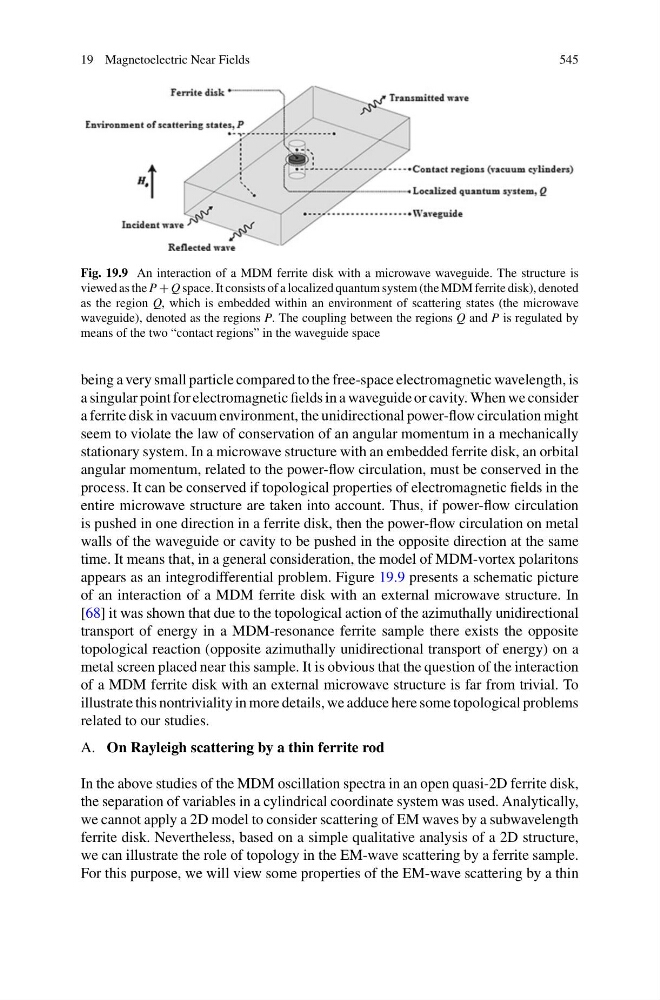
Fig. 19.9 An interaction of a MDM ferrite disk with a microwave waveguide. The structure is
viewed as the P + Q space. It consists of a localized quantum system (the MDM ferrite disk), denoted
as the region Q, which is embedded within an environment of scattering states (the microwave
waveguide), denoted as the regions P. The coupling between the regions Q and P is regulated by
means of the two “contact regions” in the waveguide space
being a very small particle compared to the free-space electromagnetic wavelength, is
a singular point for electromagnetic fields in a waveguide or cavity. When we consider
a ferrite disk in vacuum environment, the unidirectional power-flow circulation might
seem to violate the law of conservation of an angular momentum in a mechanically
stationary system. In a microwave structure with an embedded ferrite disk, an orbital
angular momentum, related to the power-flow circulation, must be conserved in the
process. It can be conserved if topological properties of electromagnetic fields in the
entire microwave structure are taken into account. Thus, if power-flow circulation
is pushed in one direction in a ferrite disk, then the power-flow circulation on metal
walls of the waveguide or cavity to be pushed in the opposite direction at the same
time. It means that, in a general consideration, the model of MDM-vortex polaritons
appears as an integrodifferential problem. Figure 19.9 presents a schematic picture
of an interaction of a MDM ferrite disk with an external microwave structure. In
[68] it was shown that due to the topological action of the azimuthally unidirectional
transport of energy in a MDM-resonance ferrite sample there exists the opposite
topological reaction (opposite azimuthally unidirectional transport of energy) on a
metal screen placed near this sample. It is obvious that the question of the interaction
of a MDM ferrite disk with an external microwave structure is far from trivial. To
illustrate this nontriviality in more details, we adduce here some topological problems
related to our studies.
A. On Rayleigh scattering by a thin ferrite rod
In the above studies of the MDM oscillation spectra in an open quasi-2D ferrite disk,
the separation of variables in a cylindrical coordinate system was used. Analytically,
we cannot apply a 2D model to consider scattering of EM waves by a subwavelength
ferrite disk. Nevertheless, based on a simple qualitative analysis of a 2D structure,
we can illustrate the role of topology in the EM-wave scattering by a ferrite sample.
For this purpose, we will view some properties of the EM-wave scattering by a thin
545
Fig. 19.9 An interaction of a MDM ferrite disk with a microwave waveguide. The structure is
viewed as the P + Q space. It consists of a localized quantum system (the MDM ferrite disk), denoted
as the region Q, which is embedded within an environment of scattering states (the microwave
waveguide), denoted as the regions P. The coupling between the regions Q and P is regulated by
means of the two “contact regions” in the waveguide space
being a very small particle compared to the free-space electromagnetic wavelength, is
a singular point for electromagnetic fields in a waveguide or cavity. When we consider
a ferrite disk in vacuum environment, the unidirectional power-flow circulation might
seem to violate the law of conservation of an angular momentum in a mechanically
stationary system. In a microwave structure with an embedded ferrite disk, an orbital
angular momentum, related to the power-flow circulation, must be conserved in the
process. It can be conserved if topological properties of electromagnetic fields in the
entire microwave structure are taken into account. Thus, if power-flow circulation
is pushed in one direction in a ferrite disk, then the power-flow circulation on metal
walls of the waveguide or cavity to be pushed in the opposite direction at the same
time. It means that, in a general consideration, the model of MDM-vortex polaritons
appears as an integrodifferential problem. Figure 19.9 presents a schematic picture
of an interaction of a MDM ferrite disk with an external microwave structure. In
[68] it was shown that due to the topological action of the azimuthally unidirectional
transport of energy in a MDM-resonance ferrite sample there exists the opposite
topological reaction (opposite azimuthally unidirectional transport of energy) on a
metal screen placed near this sample. It is obvious that the question of the interaction
of a MDM ferrite disk with an external microwave structure is far from trivial. To
illustrate this nontriviality in more details, we adduce here some topological problems
related to our studies.
A. On Rayleigh scattering by a thin ferrite rod
In the above studies of the MDM oscillation spectra in an open quasi-2D ferrite disk,
the separation of variables in a cylindrical coordinate system was used. Analytically,
we cannot apply a 2D model to consider scattering of EM waves by a subwavelength
ferrite disk. Nevertheless, based on a simple qualitative analysis of a 2D structure,
we can illustrate the role of topology in the EM-wave scattering by a ferrite sample.
For this purpose, we will view some properties of the EM-wave scattering by a thin