

540
E. Kamenetskii
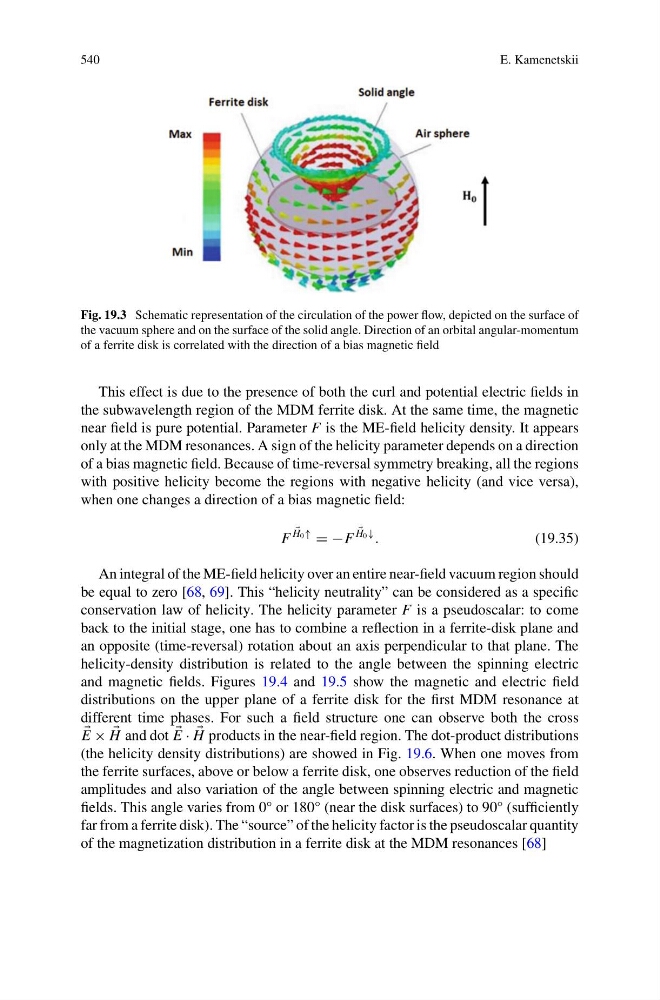
Fig. 19.3 Schematic representation of the circulation of the power flow, depicted on the surface of
the vacuum sphere and on the surface of the solid angle. Direction of an orbital angular-momentum
of a ferrite disk is correlated with the direction of a bias magnetic field
This effect is due to the presence of both the curl and potential electric fields in
the subwavelength region of the MDM ferrite disk. At the same time, the magnetic
near field is pure potential. Parameter F is the ME-field helicity density. It appears
only at the MDM resonances. A sign of the helicity parameter depends on a direction
of a bias magnetic field. Because of time-reversal symmetry breaking, all the regions
with positive helicity become the regions with negative helicity (and vice versa),
when one changes a direction of a bias magnetic field:
F
H 0 ↑
= −F
H 0 ↓
.
(19.35)
An integral of the ME-field helicity over an entire near-field vacuum region should
be equal to zero [68, 69]. This “helicity neutrality” can be considered as a specific
conservation law of helicity. The helicity parameter F is a pseudoscalar: to come
back to the initial stage, one has to combine a reflection in a ferrite-disk plane and
an opposite (time-reversal) rotation about an axis perpendicular to that plane. The
helicity-density distribution is related to the angle between the spinning electric
and magnetic fields. Figures 19.4 and 19.5 show the magnetic and electric field
distributions on the upper plane of a ferrite disk for the first MDM resonance at
different time phases. For such a field structure one can observe both the cross
E ×
H and dot
E ·
H products in the near-field region. The dot-product distributions
(the helicity density distributions) are showed in Fig. 19.6. When one moves from
the ferrite surfaces, above or below a ferrite disk, one observes reduction of the field
amplitudes and also variation of the angle between spinning electric and magnetic
fields. This angle varies from 0° or 180° (near the disk surfaces) to 90° (sufficiently
far from a ferrite disk). The “source” of the helicity factor is the pseudoscalar quantity
of the magnetization distribution in a ferrite disk at the MDM resonances [68]
E. Kamenetskii
Fig. 19.3 Schematic representation of the circulation of the power flow, depicted on the surface of
the vacuum sphere and on the surface of the solid angle. Direction of an orbital angular-momentum
of a ferrite disk is correlated with the direction of a bias magnetic field
This effect is due to the presence of both the curl and potential electric fields in
the subwavelength region of the MDM ferrite disk. At the same time, the magnetic
near field is pure potential. Parameter F is the ME-field helicity density. It appears
only at the MDM resonances. A sign of the helicity parameter depends on a direction
of a bias magnetic field. Because of time-reversal symmetry breaking, all the regions
with positive helicity become the regions with negative helicity (and vice versa),
when one changes a direction of a bias magnetic field:
F
H 0 ↑
= −F
H 0 ↓
.
(19.35)
An integral of the ME-field helicity over an entire near-field vacuum region should
be equal to zero [68, 69]. This “helicity neutrality” can be considered as a specific
conservation law of helicity. The helicity parameter F is a pseudoscalar: to come
back to the initial stage, one has to combine a reflection in a ferrite-disk plane and
an opposite (time-reversal) rotation about an axis perpendicular to that plane. The
helicity-density distribution is related to the angle between the spinning electric
and magnetic fields. Figures 19.4 and 19.5 show the magnetic and electric field
distributions on the upper plane of a ferrite disk for the first MDM resonance at
different time phases. For such a field structure one can observe both the cross
E ×
H and dot
E ·
H products in the near-field region. The dot-product distributions
(the helicity density distributions) are showed in Fig. 19.6. When one moves from
the ferrite surfaces, above or below a ferrite disk, one observes reduction of the field
amplitudes and also variation of the angle between spinning electric and magnetic
fields. This angle varies from 0° or 180° (near the disk surfaces) to 90° (sufficiently
far from a ferrite disk). The “source” of the helicity factor is the pseudoscalar quantity
of the magnetization distribution in a ferrite disk at the MDM resonances [68]