

36
S. Droulias and L. Bougas
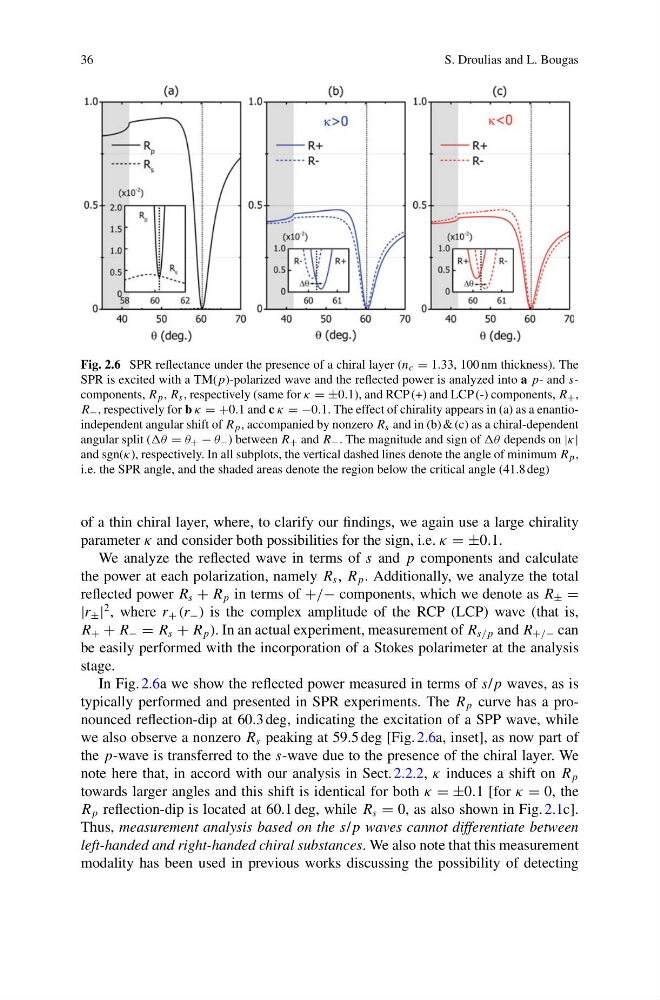
Fig. 2.6 SPR reflectance under the presence of a chiral layer (n c = 1.33, 100 nm thickness). The
SPR is excited with a TM( p)-polarized wave and the reflected power is analyzed into a p- and scomponents, R p , R s , respectively (same for κ = ±0.1), and RCP (+) and LCP (-) components, R + ,
R − , respectively for b κ = +0.1 and c κ = −0.1. The effect of chirality appears in (a) as a enantioindependent angular shift of R p , accompanied by nonzero R s and in (b) & (c) as a chiral-dependent
angular split (θ = θ + − θ − ) between R + and R − . The magnitude and sign of θ depends on |κ|
and sgn(κ), respectively. In all subplots, the vertical dashed lines denote the angle of minimum R p ,
i.e. the SPR angle, and the shaded areas denote the region below the critical angle (41.8 deg)
of a thin chiral layer, where, to clarify our findings, we again use a large chirality
parameter κ and consider both possibilities for the sign, i.e. κ = ±0.1.
We analyze the reflected wave in terms of s and p components and calculate
the power at each polarization, namely R s , R p . Additionally, we analyze the total
reflected power R s + R p in terms of +/− components, which we denote as R ± =
|r ± |
2 , where r + (r − ) is the complex amplitude of the RCP (LCP) wave (that is,
R + + R − = R s + R p ). In an actual experiment, measurement of R s/ p and R +/− can
be easily performed with the incorporation of a Stokes polarimeter at the analysis
stage.
In Fig. 2.6a we show the reflected power measured in terms of s/ p waves, as is
typically performed and presented in SPR experiments. The R p curve has a pronounced reflection-dip at 60.3 deg, indicating the excitation of a SPP wave, while
we also observe a nonzero R s peaking at 59.5 deg [Fig. 2.6a, inset], as now part of
the p-wave is transferred to the s-wave due to the presence of the chiral layer. We
note here that, in accord with our analysis in Sect. 2.2.2, κ induces a shift on R p
towards larger angles and this shift is identical for both κ = ±0.1 [for κ = 0, the
R p reflection-dip is located at 60.1 deg, while R s = 0, as also shown in Fig. 2.1c].
Thus, measurement analysis based on the s/ p waves cannot differentiate between
left-handed and right-handed chiral substances. We also note that this measurement
modality has been used in previous works discussing the possibility of detecting
S. Droulias and L. Bougas
Fig. 2.6 SPR reflectance under the presence of a chiral layer (n c = 1.33, 100 nm thickness). The
SPR is excited with a TM( p)-polarized wave and the reflected power is analyzed into a p- and scomponents, R p , R s , respectively (same for κ = ±0.1), and RCP (+) and LCP (-) components, R + ,
R − , respectively for b κ = +0.1 and c κ = −0.1. The effect of chirality appears in (a) as a enantioindependent angular shift of R p , accompanied by nonzero R s and in (b) & (c) as a chiral-dependent
angular split (θ = θ + − θ − ) between R + and R − . The magnitude and sign of θ depends on |κ|
and sgn(κ), respectively. In all subplots, the vertical dashed lines denote the angle of minimum R p ,
i.e. the SPR angle, and the shaded areas denote the region below the critical angle (41.8 deg)
of a thin chiral layer, where, to clarify our findings, we again use a large chirality
parameter κ and consider both possibilities for the sign, i.e. κ = ±0.1.
We analyze the reflected wave in terms of s and p components and calculate
the power at each polarization, namely R s , R p . Additionally, we analyze the total
reflected power R s + R p in terms of +/− components, which we denote as R ± =
|r ± |
2 , where r + (r − ) is the complex amplitude of the RCP (LCP) wave (that is,
R + + R − = R s + R p ). In an actual experiment, measurement of R s/ p and R +/− can
be easily performed with the incorporation of a Stokes polarimeter at the analysis
stage.
In Fig. 2.6a we show the reflected power measured in terms of s/ p waves, as is
typically performed and presented in SPR experiments. The R p curve has a pronounced reflection-dip at 60.3 deg, indicating the excitation of a SPP wave, while
we also observe a nonzero R s peaking at 59.5 deg [Fig. 2.6a, inset], as now part of
the p-wave is transferred to the s-wave due to the presence of the chiral layer. We
note here that, in accord with our analysis in Sect. 2.2.2, κ induces a shift on R p
towards larger angles and this shift is identical for both κ = ±0.1 [for κ = 0, the
R p reflection-dip is located at 60.1 deg, while R s = 0, as also shown in Fig. 2.1c].
Thus, measurement analysis based on the s/ p waves cannot differentiate between
left-handed and right-handed chiral substances. We also note that this measurement
modality has been used in previous works discussing the possibility of detecting