

534
E. Kamenetskii
wave described by functions (δ + ) n propagates only in one direction along the edge.
Also, the wave described by function (δ − ) n —propagates in one direction (opposite
to the former case) along the edge. It is evident that a complex conjugate ‘particle’
configuration is an ‘antiparticle’ configuration and vice versa. This fact is related to
the existence of only a single edgemode excitation for each wavenumber q. In other
words, the ‘particle’ configurations are their own ‘antiparticle’ configurations. This
resembles the well-known properties of the Majorana fermions [62]. So, we have a
“chiral Majorana fermion field” [63, 64] on the lateral wall of the MDM ferrite disk.
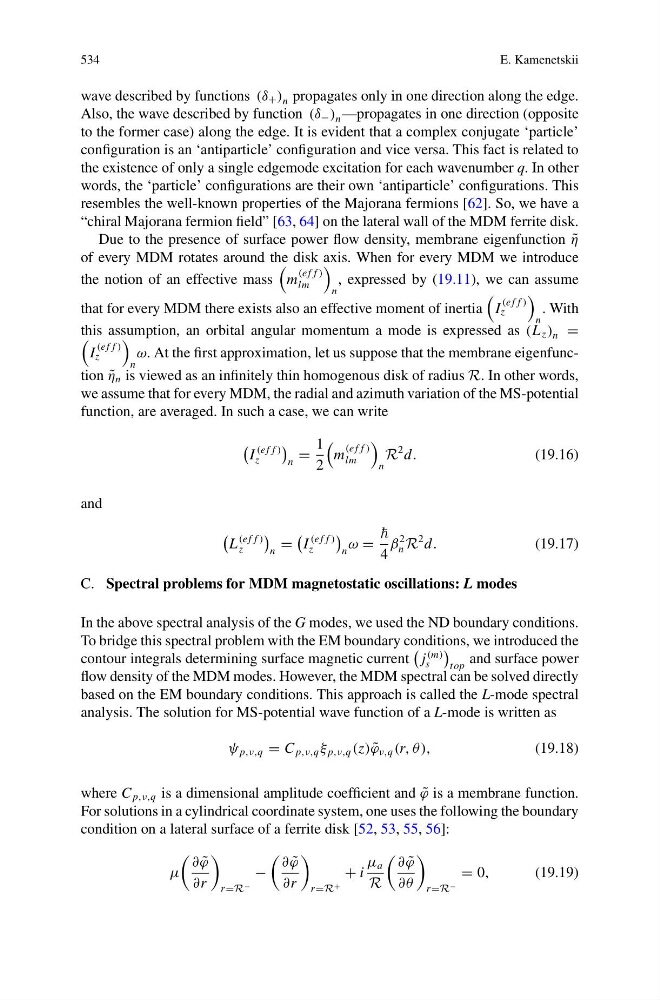
Due to the presence of surface power flow density, membrane eigenfunction ˜
η
of every MDM rotates around the disk axis. When for every MDM we introduce
the notion of an effective mass
m
(e f f )
lm
n
, expressed by (19.11), we can assume
that for every MDM there exists also an effective moment of inertia
I
(e f f )
z
n
. With
this assumption, an orbital angular momentum a mode is expressed as (L z ) n =
I
(e f f )
z
n
ω. At the first approximation, let us suppose that the membrane eigenfunction ˜
η n is viewed as an infinitely thin homogenous disk of radius R. In other words,
we assume that for every MDM, the radial and azimuth variation of the MS-potential
function, are averaged. In such a case, we can write
I
(e f f )
z
n
=
1
2
m
(e f f )
lm
n
R
2 d.
(19.16)
and
L
(e f f )
z
n
=
I
(e f f )
z
n
ω =
4
β
2
n R
2 d.
(19.17)
C. Spectral problems for MDM magnetostatic oscillations: L modes
In the above spectral analysis of the G modes, we used the ND boundary conditions.
To bridge this spectral problem with the EM boundary conditions, we introduced the
contour integrals determining surface magnetic current
j
(m)
s
top
and surface power
flow density of the MDM modes. However, the MDM spectral can be solved directly
based on the EM boundary conditions. This approach is called the L-mode spectral
analysis. The solution for MS-potential wave function of a L-mode is written as
ψ p,ν,q = C p,ν,q ξ p,ν,q (z) ˜
ϕ ν,q (r, θ),
(19.18)
where C p,ν,q is a dimensional amplitude coefficient and ˜
ϕ is a membrane function.
For solutions in a cylindrical coordinate system, one uses the following the boundary
condition on a lateral surface of a ferrite disk [52, 53, 55, 56]:
μ
∂ ˜
ϕ
∂r
r =R −
−
∂ ˜
ϕ
∂r
r =R +
+ i
μ a
R
∂ ˜
ϕ
∂θ
r =R −
= 0,
(19.19)
E. Kamenetskii
wave described by functions (δ + ) n propagates only in one direction along the edge.
Also, the wave described by function (δ − ) n —propagates in one direction (opposite
to the former case) along the edge. It is evident that a complex conjugate ‘particle’
configuration is an ‘antiparticle’ configuration and vice versa. This fact is related to
the existence of only a single edgemode excitation for each wavenumber q. In other
words, the ‘particle’ configurations are their own ‘antiparticle’ configurations. This
resembles the well-known properties of the Majorana fermions [62]. So, we have a
“chiral Majorana fermion field” [63, 64] on the lateral wall of the MDM ferrite disk.
Due to the presence of surface power flow density, membrane eigenfunction ˜
η
of every MDM rotates around the disk axis. When for every MDM we introduce
the notion of an effective mass
m
(e f f )
lm
n
, expressed by (19.11), we can assume
that for every MDM there exists also an effective moment of inertia
I
(e f f )
z
n
. With
this assumption, an orbital angular momentum a mode is expressed as (L z ) n =
I
(e f f )
z
n
ω. At the first approximation, let us suppose that the membrane eigenfunction ˜
η n is viewed as an infinitely thin homogenous disk of radius R. In other words,
we assume that for every MDM, the radial and azimuth variation of the MS-potential
function, are averaged. In such a case, we can write
I
(e f f )
z
n
=
1
2
m
(e f f )
lm
n
R
2 d.
(19.16)
and
L
(e f f )
z
n
=
I
(e f f )
z
n
ω =
4
β
2
n R
2 d.
(19.17)
C. Spectral problems for MDM magnetostatic oscillations: L modes
In the above spectral analysis of the G modes, we used the ND boundary conditions.
To bridge this spectral problem with the EM boundary conditions, we introduced the
contour integrals determining surface magnetic current
j
(m)
s
top
and surface power
flow density of the MDM modes. However, the MDM spectral can be solved directly
based on the EM boundary conditions. This approach is called the L-mode spectral
analysis. The solution for MS-potential wave function of a L-mode is written as
ψ p,ν,q = C p,ν,q ξ p,ν,q (z) ˜
ϕ ν,q (r, θ),
(19.18)
where C p,ν,q is a dimensional amplitude coefficient and ˜
ϕ is a membrane function.
For solutions in a cylindrical coordinate system, one uses the following the boundary
condition on a lateral surface of a ferrite disk [52, 53, 55, 56]:
μ
∂ ˜
ϕ
∂r
r =R −
−
∂ ˜
ϕ
∂r
r =R +
+ i
μ a
R
∂ ˜
ϕ
∂θ
r =R −
= 0,
(19.19)