

18 Purcell Effect in PT-Symmetric Waveguides
515
we straightforwardly derive the diagonal and off-diagonal terms
F p,diag =
3π c
4ω 2 μ 0
2 cosh θ
sinh
2
θ
(|ˆ e p,g |
2
+ |ˆ e p,l |
2
) cosh θ − 2 Im ( ˆ
e
∗
p,g ˆ
e p,l )
, (18.81a)
F p,off−diag = −
3π c
4ω 2 μ 0
2
sinh
2
θ
|ˆ e p,g |
2
+ |ˆ e p,l |
2
− 2 cosh θ Im ( ˆ
e
∗
p,g ˆ
e p,l )
(18.81b)
as well as the modal Purcell factor
F p = F p,diag + F p,off−diag =
6π c
ω 2 μ 0
(|ˆ e p,g |
2
+ |ˆ e p,l |
2
).
(18.82)
The main result of this section is that although diagonal and off-diagonal terms
of the modal Purcell factor diverge at the EP, the modal Purcell factor itself does not
exhibit a singular behavior when approaching to the EP either from the left or right
side.
Though we do not carry out a rigorous analysis of the behavior at the EP accounting
for the degeneracy of the modes as it was done in [15], the developed approach leads
to the well-defined expressions (18.76) and (18.82) for F p at the exceptional point.
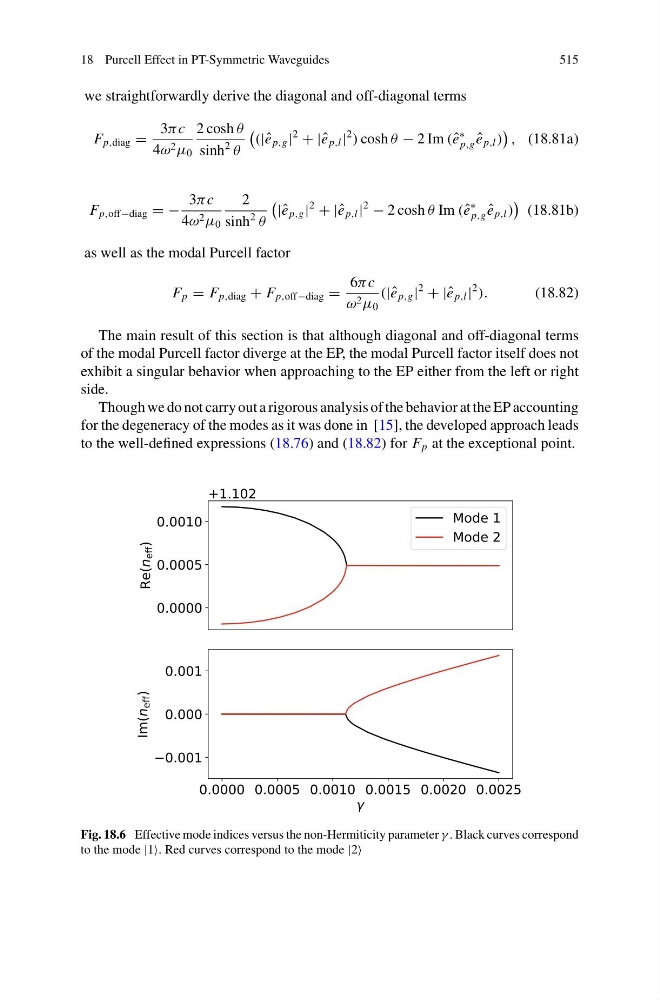
Fig. 18.6 Effective mode indices versus the non-Hermiticity parameter γ . Black curves correspond
to the mode |1. Red curves correspond to the mode |2
515
we straightforwardly derive the diagonal and off-diagonal terms
F p,diag =
3π c
4ω 2 μ 0
2 cosh θ
sinh
2
θ
(|ˆ e p,g |
2
+ |ˆ e p,l |
2
) cosh θ − 2 Im ( ˆ
e
∗
p,g ˆ
e p,l )
, (18.81a)
F p,off−diag = −
3π c
4ω 2 μ 0
2
sinh
2
θ
|ˆ e p,g |
2
+ |ˆ e p,l |
2
− 2 cosh θ Im ( ˆ
e
∗
p,g ˆ
e p,l )
(18.81b)
as well as the modal Purcell factor
F p = F p,diag + F p,off−diag =
6π c
ω 2 μ 0
(|ˆ e p,g |
2
+ |ˆ e p,l |
2
).
(18.82)
The main result of this section is that although diagonal and off-diagonal terms
of the modal Purcell factor diverge at the EP, the modal Purcell factor itself does not
exhibit a singular behavior when approaching to the EP either from the left or right
side.
Though we do not carry out a rigorous analysis of the behavior at the EP accounting
for the degeneracy of the modes as it was done in [15], the developed approach leads
to the well-defined expressions (18.76) and (18.82) for F p at the exceptional point.
Fig. 18.6 Effective mode indices versus the non-Hermiticity parameter γ . Black curves correspond
to the mode |1. Red curves correspond to the mode |2