

508
A. Karabchevsky et al.
a two-level atom below the vacuum level. Recent work of Khanbekyan and Wiersig
reports on decay suppression of spontaneous emission of a single emitter in a high-Q
cavity at exceptional points [56].
The Purcell factor can be calculated separately for each of the discrete scattering channels. For instance, just a couple of years ago, the Purcell effect in the mode
of the basic element of PIC planar waveguide was introduced within the scattering
matrix formalism [57].
It has recently been shown in the context of single molecule detections that the
power emitted from a molecule into a single mode fiber can be elegantly calculated
using the reciprocity theorem of electromagnetic theory [58]. In the work [59] authors
propose a reciprocity approach to calculate the emission enhancement for emitters
coupled to arbitrary resonant or non-resonant open optical systems. They calculate the
modal Purcell factor—the quantity which measures the power emitted by an emitter
situated in the vicinity of a device into a particular propagating mode normalised by
the power radiated by the same emitter into the free space.
18.4.1 Reciprocity Approach
In this section, we generalise the reciprocity approach formulated in [59] to the
case when the propagating modes are not orthogonal. We probe the method by
calculation of the modal Purcell factor in PT-symmetric coupled waveguide system.
In the following section we will obtain closed-form expressions for modal Purcell
factor describing the system in terms of coupled modes.
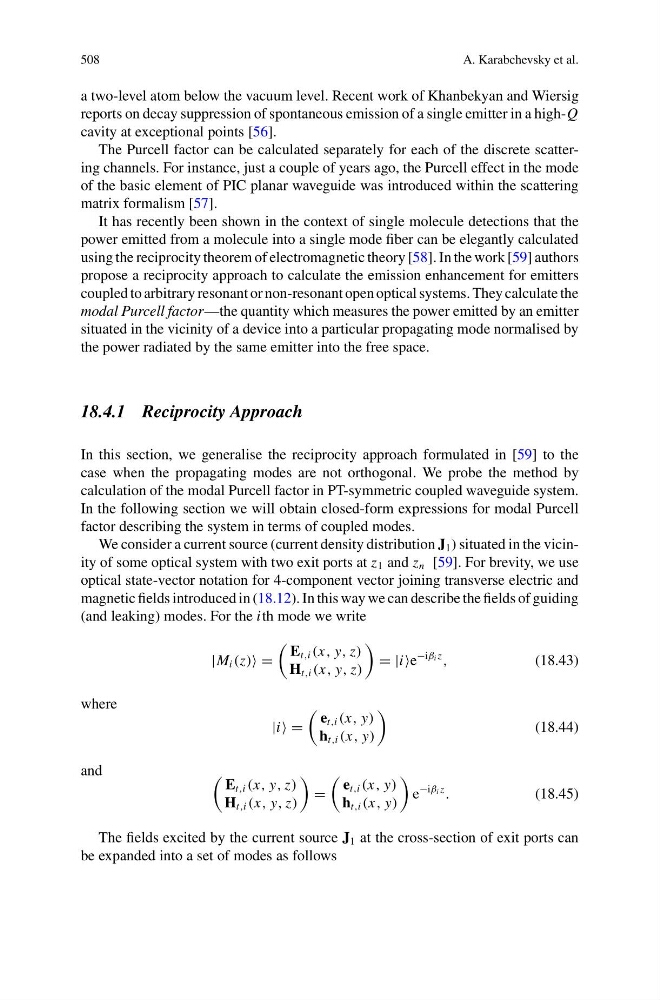
We consider a current source (current density distribution J 1 ) situated in the vicinity of some optical system with two exit ports at z 1 and z n [59]. For brevity, we use
optical state-vector notation for 4-component vector joining transverse electric and
magnetic fields introduced in (18.12). In this way we can describe the fields of guiding
(and leaking) modes. For the ith mode we write
|M i (z) =
E t,i (x, y, z)
H t,i (x, y, z)
= |ie
−iβ i z
,
(18.43)
where
|i =
e t,i (x, y)
h t,i (x, y)
(18.44)
and
E t,i (x, y, z)
H t,i (x, y, z)
=
e t,i (x, y)
h t,i (x, y)
e
−iβ i z
.
(18.45)
The fields excited by the current source J 1 at the cross-section of exit ports can
be expanded into a set of modes as follows
A. Karabchevsky et al.
a two-level atom below the vacuum level. Recent work of Khanbekyan and Wiersig
reports on decay suppression of spontaneous emission of a single emitter in a high-Q
cavity at exceptional points [56].
The Purcell factor can be calculated separately for each of the discrete scattering channels. For instance, just a couple of years ago, the Purcell effect in the mode
of the basic element of PIC planar waveguide was introduced within the scattering
matrix formalism [57].
It has recently been shown in the context of single molecule detections that the
power emitted from a molecule into a single mode fiber can be elegantly calculated
using the reciprocity theorem of electromagnetic theory [58]. In the work [59] authors
propose a reciprocity approach to calculate the emission enhancement for emitters
coupled to arbitrary resonant or non-resonant open optical systems. They calculate the
modal Purcell factor—the quantity which measures the power emitted by an emitter
situated in the vicinity of a device into a particular propagating mode normalised by
the power radiated by the same emitter into the free space.
18.4.1 Reciprocity Approach
In this section, we generalise the reciprocity approach formulated in [59] to the
case when the propagating modes are not orthogonal. We probe the method by
calculation of the modal Purcell factor in PT-symmetric coupled waveguide system.
In the following section we will obtain closed-form expressions for modal Purcell
factor describing the system in terms of coupled modes.
We consider a current source (current density distribution J 1 ) situated in the vicinity of some optical system with two exit ports at z 1 and z n [59]. For brevity, we use
optical state-vector notation for 4-component vector joining transverse electric and
magnetic fields introduced in (18.12). In this way we can describe the fields of guiding
(and leaking) modes. For the ith mode we write
|M i (z) =
E t,i (x, y, z)
H t,i (x, y, z)
= |ie
−iβ i z
,
(18.43)
where
|i =
e t,i (x, y)
h t,i (x, y)
(18.44)
and
E t,i (x, y, z)
H t,i (x, y, z)
=
e t,i (x, y)
h t,i (x, y)
e
−iβ i z
.
(18.45)
The fields excited by the current source J 1 at the cross-section of exit ports can
be expanded into a set of modes as follows