

18 Purcell Effect in PT-Symmetric Waveguides
507
18.4 Purcell Effect in PT-Symmetric Waveguides
In 1946, E. M. Purcell predicted that the spontaneous emission rate of a light source
is not solely an intrinsic property of the source but is affected by the optical environment [54]. This effect is now referred to as Purcell effect. The Purcell factor is
defined as
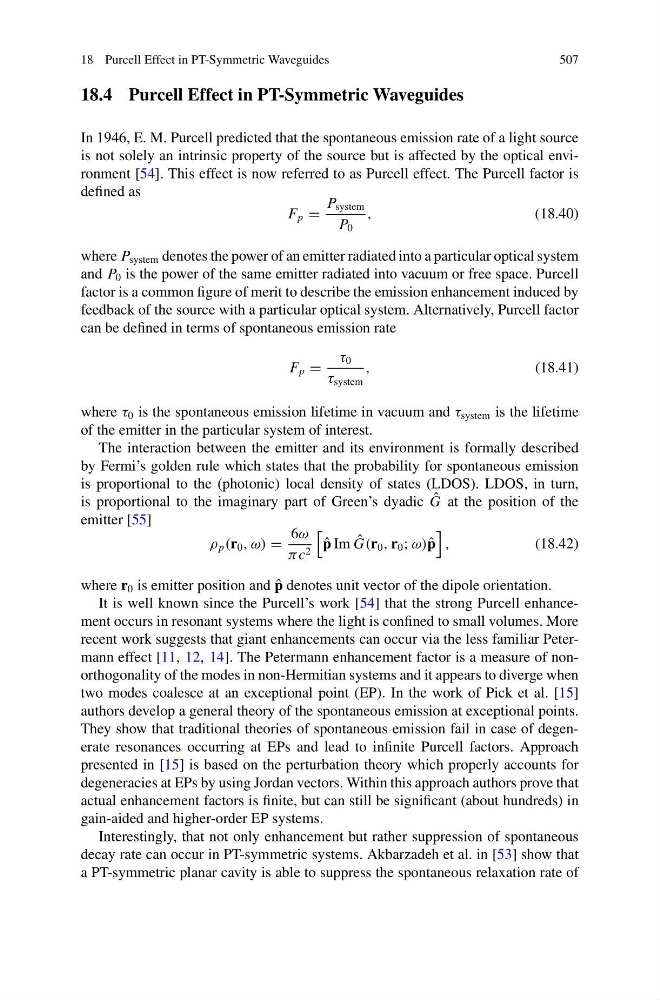
F p =
P system
P 0
,
(18.40)
where P system denotes the power of an emitter radiated into a particular optical system
and P 0 is the power of the same emitter radiated into vacuum or free space. Purcell
factor is a common figure of merit to describe the emission enhancement induced by
feedback of the source with a particular optical system. Alternatively, Purcell factor
can be defined in terms of spontaneous emission rate
F p =
τ 0
τ system
,
(18.41)
where τ 0 is the spontaneous emission lifetime in vacuum and τ system is the lifetime
of the emitter in the particular system of interest.
The interaction between the emitter and its environment is formally described
by Fermi’s golden rule which states that the probability for spontaneous emission
is proportional to the (photonic) local density of states (LDOS). LDOS, in turn,
is proportional to the imaginary part of Green’s dyadic ˆ
G at the position of the
emitter [55]
ρ p (r 0 , ω) =
6ω
π c 2
ˆ
p Im ˆ
G(r 0 , r 0 ; ω) ˆ
p
,
(18.42)
where r 0 is emitter position and ˆ
p denotes unit vector of the dipole orientation.
It is well known since the Purcell’s work [54] that the strong Purcell enhancement occurs in resonant systems where the light is confined to small volumes. More
recent work suggests that giant enhancements can occur via the less familiar Petermann effect [11, 12, 14]. The Petermann enhancement factor is a measure of nonorthogonality of the modes in non-Hermitian systems and it appears to diverge when
two modes coalesce at an exceptional point (EP). In the work of Pick et al. [15]
authors develop a general theory of the spontaneous emission at exceptional points.
They show that traditional theories of spontaneous emission fail in case of degenerate resonances occurring at EPs and lead to infinite Purcell factors. Approach
presented in [15] is based on the perturbation theory which properly accounts for
degeneracies at EPs by using Jordan vectors. Within this approach authors prove that
actual enhancement factors is finite, but can still be significant (about hundreds) in
gain-aided and higher-order EP systems.
Interestingly, that not only enhancement but rather suppression of spontaneous
decay rate can occur in PT-symmetric systems. Akbarzadeh et al. in [53] show that
a PT-symmetric planar cavity is able to suppress the spontaneous relaxation rate of
507
18.4 Purcell Effect in PT-Symmetric Waveguides
In 1946, E. M. Purcell predicted that the spontaneous emission rate of a light source
is not solely an intrinsic property of the source but is affected by the optical environment [54]. This effect is now referred to as Purcell effect. The Purcell factor is
defined as
F p =
P system
P 0
,
(18.40)
where P system denotes the power of an emitter radiated into a particular optical system
and P 0 is the power of the same emitter radiated into vacuum or free space. Purcell
factor is a common figure of merit to describe the emission enhancement induced by
feedback of the source with a particular optical system. Alternatively, Purcell factor
can be defined in terms of spontaneous emission rate
F p =
τ 0
τ system
,
(18.41)
where τ 0 is the spontaneous emission lifetime in vacuum and τ system is the lifetime
of the emitter in the particular system of interest.
The interaction between the emitter and its environment is formally described
by Fermi’s golden rule which states that the probability for spontaneous emission
is proportional to the (photonic) local density of states (LDOS). LDOS, in turn,
is proportional to the imaginary part of Green’s dyadic ˆ
G at the position of the
emitter [55]
ρ p (r 0 , ω) =
6ω
π c 2
ˆ
p Im ˆ
G(r 0 , r 0 ; ω) ˆ
p
,
(18.42)
where r 0 is emitter position and ˆ
p denotes unit vector of the dipole orientation.
It is well known since the Purcell’s work [54] that the strong Purcell enhancement occurs in resonant systems where the light is confined to small volumes. More
recent work suggests that giant enhancements can occur via the less familiar Petermann effect [11, 12, 14]. The Petermann enhancement factor is a measure of nonorthogonality of the modes in non-Hermitian systems and it appears to diverge when
two modes coalesce at an exceptional point (EP). In the work of Pick et al. [15]
authors develop a general theory of the spontaneous emission at exceptional points.
They show that traditional theories of spontaneous emission fail in case of degenerate resonances occurring at EPs and lead to infinite Purcell factors. Approach
presented in [15] is based on the perturbation theory which properly accounts for
degeneracies at EPs by using Jordan vectors. Within this approach authors prove that
actual enhancement factors is finite, but can still be significant (about hundreds) in
gain-aided and higher-order EP systems.
Interestingly, that not only enhancement but rather suppression of spontaneous
decay rate can occur in PT-symmetric systems. Akbarzadeh et al. in [53] show that
a PT-symmetric planar cavity is able to suppress the spontaneous relaxation rate of