

504
A. Karabchevsky et al.
symmetric states. At the same time, light beams propagating in lattices demonstrate
beam splitting, power oscillations, nonreciprocity and secondary emissions [28].
These diffraction properties are explained by nonorthogonality of the Floquet-Bloch
modes of the periodic structure.
In the system of PT-symmetric periodically arranged cylinders situated at the interface between two semi-infinite media, unidirectional transmission without reflection can be achieved. It was investigated in [29] using the perturbation and scattering matrix theories. Photonic graphene lattice of waveguides described using the
coupled-mode techniques can be represented as the Dirac equation. The PT symmetry in such a system requires the corresponding Hamiltonian is non-Hermitian
exhibiting unbroken and broken PT-symmetry phases. These theoretical findings are
well confirmed in experiments [30]. In [31] photonic lattices were used for the proof
of existence of topological interface states on a defect waveguide between two PTsymmetric media. The results propose a way of excitation of topologically protected
localised states. A PT-symmetric photonic crystal can be also designed as a group of
gain cylinders paired with a group of lossy cylinders. Then surface electromagnetic
waves emerge at the gain-loss interface, while exceptional points can be tuned to
coalesce forming higher-order exceptional points [32].
18.3.3 Multilayer Structures
To illustrate the basic principles of the PT symmetry, a simple multilayer system may
be harnessed. The PT symmetry in multilayer structures is introduced in direction
of the wave propagation, and multilayers as open systems can be described by a
scattering matrix. The scattering matrix connects the input and output channels.
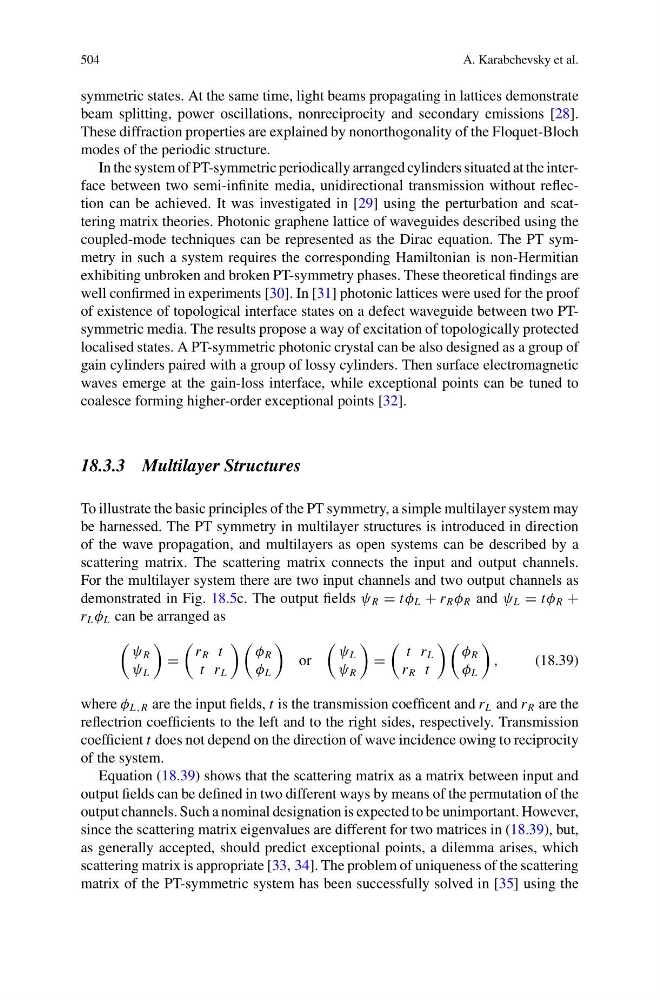
For the multilayer system there are two input channels and two output channels as
demonstrated in Fig. 18.5c. The output fields ψ R = tφ L + r R φ R and ψ L = tφ R +
r L φ L can be arranged as
ψ R
ψ L
=
r R t
t r L
φ R
φ L
or
ψ L
ψ R
=
t r L
r R t
φ R
φ L
,
(18.39)
where φ L ,R are the input fields, t is the transmission coefficent and r L and r R are the
reflectrion coefficients to the left and to the right sides, respectively. Transmission
coefficient t does not depend on the direction of wave incidence owing to reciprocity
of the system.
Equation (18.39) shows that the scattering matrix as a matrix between input and
output fields can be defined in two different ways by means of the permutation of the
output channels. Such a nominal designation is expected to be unimportant. However,
since the scattering matrix eigenvalues are different for two matrices in (18.39), but,
as generally accepted, should predict exceptional points, a dilemma arises, which
scattering matrix is appropriate [33, 34]. The problem of uniqueness of the scattering
matrix of the PT-symmetric system has been successfully solved in [35] using the
A. Karabchevsky et al.
symmetric states. At the same time, light beams propagating in lattices demonstrate
beam splitting, power oscillations, nonreciprocity and secondary emissions [28].
These diffraction properties are explained by nonorthogonality of the Floquet-Bloch
modes of the periodic structure.
In the system of PT-symmetric periodically arranged cylinders situated at the interface between two semi-infinite media, unidirectional transmission without reflection can be achieved. It was investigated in [29] using the perturbation and scattering matrix theories. Photonic graphene lattice of waveguides described using the
coupled-mode techniques can be represented as the Dirac equation. The PT symmetry in such a system requires the corresponding Hamiltonian is non-Hermitian
exhibiting unbroken and broken PT-symmetry phases. These theoretical findings are
well confirmed in experiments [30]. In [31] photonic lattices were used for the proof
of existence of topological interface states on a defect waveguide between two PTsymmetric media. The results propose a way of excitation of topologically protected
localised states. A PT-symmetric photonic crystal can be also designed as a group of
gain cylinders paired with a group of lossy cylinders. Then surface electromagnetic
waves emerge at the gain-loss interface, while exceptional points can be tuned to
coalesce forming higher-order exceptional points [32].
18.3.3 Multilayer Structures
To illustrate the basic principles of the PT symmetry, a simple multilayer system may
be harnessed. The PT symmetry in multilayer structures is introduced in direction
of the wave propagation, and multilayers as open systems can be described by a
scattering matrix. The scattering matrix connects the input and output channels.
For the multilayer system there are two input channels and two output channels as
demonstrated in Fig. 18.5c. The output fields ψ R = tφ L + r R φ R and ψ L = tφ R +
r L φ L can be arranged as
ψ R
ψ L
=
r R t
t r L
φ R
φ L
or
ψ L
ψ R
=
t r L
r R t
φ R
φ L
,
(18.39)
where φ L ,R are the input fields, t is the transmission coefficent and r L and r R are the
reflectrion coefficients to the left and to the right sides, respectively. Transmission
coefficient t does not depend on the direction of wave incidence owing to reciprocity
of the system.
Equation (18.39) shows that the scattering matrix as a matrix between input and
output fields can be defined in two different ways by means of the permutation of the
output channels. Such a nominal designation is expected to be unimportant. However,
since the scattering matrix eigenvalues are different for two matrices in (18.39), but,
as generally accepted, should predict exceptional points, a dilemma arises, which
scattering matrix is appropriate [33, 34]. The problem of uniqueness of the scattering
matrix of the PT-symmetric system has been successfully solved in [35] using the