

18 Purcell Effect in PT-Symmetric Waveguides
495
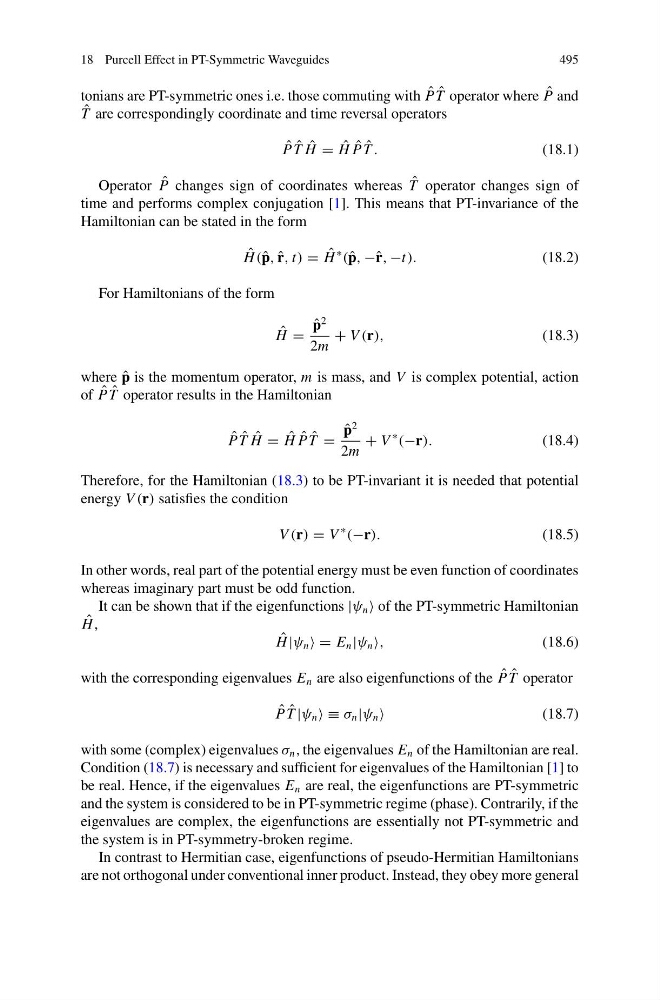
tonians are PT-symmetric ones i.e. those commuting with ˆ
P ˆ
T operator where ˆ
P and
ˆ
T are correspondingly coordinate and time reversal operators
ˆ
P ˆ
T ˆ
H = ˆ
H ˆ
P ˆ
T .
(18.1)
Operator ˆ
P changes sign of coordinates whereas ˆ
T operator changes sign of
time and performs complex conjugation [1]. This means that PT-invariance of the
Hamiltonian can be stated in the form
ˆ
H ( ˆ
p, ˆ
r, t) = ˆ
H
∗
( ˆ
p, −ˆ r, −t).
(18.2)
For Hamiltonians of the form
ˆ
H =
ˆ
p
2
2m
+ V (r),
(18.3)
where ˆ
p is the momentum operator, m is mass, and V is complex potential, action
of ˆ
P ˆ
T operator results in the Hamiltonian
ˆ
P ˆ
T ˆ
H = ˆ
H ˆ
P ˆ
T =
ˆ
p
2
2m
+ V
∗
(−r).
(18.4)
Therefore, for the Hamiltonian (18.3) to be PT-invariant it is needed that potential
energy V (r) satisfies the condition
V (r) = V
∗
(−r).
(18.5)
In other words, real part of the potential energy must be even function of coordinates
whereas imaginary part must be odd function.
It can be shown that if the eigenfunctions |ψ n of the PT-symmetric Hamiltonian
ˆ
H ,
ˆ
H |ψ n = E n |ψ n ,
(18.6)
with the corresponding eigenvalues E n are also eigenfunctions of the ˆ
P ˆ
T operator
ˆ
P ˆ
T |ψ n ≡ σ n |ψ n
(18.7)
with some (complex) eigenvalues σ n , the eigenvalues E n of the Hamiltonian are real.
Condition (18.7) is necessary and sufficient for eigenvalues of the Hamiltonian [1] to
be real. Hence, if the eigenvalues E n are real, the eigenfunctions are PT-symmetric
and the system is considered to be in PT-symmetric regime (phase). Contrarily, if the
eigenvalues are complex, the eigenfunctions are essentially not PT-symmetric and
the system is in PT-symmetry-broken regime.
In contrast to Hermitian case, eigenfunctions of pseudo-Hermitian Hamiltonians
are not orthogonal under conventional inner product. Instead, they obey more general
495
tonians are PT-symmetric ones i.e. those commuting with ˆ
P ˆ
T operator where ˆ
P and
ˆ
T are correspondingly coordinate and time reversal operators
ˆ
P ˆ
T ˆ
H = ˆ
H ˆ
P ˆ
T .
(18.1)
Operator ˆ
P changes sign of coordinates whereas ˆ
T operator changes sign of
time and performs complex conjugation [1]. This means that PT-invariance of the
Hamiltonian can be stated in the form
ˆ
H ( ˆ
p, ˆ
r, t) = ˆ
H
∗
( ˆ
p, −ˆ r, −t).
(18.2)
For Hamiltonians of the form
ˆ
H =
ˆ
p
2
2m
+ V (r),
(18.3)
where ˆ
p is the momentum operator, m is mass, and V is complex potential, action
of ˆ
P ˆ
T operator results in the Hamiltonian
ˆ
P ˆ
T ˆ
H = ˆ
H ˆ
P ˆ
T =
ˆ
p
2
2m
+ V
∗
(−r).
(18.4)
Therefore, for the Hamiltonian (18.3) to be PT-invariant it is needed that potential
energy V (r) satisfies the condition
V (r) = V
∗
(−r).
(18.5)
In other words, real part of the potential energy must be even function of coordinates
whereas imaginary part must be odd function.
It can be shown that if the eigenfunctions |ψ n of the PT-symmetric Hamiltonian
ˆ
H ,
ˆ
H |ψ n = E n |ψ n ,
(18.6)
with the corresponding eigenvalues E n are also eigenfunctions of the ˆ
P ˆ
T operator
ˆ
P ˆ
T |ψ n ≡ σ n |ψ n
(18.7)
with some (complex) eigenvalues σ n , the eigenvalues E n of the Hamiltonian are real.
Condition (18.7) is necessary and sufficient for eigenvalues of the Hamiltonian [1] to
be real. Hence, if the eigenvalues E n are real, the eigenfunctions are PT-symmetric
and the system is considered to be in PT-symmetric regime (phase). Contrarily, if the
eigenvalues are complex, the eigenfunctions are essentially not PT-symmetric and
the system is in PT-symmetry-broken regime.
In contrast to Hermitian case, eigenfunctions of pseudo-Hermitian Hamiltonians
are not orthogonal under conventional inner product. Instead, they obey more general