

494
A. Karabchevsky et al.
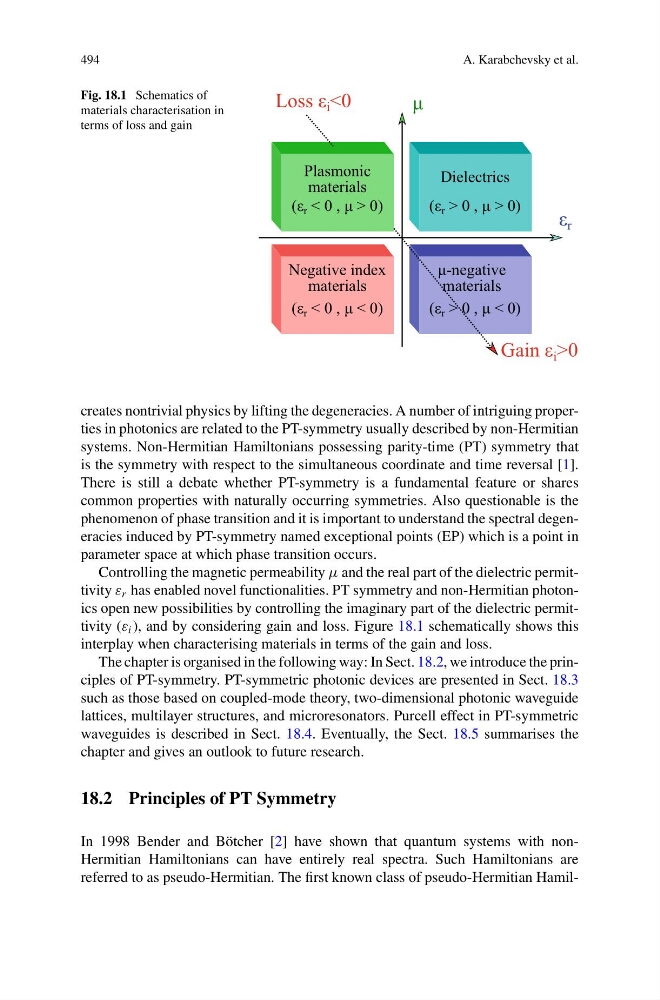
Fig. 18.1 Schematics of
materials characterisation in
terms of loss and gain
μ
ε r
Negative index
materials
μ-negative
materials
Dielectrics
(ε r > 0 , μ > 0)
Plasmonic
materials
(ε r < 0 , μ > 0)
(ε r > 0 , μ < 0)
(ε r < 0 , μ < 0)
Gain ε i >0
Loss ε i <0
creates nontrivial physics by lifting the degeneracies. A number of intriguing properties in photonics are related to the PT-symmetry usually described by non-Hermitian
systems. Non-Hermitian Hamiltonians possessing parity-time (PT) symmetry that
is the symmetry with respect to the simultaneous coordinate and time reversal [1].
There is still a debate whether PT-symmetry is a fundamental feature or shares
common properties with naturally occurring symmetries. Also questionable is the
phenomenon of phase transition and it is important to understand the spectral degeneracies induced by PT-symmetry named exceptional points (EP) which is a point in
parameter space at which phase transition occurs.
Controlling the magnetic permeability μ and the real part of the dielectric permittivity ε r has enabled novel functionalities. PT symmetry and non-Hermitian photonics open new possibilities by controlling the imaginary part of the dielectric permittivity (ε i ), and by considering gain and loss. Figure 18.1 schematically shows this
interplay when characterising materials in terms of the gain and loss.
The chapter is organised in the following way: In Sect. 18.2, we introduce the principles of PT-symmetry. PT-symmetric photonic devices are presented in Sect. 18.3
such as those based on coupled-mode theory, two-dimensional photonic waveguide
lattices, multilayer structures, and microresonators. Purcell effect in PT-symmetric
waveguides is described in Sect. 18.4. Eventually, the Sect. 18.5 summarises the
chapter and gives an outlook to future research.
18.2 Principles of PT Symmetry
In 1998 Bender and Bötcher [2] have shown that quantum systems with nonHermitian Hamiltonians can have entirely real spectra. Such Hamiltonians are
referred to as pseudo-Hermitian. The first known class of pseudo-Hermitian Hamil-
A. Karabchevsky et al.
Fig. 18.1 Schematics of
materials characterisation in
terms of loss and gain
μ
ε r
Negative index
materials
μ-negative
materials
Dielectrics
(ε r > 0 , μ > 0)
Plasmonic
materials
(ε r < 0 , μ > 0)
(ε r > 0 , μ < 0)
(ε r < 0 , μ < 0)
Gain ε i >0
Loss ε i <0
creates nontrivial physics by lifting the degeneracies. A number of intriguing properties in photonics are related to the PT-symmetry usually described by non-Hermitian
systems. Non-Hermitian Hamiltonians possessing parity-time (PT) symmetry that
is the symmetry with respect to the simultaneous coordinate and time reversal [1].
There is still a debate whether PT-symmetry is a fundamental feature or shares
common properties with naturally occurring symmetries. Also questionable is the
phenomenon of phase transition and it is important to understand the spectral degeneracies induced by PT-symmetry named exceptional points (EP) which is a point in
parameter space at which phase transition occurs.
Controlling the magnetic permeability μ and the real part of the dielectric permittivity ε r has enabled novel functionalities. PT symmetry and non-Hermitian photonics open new possibilities by controlling the imaginary part of the dielectric permittivity (ε i ), and by considering gain and loss. Figure 18.1 schematically shows this
interplay when characterising materials in terms of the gain and loss.
The chapter is organised in the following way: In Sect. 18.2, we introduce the principles of PT-symmetry. PT-symmetric photonic devices are presented in Sect. 18.3
such as those based on coupled-mode theory, two-dimensional photonic waveguide
lattices, multilayer structures, and microresonators. Purcell effect in PT-symmetric
waveguides is described in Sect. 18.4. Eventually, the Sect. 18.5 summarises the
chapter and gives an outlook to future research.
18.2 Principles of PT Symmetry
In 1998 Bender and Bötcher [2] have shown that quantum systems with nonHermitian Hamiltonians can have entirely real spectra. Such Hamiltonians are
referred to as pseudo-Hermitian. The first known class of pseudo-Hermitian Hamil-