

17 Axion Electrodynamics in Magnetoelectric Media
467
The notation V i
stands for the discontinuity of the i component of the vector
V through the interface , while V j
indicates the continuous value of the j component evaluated at . The boundary conditions in (17.13) imply that the members
of the right hand side in (17.12) are correctly defined, representing field dependent
charge densities and surface currents respectively. Again, the magnetoelectric effect
is manifest in the boundary conditions (17.12). In order to emphasize the effects of
the topological coupling we consider the simplest media having θ 1 = θ 2 , but with
ε = 1 and μ = 1.
At this stage it is convenient to go back to the four dimensional notation:
A
μ
= ((, A), F μν = ∂ μ A ν − ∂ ν A μ , ˜
F
μν
=
1
2
μναβ F αβ , j
μ
= (ρ, J). In this way,
the
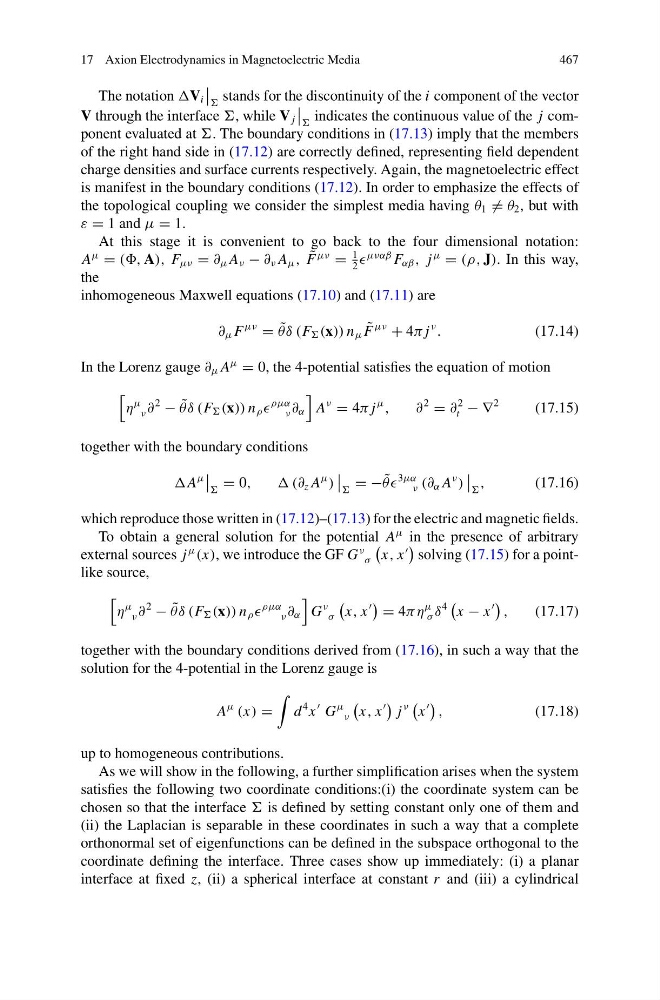
inhomogeneous Maxwell equations (17.10) and (17.11) are
∂ μ F
μν
= ˜
θδ (F (x)) n μ ˜
F
μν
+ 4π j
ν
.
(17.14)
In the Lorenz gauge ∂ μ A
μ
= 0, the 4-potential satisfies the equation of motion
η
μ
ν ∂
2
− ˜
θδ (F (x)) n ρ
ρμα
ν ∂ α
A
ν
= 4π j
μ
,
∂
2
= ∂
2
t − ∇
2
(17.15)
together with the boundary conditions
A
μ
= 0,
,(∂ z A
μ
)
= − ˜
θθ
3μα
ν (∂ α A
ν
)
,
(17.16)
which reproduce those written in (17.12)–(17.13) for the electric and magnetic fields.
To obtain a general solution for the potential A
μ in the presence of arbitrary
external sources j
μ
(x), we introduce the GF G
ν σ
x, x
solving (17.15) for a pointlike source,
η
μ
ν ∂
2
− ˜
θδ (F (x)) n ρ
ρμα
ν ∂ α
G
ν
σ
x, x
= 4πη
μ
σ δ
4
x − x
,
(17.17)
together with the boundary conditions derived from (17.16), in such a way that the
solution for the 4-potential in the Lorenz gauge is
A
μ
(x) =
d
4 x
G
μ
ν
x, x
j
ν
x
,
(17.18)
up to homogeneous contributions.
As we will show in the following, a further simplification arises when the system
satisfies the following two coordinate conditions:(i) the coordinate system can be
chosen so that the interface is defined by setting constant only one of them and
(ii) the Laplacian is separable in these coordinates in such a way that a complete
orthonormal set of eigenfunctions can be defined in the subspace orthogonal to the
coordinate defining the interface. Three cases show up immediately: (i) a planar
interface at fixed z, (ii) a spherical interface at constant r and (iii) a cylindrical
467
The notation V i
stands for the discontinuity of the i component of the vector
V through the interface , while V j
indicates the continuous value of the j component evaluated at . The boundary conditions in (17.13) imply that the members
of the right hand side in (17.12) are correctly defined, representing field dependent
charge densities and surface currents respectively. Again, the magnetoelectric effect
is manifest in the boundary conditions (17.12). In order to emphasize the effects of
the topological coupling we consider the simplest media having θ 1 = θ 2 , but with
ε = 1 and μ = 1.
At this stage it is convenient to go back to the four dimensional notation:
A
μ
= ((, A), F μν = ∂ μ A ν − ∂ ν A μ , ˜
F
μν
=
1
2
μναβ F αβ , j
μ
= (ρ, J). In this way,
the
inhomogeneous Maxwell equations (17.10) and (17.11) are
∂ μ F
μν
= ˜
θδ (F (x)) n μ ˜
F
μν
+ 4π j
ν
.
(17.14)
In the Lorenz gauge ∂ μ A
μ
= 0, the 4-potential satisfies the equation of motion
η
μ
ν ∂
2
− ˜
θδ (F (x)) n ρ
ρμα
ν ∂ α
A
ν
= 4π j
μ
,
∂
2
= ∂
2
t − ∇
2
(17.15)
together with the boundary conditions
A
μ
= 0,
,(∂ z A
μ
)
= − ˜
θθ
3μα
ν (∂ α A
ν
)
,
(17.16)
which reproduce those written in (17.12)–(17.13) for the electric and magnetic fields.
To obtain a general solution for the potential A
μ in the presence of arbitrary
external sources j
μ
(x), we introduce the GF G
ν σ
x, x
solving (17.15) for a pointlike source,
η
μ
ν ∂
2
− ˜
θδ (F (x)) n ρ
ρμα
ν ∂ α
G
ν
σ
x, x
= 4πη
μ
σ δ
4
x − x
,
(17.17)
together with the boundary conditions derived from (17.16), in such a way that the
solution for the 4-potential in the Lorenz gauge is
A
μ
(x) =
d
4 x
G
μ
ν
x, x
j
ν
x
,
(17.18)
up to homogeneous contributions.
As we will show in the following, a further simplification arises when the system
satisfies the following two coordinate conditions:(i) the coordinate system can be
chosen so that the interface is defined by setting constant only one of them and
(ii) the Laplacian is separable in these coordinates in such a way that a complete
orthonormal set of eigenfunctions can be defined in the subspace orthogonal to the
coordinate defining the interface. Three cases show up immediately: (i) a planar
interface at fixed z, (ii) a spherical interface at constant r and (iii) a cylindrical