

16 Antiferromagnetic Skyrmions and Bimerons
445
condition rather than a sufficient condition, so that not all nonlinear systems will
exhibit chaotic behavior. Therefore, under the action of the alternating current, the
antiferromagnetic bimeron (or skyrmion) generally does periodic motion. Taking
certain parameter values, it shows chaotic behavior. The Lyapunov exponents (LEs)
are usually used to judge whether there is chaos [39]. If the largest LE is positive, it
means that two close trajectories will be separated. Namely, a small initial error will
increase rapidly, resulting in the motion of antiferromagnetic bimeron being sensitive to initial conditions, and its motion behavior cannot be predicted for a long time,
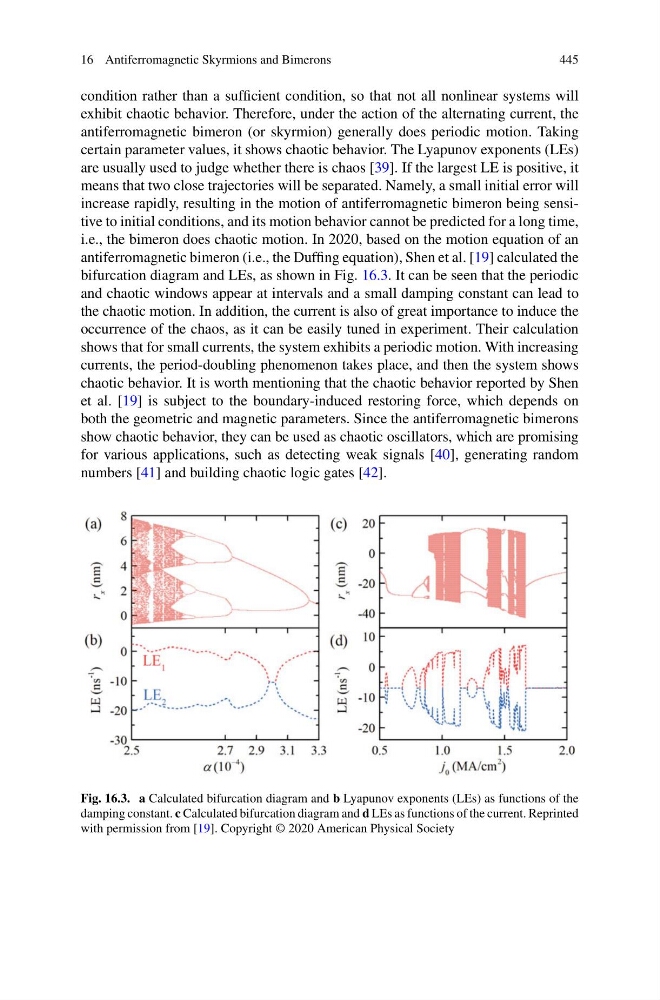
i.e., the bimeron does chaotic motion. In 2020, based on the motion equation of an
antiferromagnetic bimeron (i.e., the Duffing equation), Shen et al. [19] calculated the
bifurcation diagram and LEs, as shown in Fig. 16.3. It can be seen that the periodic
and chaotic windows appear at intervals and a small damping constant can lead to
the chaotic motion. In addition, the current is also of great importance to induce the
occurrence of the chaos, as it can be easily tuned in experiment. Their calculation
shows that for small currents, the system exhibits a periodic motion. With increasing
currents, the period-doubling phenomenon takes place, and then the system shows
chaotic behavior. It is worth mentioning that the chaotic behavior reported by Shen
et al. [19] is subject to the boundary-induced restoring force, which depends on
both the geometric and magnetic parameters. Since the antiferromagnetic bimerons
show chaotic behavior, they can be used as chaotic oscillators, which are promising
for various applications, such as detecting weak signals [40], generating random
numbers [41] and building chaotic logic gates [42].
Fig. 16.3. a Calculated bifurcation diagram and b Lyapunov exponents (LEs) as functions of the
damping constant. c Calculated bifurcation diagram and d LEs as functions of the current. Reprinted
with permission from [19]. Copyright © 2020 American Physical Society
445
condition rather than a sufficient condition, so that not all nonlinear systems will
exhibit chaotic behavior. Therefore, under the action of the alternating current, the
antiferromagnetic bimeron (or skyrmion) generally does periodic motion. Taking
certain parameter values, it shows chaotic behavior. The Lyapunov exponents (LEs)
are usually used to judge whether there is chaos [39]. If the largest LE is positive, it
means that two close trajectories will be separated. Namely, a small initial error will
increase rapidly, resulting in the motion of antiferromagnetic bimeron being sensitive to initial conditions, and its motion behavior cannot be predicted for a long time,
i.e., the bimeron does chaotic motion. In 2020, based on the motion equation of an
antiferromagnetic bimeron (i.e., the Duffing equation), Shen et al. [19] calculated the
bifurcation diagram and LEs, as shown in Fig. 16.3. It can be seen that the periodic
and chaotic windows appear at intervals and a small damping constant can lead to
the chaotic motion. In addition, the current is also of great importance to induce the
occurrence of the chaos, as it can be easily tuned in experiment. Their calculation
shows that for small currents, the system exhibits a periodic motion. With increasing
currents, the period-doubling phenomenon takes place, and then the system shows
chaotic behavior. It is worth mentioning that the chaotic behavior reported by Shen
et al. [19] is subject to the boundary-induced restoring force, which depends on
both the geometric and magnetic parameters. Since the antiferromagnetic bimerons
show chaotic behavior, they can be used as chaotic oscillators, which are promising
for various applications, such as detecting weak signals [40], generating random
numbers [41] and building chaotic logic gates [42].
Fig. 16.3. a Calculated bifurcation diagram and b Lyapunov exponents (LEs) as functions of the
damping constant. c Calculated bifurcation diagram and d LEs as functions of the current. Reprinted
with permission from [19]. Copyright © 2020 American Physical Society