

444
L. Shen et al.
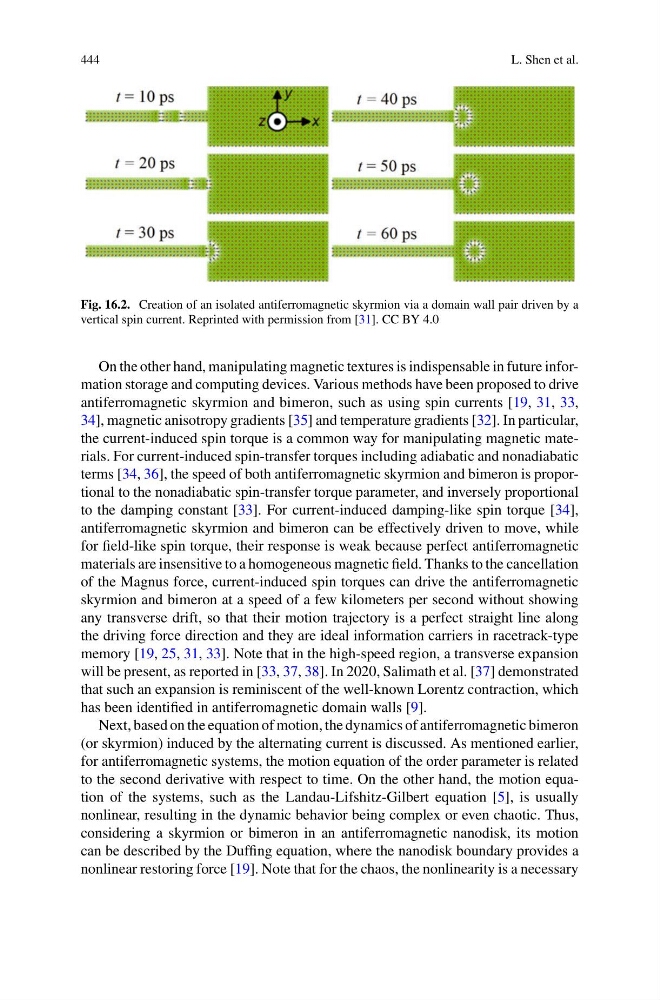
Fig. 16.2. Creation of an isolated antiferromagnetic skyrmion via a domain wall pair driven by a
vertical spin current. Reprinted with permission from [31]. CC BY 4.0
On the other hand, manipulating magnetic textures is indispensable in future information storage and computing devices. Various methods have been proposed to drive
antiferromagnetic skyrmion and bimeron, such as using spin currents [19, 31, 33,
34], magnetic anisotropy gradients [35] and temperature gradients [32]. In particular,
the current-induced spin torque is a common way for manipulating magnetic materials. For current-induced spin-transfer torques including adiabatic and nonadiabatic
terms [34, 36], the speed of both antiferromagnetic skyrmion and bimeron is proportional to the nonadiabatic spin-transfer torque parameter, and inversely proportional
to the damping constant [33]. For current-induced damping-like spin torque [34],
antiferromagnetic skyrmion and bimeron can be effectively driven to move, while
for field-like spin torque, their response is weak because perfect antiferromagnetic
materials are insensitive to a homogeneous magnetic field. Thanks to the cancellation
of the Magnus force, current-induced spin torques can drive the antiferromagnetic
skyrmion and bimeron at a speed of a few kilometers per second without showing
any transverse drift, so that their motion trajectory is a perfect straight line along
the driving force direction and they are ideal information carriers in racetrack-type
memory [19, 25, 31, 33]. Note that in the high-speed region, a transverse expansion
will be present, as reported in [33, 37, 38]. In 2020, Salimath et al. [37] demonstrated
that such an expansion is reminiscent of the well-known Lorentz contraction, which
has been identified in antiferromagnetic domain walls [9].
Next, based on the equation of motion, the dynamics of antiferromagnetic bimeron
(or skyrmion) induced by the alternating current is discussed. As mentioned earlier,
for antiferromagnetic systems, the motion equation of the order parameter is related
to the second derivative with respect to time. On the other hand, the motion equation of the systems, such as the Landau-Lifshitz-Gilbert equation [5], is usually
nonlinear, resulting in the dynamic behavior being complex or even chaotic. Thus,
considering a skyrmion or bimeron in an antiferromagnetic nanodisk, its motion
can be described by the Duffing equation, where the nanodisk boundary provides a
nonlinear restoring force [19]. Note that for the chaos, the nonlinearity is a necessary
L. Shen et al.
Fig. 16.2. Creation of an isolated antiferromagnetic skyrmion via a domain wall pair driven by a
vertical spin current. Reprinted with permission from [31]. CC BY 4.0
On the other hand, manipulating magnetic textures is indispensable in future information storage and computing devices. Various methods have been proposed to drive
antiferromagnetic skyrmion and bimeron, such as using spin currents [19, 31, 33,
34], magnetic anisotropy gradients [35] and temperature gradients [32]. In particular,
the current-induced spin torque is a common way for manipulating magnetic materials. For current-induced spin-transfer torques including adiabatic and nonadiabatic
terms [34, 36], the speed of both antiferromagnetic skyrmion and bimeron is proportional to the nonadiabatic spin-transfer torque parameter, and inversely proportional
to the damping constant [33]. For current-induced damping-like spin torque [34],
antiferromagnetic skyrmion and bimeron can be effectively driven to move, while
for field-like spin torque, their response is weak because perfect antiferromagnetic
materials are insensitive to a homogeneous magnetic field. Thanks to the cancellation
of the Magnus force, current-induced spin torques can drive the antiferromagnetic
skyrmion and bimeron at a speed of a few kilometers per second without showing
any transverse drift, so that their motion trajectory is a perfect straight line along
the driving force direction and they are ideal information carriers in racetrack-type
memory [19, 25, 31, 33]. Note that in the high-speed region, a transverse expansion
will be present, as reported in [33, 37, 38]. In 2020, Salimath et al. [37] demonstrated
that such an expansion is reminiscent of the well-known Lorentz contraction, which
has been identified in antiferromagnetic domain walls [9].
Next, based on the equation of motion, the dynamics of antiferromagnetic bimeron
(or skyrmion) induced by the alternating current is discussed. As mentioned earlier,
for antiferromagnetic systems, the motion equation of the order parameter is related
to the second derivative with respect to time. On the other hand, the motion equation of the systems, such as the Landau-Lifshitz-Gilbert equation [5], is usually
nonlinear, resulting in the dynamic behavior being complex or even chaotic. Thus,
considering a skyrmion or bimeron in an antiferromagnetic nanodisk, its motion
can be described by the Duffing equation, where the nanodisk boundary provides a
nonlinear restoring force [19]. Note that for the chaos, the nonlinearity is a necessary