

15 Topological Dynamics of Spin Texture Based Metamaterials
429
does not possess any chiral symmetry to protect the “zero-energy” modes because
the breathing honeycomb lattice is not a bipartite lattice. Inspired by the explanation
of generalized chiral symmetry in the breathing kagome lattice [37, 139], the chiral
symmetry for a unit cell containing six sites can be generalized by defining
−1
6 H 1 6 = H 2 ,
−1
6 H 2 6 = H 3 ,
−1
6 H 3 6 = H 4 ,
−1
6 H 4 6 = H 5 ,
−1
6 H 5 6 = H 6 ,
H 1 + H 2 + H 3 + H 4 + H 5 + H 6 = 0,
(15.17)
where the chiral operator 6 is a diagonal matrix to be determined, and H 1 =
H − Q 0 I. Here, to prove the system has generalized chiral symmetry, we divide
the system into six subgroups with the components of matrix Hamiltonian being
nonzero only between different subgroups, such a property is essential for chiral
symmetry and indicates no interaction within sublattices. Therefore, the matrices
(H 2 , H 3 , etc.) are the subgroups used for explaining the chiral symmetry of system. Upon combining the last equation with the previous five in (15.17), we have
−1
6 H 6 6 = H 1 , implying that [H 1 , ,
6
6 ] = 0; thus,
6
6 = I, via the reasoning completely analogous to the Su-Schrieffer-Heeger model [140]. Hamiltonians H 1,2,3,4,5,6
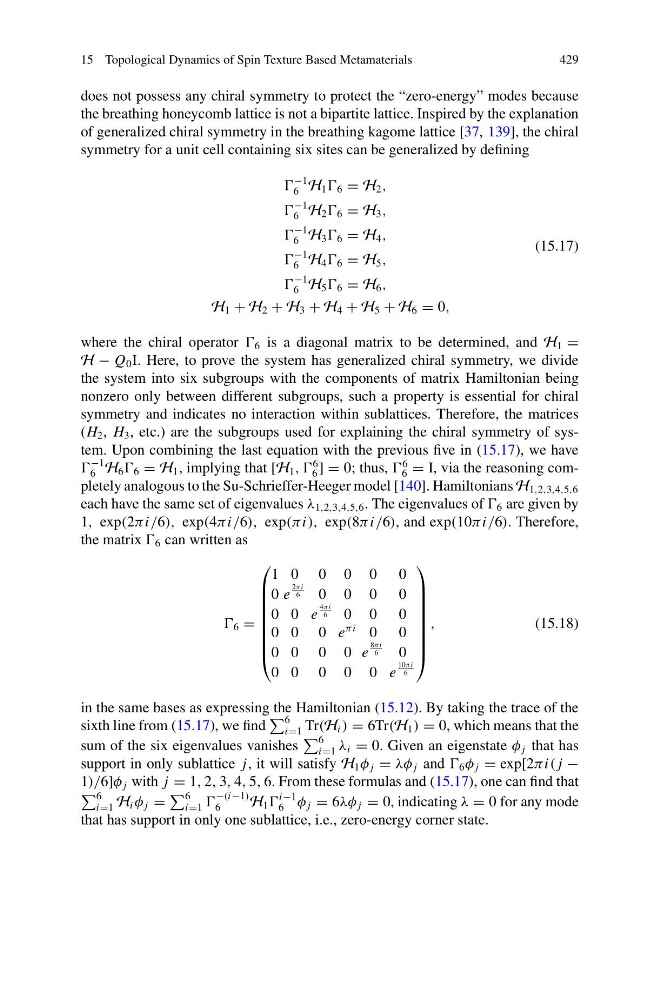
each have the same set of eigenvalues λ 1,2,3,4,5,6 . The eigenvalues of 6 are given by
1, exp(2πi/6), exp(4πi/6), exp(πi), exp(8πi/6), and exp(10πi/6). Therefore,
the matrix 6 can written as
6 =
⎛
⎜
⎜
⎜
⎜
⎜
⎜
⎜
⎝
1 0 0 0 0 0
0 e
2πi
6
0 0 0 0
0 0 e
4πi
6
0 0 0
0 0 0 e
πi 0 0
0 0 0 0 e
8πi
6
0
0 0 0 0 0 e
10πi
6
⎞
⎟
⎟
⎟
⎟
⎟
⎟
⎟
⎠
,
(15.18)
in the same bases as expressing the Hamiltonian (15.12). By taking the trace of the
sixth line from (15.17), we find
6
i=1 Tr(H i ) = 6Tr(H 1 ) = 0, which means that the
sum of the six eigenvalues vanishes
6
i=1 λ i = 0. Given an eigenstate φ j that has
support in only sublattice j, it will satisfy H 1 φ j = λφ j and 6 φ j = exp[2πi( j −
1)/6]φ j with j = 1, 2, 3, 4, 5, 6. From these formulas and (15.17), one can find that
6
i=1 H i φ j =
6
i=1
−(i−1)
6
H 1
i−1
6 φ j = 6λφ j = 0, indicating λ = 0 for any mode
that has support in only one sublattice, i.e., zero-energy corner state.
429
does not possess any chiral symmetry to protect the “zero-energy” modes because
the breathing honeycomb lattice is not a bipartite lattice. Inspired by the explanation
of generalized chiral symmetry in the breathing kagome lattice [37, 139], the chiral
symmetry for a unit cell containing six sites can be generalized by defining
−1
6 H 1 6 = H 2 ,
−1
6 H 2 6 = H 3 ,
−1
6 H 3 6 = H 4 ,
−1
6 H 4 6 = H 5 ,
−1
6 H 5 6 = H 6 ,
H 1 + H 2 + H 3 + H 4 + H 5 + H 6 = 0,
(15.17)
where the chiral operator 6 is a diagonal matrix to be determined, and H 1 =
H − Q 0 I. Here, to prove the system has generalized chiral symmetry, we divide
the system into six subgroups with the components of matrix Hamiltonian being
nonzero only between different subgroups, such a property is essential for chiral
symmetry and indicates no interaction within sublattices. Therefore, the matrices
(H 2 , H 3 , etc.) are the subgroups used for explaining the chiral symmetry of system. Upon combining the last equation with the previous five in (15.17), we have
−1
6 H 6 6 = H 1 , implying that [H 1 , ,
6
6 ] = 0; thus,
6
6 = I, via the reasoning completely analogous to the Su-Schrieffer-Heeger model [140]. Hamiltonians H 1,2,3,4,5,6
each have the same set of eigenvalues λ 1,2,3,4,5,6 . The eigenvalues of 6 are given by
1, exp(2πi/6), exp(4πi/6), exp(πi), exp(8πi/6), and exp(10πi/6). Therefore,
the matrix 6 can written as
6 =
⎛
⎜
⎜
⎜
⎜
⎜
⎜
⎜
⎝
1 0 0 0 0 0
0 e
2πi
6
0 0 0 0
0 0 e
4πi
6
0 0 0
0 0 0 e
πi 0 0
0 0 0 0 e
8πi
6
0
0 0 0 0 0 e
10πi
6
⎞
⎟
⎟
⎟
⎟
⎟
⎟
⎟
⎠
,
(15.18)
in the same bases as expressing the Hamiltonian (15.12). By taking the trace of the
sixth line from (15.17), we find
6
i=1 Tr(H i ) = 6Tr(H 1 ) = 0, which means that the
sum of the six eigenvalues vanishes
6
i=1 λ i = 0. Given an eigenstate φ j that has
support in only sublattice j, it will satisfy H 1 φ j = λφ j and 6 φ j = exp[2πi( j −
1)/6]φ j with j = 1, 2, 3, 4, 5, 6. From these formulas and (15.17), one can find that
6
i=1 H i φ j =
6
i=1
−(i−1)
6
H 1
i−1
6 φ j = 6λφ j = 0, indicating λ = 0 for any mode
that has support in only one sublattice, i.e., zero-energy corner state.