

428
Z. Li et al.
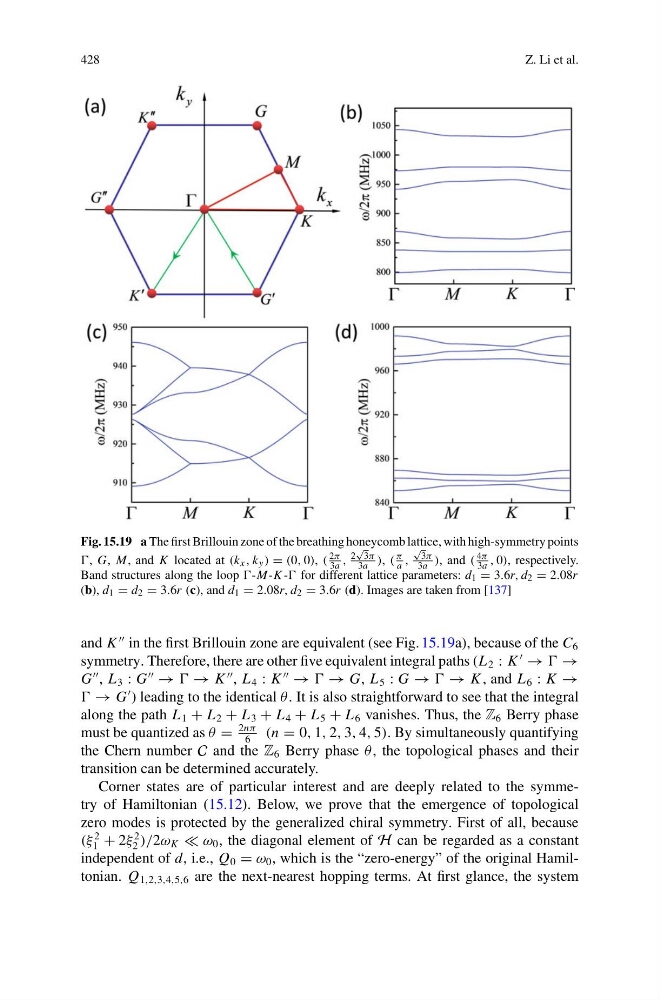
Fig. 15.19 a The first Brillouin zone of the breathing honeycomb lattice, with high-symmetry points
, G, M, and K located at (k x , k y ) = (0, 0), (
2π
3a ,
2
√
3π
3a ), (
π
a ,
√
3π
3a ), and (
4π
3a , 0), respectively.
Band structures along the loop -M-K - for different lattice parameters: d 1 = 3.6r, d 2 = 2.08r
(b), d 1 = d 2 = 3.6r (c), and d 1 = 2.08r, d 2 = 3.6r (d). Images are taken from [137]
and K
in the first Brillouin zone are equivalent (see Fig. 15.19a), because of the C 6
symmetry. Therefore, there are other five equivalent integral paths (L 2 : K
→ →
G
, L 3 : G
→ → K
, L 4 : K
→ → G, L 5 : G → → K , and L 6 : K →
→ G
) leading to the identical θ . It is also straightforward to see that the integral
along the path L 1 + L 2 + L 3 + L 4 + L 5 + L 6 vanishes. Thus, the Z 6 Berry phase
must be quantized as θ =
2nπ
6
(n = 0, 1, 2, 3, 4, 5). By simultaneously quantifying
the Chern number C and the Z 6 Berry phase θ , the topological phases and their
transition can be determined accurately.
Corner states are of particular interest and are deeply related to the symmetry of Hamiltonian (15.12). Below, we prove that the emergence of topological
zero modes is protected by the generalized chiral symmetry. First of all, because
(ξ
2
1 + 2ξ
2
2 )/2ω K ω 0 , the diagonal element of H can be regarded as a constant
independent of d, i.e., Q 0 = ω 0 , which is the “zero-energy” of the original Hamiltonian. Q 1,2,3,4,5,6 are the next-nearest hopping terms. At first glance, the system
Z. Li et al.
Fig. 15.19 a The first Brillouin zone of the breathing honeycomb lattice, with high-symmetry points
, G, M, and K located at (k x , k y ) = (0, 0), (
2π
3a ,
2
√
3π
3a ), (
π
a ,
√
3π
3a ), and (
4π
3a , 0), respectively.
Band structures along the loop -M-K - for different lattice parameters: d 1 = 3.6r, d 2 = 2.08r
(b), d 1 = d 2 = 3.6r (c), and d 1 = 2.08r, d 2 = 3.6r (d). Images are taken from [137]
and K
in the first Brillouin zone are equivalent (see Fig. 15.19a), because of the C 6
symmetry. Therefore, there are other five equivalent integral paths (L 2 : K
→ →
G
, L 3 : G
→ → K
, L 4 : K
→ → G, L 5 : G → → K , and L 6 : K →
→ G
) leading to the identical θ . It is also straightforward to see that the integral
along the path L 1 + L 2 + L 3 + L 4 + L 5 + L 6 vanishes. Thus, the Z 6 Berry phase
must be quantized as θ =
2nπ
6
(n = 0, 1, 2, 3, 4, 5). By simultaneously quantifying
the Chern number C and the Z 6 Berry phase θ , the topological phases and their
transition can be determined accurately.
Corner states are of particular interest and are deeply related to the symmetry of Hamiltonian (15.12). Below, we prove that the emergence of topological
zero modes is protected by the generalized chiral symmetry. First of all, because
(ξ
2
1 + 2ξ
2
2 )/2ω K ω 0 , the diagonal element of H can be regarded as a constant
independent of d, i.e., Q 0 = ω 0 , which is the “zero-energy” of the original Hamiltonian. Q 1,2,3,4,5,6 are the next-nearest hopping terms. At first glance, the system