

15 Topological Dynamics of Spin Texture Based Metamaterials
415
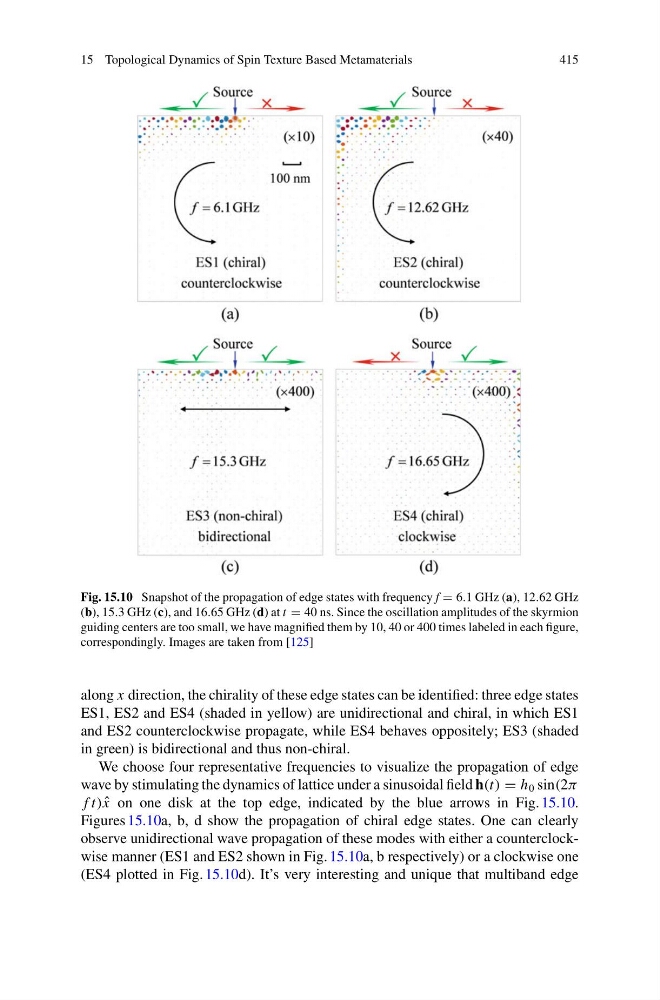
Fig. 15.10 Snapshot of the propagation of edge states with frequency f = 6.1 GHz (a), 12.62 GHz
(b), 15.3 GHz (c), and 16.65 GHz (d) at t = 40 ns. Since the oscillation amplitudes of the skyrmion
guiding centers are too small, we have magnified them by 10, 40 or 400 times labeled in each figure,
correspondingly. Images are taken from [125]
along x direction, the chirality of these edge states can be identified: three edge states
ES1, ES2 and ES4 (shaded in yellow) are unidirectional and chiral, in which ES1
and ES2 counterclockwise propagate, while ES4 behaves oppositely; ES3 (shaded
in green) is bidirectional and thus non-chiral.
We choose four representative frequencies to visualize the propagation of edge
wave by stimulating the dynamics of lattice under a sinusoidal field h(t) = h 0 sin(2π
f t) ˆ
x on one disk at the top edge, indicated by the blue arrows in Fig. 15.10.
Figures 15.10a, b, d show the propagation of chiral edge states. One can clearly
observe unidirectional wave propagation of these modes with either a counterclockwise manner (ES1 and ES2 shown in Fig. 15.10a, b respectively) or a clockwise one
(ES4 plotted in Fig. 15.10d). It’s very interesting and unique that multiband edge
415
Fig. 15.10 Snapshot of the propagation of edge states with frequency f = 6.1 GHz (a), 12.62 GHz
(b), 15.3 GHz (c), and 16.65 GHz (d) at t = 40 ns. Since the oscillation amplitudes of the skyrmion
guiding centers are too small, we have magnified them by 10, 40 or 400 times labeled in each figure,
correspondingly. Images are taken from [125]
along x direction, the chirality of these edge states can be identified: three edge states
ES1, ES2 and ES4 (shaded in yellow) are unidirectional and chiral, in which ES1
and ES2 counterclockwise propagate, while ES4 behaves oppositely; ES3 (shaded
in green) is bidirectional and thus non-chiral.
We choose four representative frequencies to visualize the propagation of edge
wave by stimulating the dynamics of lattice under a sinusoidal field h(t) = h 0 sin(2π
f t) ˆ
x on one disk at the top edge, indicated by the blue arrows in Fig. 15.10.
Figures 15.10a, b, d show the propagation of chiral edge states. One can clearly
observe unidirectional wave propagation of these modes with either a counterclockwise manner (ES1 and ES2 shown in Fig. 15.10a, b respectively) or a clockwise one
(ES4 plotted in Fig. 15.10d). It’s very interesting and unique that multiband edge