

14 Topology in Magnetism
393
units of γ J/μ where μ is the magnitude of magnetic moment of each spin. The
top-left (the low-right) inset is the band structure in k x -k y (k y -k z ) plane for k z = 0
(k x = 0). The magnon band is globally gapped with an indirect gap between K and
H points. Figure 14.20b shows the spectral function on the left (−x side) surface of
a slab infinite in yz plane and 15 unit cells in x direction). The brighter color means
larger local density of states. The upper (lower) panel is the spectral function along
k y (k z ) direction with k z = 0 (k y = 0). A surface magnon band is clearly shown
inside the bulk band gap with a negative slope in ω-k y plane, which means a negative
group velocity and a unidirectional propagation along −y direction. Similarly, on the
rear surface, the surface modes propagate along +y direction (not shown). In other
words, the surface states propagate counterclockwise with respect to the ground
state magnetization direction. The Chern number of the system can be calculated
by the standard formula [145, 154, 157] to show that the system is a magnonic
weak topological insulator, so that the side surface states along xz or yz surfaces are
topologically protected.
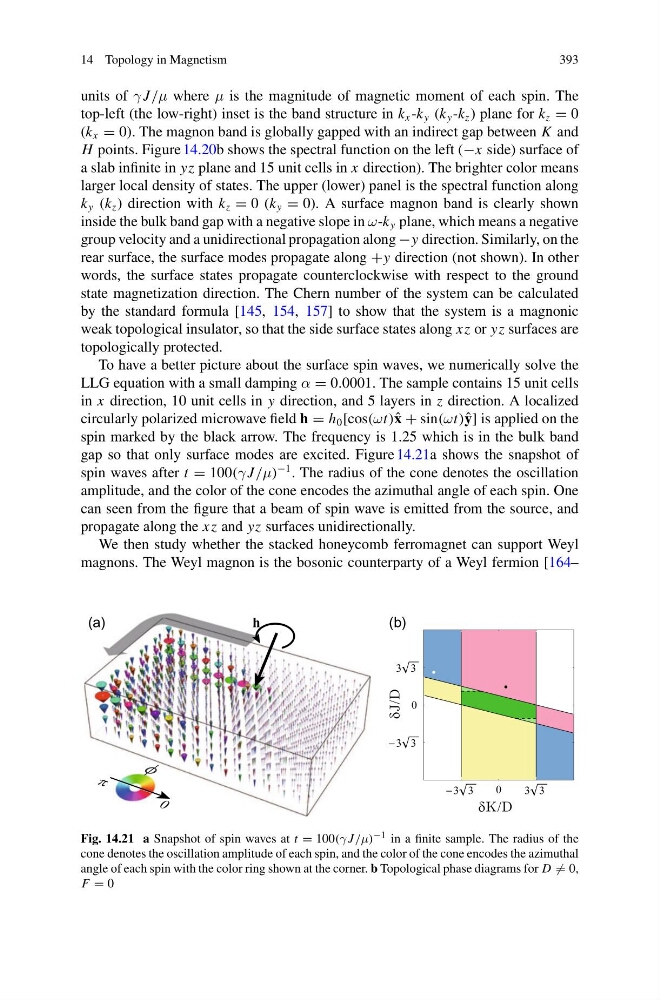
To have a better picture about the surface spin waves, we numerically solve the
LLG equation with a small damping α = 0.0001. The sample contains 15 unit cells
in x direction, 10 unit cells in y direction, and 5 layers in z direction. A localized
circularly polarized microwave field h = h 0 [cos(ωt)ˆ x + sin(ωt)ˆ y] is applied on the
spin marked by the black arrow. The frequency is 1.25 which is in the bulk band
gap so that only surface modes are excited. Figure 14.21a shows the snapshot of
spin waves after t = 100(γ J/μ)
−1 . The radius of the cone denotes the oscillation
amplitude, and the color of the cone encodes the azimuthal angle of each spin. One
can seen from the figure that a beam of spin wave is emitted from the source, and
propagate along the xz and yz surfaces unidirectionally.
We then study whether the stacked honeycomb ferromagnet can support Weyl
magnons. The Weyl magnon is the bosonic counterparty of a Weyl fermion [164–
h
(b)
K D
J D
(a)
Fig. 14.21 a Snapshot of spin waves at t = 100(γ J/μ) −1 in a finite sample. The radius of the
cone denotes the oscillation amplitude of each spin, and the color of the cone encodes the azimuthal
angle of each spin with the color ring shown at the corner. b Topological phase diagrams for D = 0,
F = 0
393
units of γ J/μ where μ is the magnitude of magnetic moment of each spin. The
top-left (the low-right) inset is the band structure in k x -k y (k y -k z ) plane for k z = 0
(k x = 0). The magnon band is globally gapped with an indirect gap between K and
H points. Figure 14.20b shows the spectral function on the left (−x side) surface of
a slab infinite in yz plane and 15 unit cells in x direction). The brighter color means
larger local density of states. The upper (lower) panel is the spectral function along
k y (k z ) direction with k z = 0 (k y = 0). A surface magnon band is clearly shown
inside the bulk band gap with a negative slope in ω-k y plane, which means a negative
group velocity and a unidirectional propagation along −y direction. Similarly, on the
rear surface, the surface modes propagate along +y direction (not shown). In other
words, the surface states propagate counterclockwise with respect to the ground
state magnetization direction. The Chern number of the system can be calculated
by the standard formula [145, 154, 157] to show that the system is a magnonic
weak topological insulator, so that the side surface states along xz or yz surfaces are
topologically protected.
To have a better picture about the surface spin waves, we numerically solve the
LLG equation with a small damping α = 0.0001. The sample contains 15 unit cells
in x direction, 10 unit cells in y direction, and 5 layers in z direction. A localized
circularly polarized microwave field h = h 0 [cos(ωt)ˆ x + sin(ωt)ˆ y] is applied on the
spin marked by the black arrow. The frequency is 1.25 which is in the bulk band
gap so that only surface modes are excited. Figure 14.21a shows the snapshot of
spin waves after t = 100(γ J/μ)
−1 . The radius of the cone denotes the oscillation
amplitude, and the color of the cone encodes the azimuthal angle of each spin. One
can seen from the figure that a beam of spin wave is emitted from the source, and
propagate along the xz and yz surfaces unidirectionally.
We then study whether the stacked honeycomb ferromagnet can support Weyl
magnons. The Weyl magnon is the bosonic counterparty of a Weyl fermion [164–
h
(b)
K D
J D
(a)
Fig. 14.21 a Snapshot of spin waves at t = 100(γ J/μ) −1 in a finite sample. The radius of the
cone denotes the oscillation amplitude of each spin, and the color of the cone encodes the azimuthal
angle of each spin with the color ring shown at the corner. b Topological phase diagrams for D = 0,
F = 0