

384
X. S. Wang and X. R. Wang
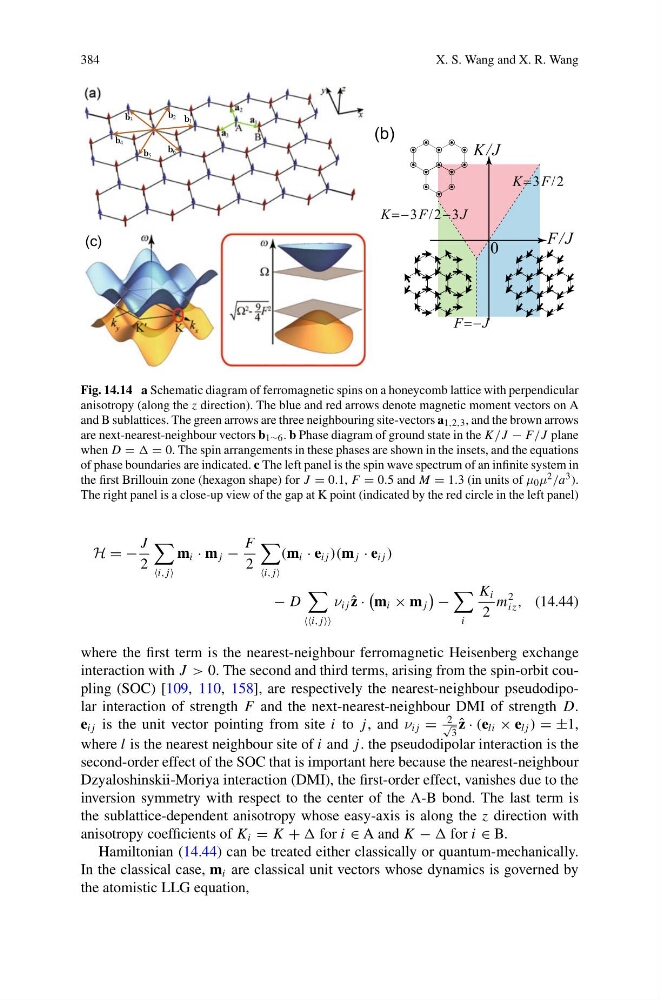
Fig. 14.14 a Schematic diagram of ferromagnetic spins on a honeycomb lattice with perpendicular
anisotropy (along the z direction). The blue and red arrows denote magnetic moment vectors on A
and B sublattices. The green arrows are three neighbouring site-vectors a 1,2,3 , and the brown arrows
are next-nearest-neighbour vectors b 1∼6 . b Phase diagram of ground state in the K /J − F/J plane
when D = = 0. The spin arrangements in these phases are shown in the insets, and the equations
of phase boundaries are indicated. c The left panel is the spin wave spectrum of an infinite system in
the first Brillouin zone (hexagon shape) for J = 0.1, F = 0.5 and M = 1.3 (in units of μ 0 μ 2 /a 3 ).
The right panel is a close-up view of the gap at K point (indicated by the red circle in the left panel)
H = −
J
2
i, j
m i · m j −
F
2
i, j
(m i · e i j )(m j · e i j )
− D
j
ν i j ˆ
z ·
m i × m j
−
i
K i
2
m
2
iz , (14.44)
where the first term is the nearest-neighbour ferromagnetic Heisenberg exchange
interaction with J > 0. The second and third terms, arising from the spin-orbit coupling (SOC) [109, 110, 158], are respectively the nearest-neighbour pseudodipolar interaction of strength F and the next-nearest-neighbour DMI of strength D.
e i j is the unit vector pointing from site i to j, and ν i j =
2
√
3
ˆ
z · (e li × e l j ) = ±1,
where l is the nearest neighbour site of i and j. the pseudodipolar interaction is the
second-order effect of the SOC that is important here because the nearest-neighbour
Dzyaloshinskii-Moriya interaction (DMI), the first-order effect, vanishes due to the
inversion symmetry with respect to the center of the A-B bond. The last term is
the sublattice-dependent anisotropy whose easy-axis is along the z direction with
anisotropy coefficients of K i = K + for i ∈ A and K − for i ∈ B.
Hamiltonian (14.44) can be treated either classically or quantum-mechanically.
In the classical case, m i are classical unit vectors whose dynamics is governed by
the atomistic LLG equation,
X. S. Wang and X. R. Wang
Fig. 14.14 a Schematic diagram of ferromagnetic spins on a honeycomb lattice with perpendicular
anisotropy (along the z direction). The blue and red arrows denote magnetic moment vectors on A
and B sublattices. The green arrows are three neighbouring site-vectors a 1,2,3 , and the brown arrows
are next-nearest-neighbour vectors b 1∼6 . b Phase diagram of ground state in the K /J − F/J plane
when D = = 0. The spin arrangements in these phases are shown in the insets, and the equations
of phase boundaries are indicated. c The left panel is the spin wave spectrum of an infinite system in
the first Brillouin zone (hexagon shape) for J = 0.1, F = 0.5 and M = 1.3 (in units of μ 0 μ 2 /a 3 ).
The right panel is a close-up view of the gap at K point (indicated by the red circle in the left panel)
H = −
J
2
i, j
m i · m j −
F
2
i, j
(m i · e i j )(m j · e i j )
− D
j
ν i j ˆ
z ·
m i × m j
−
i
K i
2
m
2
iz , (14.44)
where the first term is the nearest-neighbour ferromagnetic Heisenberg exchange
interaction with J > 0. The second and third terms, arising from the spin-orbit coupling (SOC) [109, 110, 158], are respectively the nearest-neighbour pseudodipolar interaction of strength F and the next-nearest-neighbour DMI of strength D.
e i j is the unit vector pointing from site i to j, and ν i j =
2
√
3
ˆ
z · (e li × e l j ) = ±1,
where l is the nearest neighbour site of i and j. the pseudodipolar interaction is the
second-order effect of the SOC that is important here because the nearest-neighbour
Dzyaloshinskii-Moriya interaction (DMI), the first-order effect, vanishes due to the
inversion symmetry with respect to the center of the A-B bond. The last term is
the sublattice-dependent anisotropy whose easy-axis is along the z direction with
anisotropy coefficients of K i = K + for i ∈ A and K − for i ∈ B.
Hamiltonian (14.44) can be treated either classically or quantum-mechanically.
In the classical case, m i are classical unit vectors whose dynamics is governed by
the atomistic LLG equation,