

14 Topology in Magnetism
381
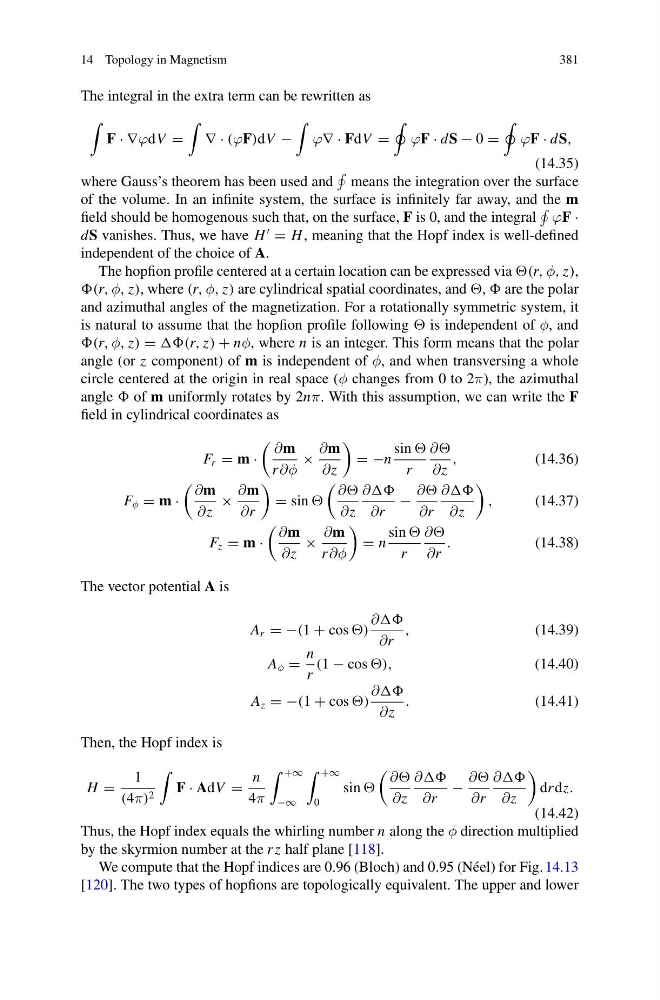
The integral in the extra term can be rewritten as
F · ∇ϕdV =
∇ · (ϕF)dV −
ϕ∇ · FdV =
ϕF · dS − 0 =
ϕF · dS,
(14.35)
where Gauss’s theorem has been used and
means the integration over the surface
of the volume. In an infinite system, the surface is infinitely far away, and the m
field should be homogenous such that, on the surface, F is 0, and the integral
ϕF ·
dS vanishes. Thus, we have H
= H , meaning that the Hopf index is well-defined
independent of the choice of A.
The hopfion profile centered at a certain location can be expressed via (r, φ, z),
(r, φ, z), where (r, φ, z) are cylindrical spatial coordinates, and , are the polar
and azimuthal angles of the magnetization. For a rotationally symmetric system, it
is natural to assume that the hopfion profile following is independent of φ, and
(r, φ, z) = z) + nφ, where n is an integer. This form means that the polar
angle (or z component) of m is independent of φ, and when transversing a whole
circle centered at the origin in real space (φ changes from 0 to 2π), the azimuthal
angle of m uniformly rotates by 2nπ. With this assumption, we can write the F
field in cylindrical coordinates as
F r = m ·
∂m
r ∂φ
×
∂m
∂z
= −n
sin
r
∂
∂z
,
(14.36)
F φ = m ·
∂m
∂z
×
∂m
∂r
= sin
∂
∂z
∂
∂r
−
∂
∂r
∂
∂z
,
(14.37)
F z = m ·
∂m
∂z
×
∂m
r ∂φ
= n
sin
r
∂
∂r
.
(14.38)
The vector potential A is
A r = −(1 + cos )
∂
∂r
,
(14.39)
A φ =
n
r
(1 − cos ),
(14.40)
A z = −(1 + cos )
∂
∂z
.
(14.41)
Then, the Hopf index is
H =
1
(4π) 2
F · AdV =
n
4π
+∞
−∞
+∞
0
sin
∂
∂z
∂
∂r
−
∂
∂r
∂
∂z
dr dz.
(14.42)
Thus, the Hopf index equals the whirling number n along the φ direction multiplied
by the skyrmion number at the r z half plane [118].
We compute that the Hopf indices are 0.96 (Bloch) and 0.95 (Néel) for Fig. 14.13
[120]. The two types of hopfions are topologically equivalent. The upper and lower
381
The integral in the extra term can be rewritten as
F · ∇ϕdV =
∇ · (ϕF)dV −
ϕ∇ · FdV =
ϕF · dS − 0 =
ϕF · dS,
(14.35)
where Gauss’s theorem has been used and
means the integration over the surface
of the volume. In an infinite system, the surface is infinitely far away, and the m
field should be homogenous such that, on the surface, F is 0, and the integral
ϕF ·
dS vanishes. Thus, we have H
= H , meaning that the Hopf index is well-defined
independent of the choice of A.
The hopfion profile centered at a certain location can be expressed via (r, φ, z),
(r, φ, z), where (r, φ, z) are cylindrical spatial coordinates, and , are the polar
and azimuthal angles of the magnetization. For a rotationally symmetric system, it
is natural to assume that the hopfion profile following is independent of φ, and
(r, φ, z) = z) + nφ, where n is an integer. This form means that the polar
angle (or z component) of m is independent of φ, and when transversing a whole
circle centered at the origin in real space (φ changes from 0 to 2π), the azimuthal
angle of m uniformly rotates by 2nπ. With this assumption, we can write the F
field in cylindrical coordinates as
F r = m ·
∂m
r ∂φ
×
∂m
∂z
= −n
sin
r
∂
∂z
,
(14.36)
F φ = m ·
∂m
∂z
×
∂m
∂r
= sin
∂
∂z
∂
∂r
−
∂
∂r
∂
∂z
,
(14.37)
F z = m ·
∂m
∂z
×
∂m
r ∂φ
= n
sin
r
∂
∂r
.
(14.38)
The vector potential A is
A r = −(1 + cos )
∂
∂r
,
(14.39)
A φ =
n
r
(1 − cos ),
(14.40)
A z = −(1 + cos )
∂
∂z
.
(14.41)
Then, the Hopf index is
H =
1
(4π) 2
F · AdV =
n
4π
+∞
−∞
+∞
0
sin
∂
∂z
∂
∂r
−
∂
∂r
∂
∂z
dr dz.
(14.42)
Thus, the Hopf index equals the whirling number n along the φ direction multiplied
by the skyrmion number at the r z half plane [118].
We compute that the Hopf indices are 0.96 (Bloch) and 0.95 (Néel) for Fig. 14.13
[120]. The two types of hopfions are topologically equivalent. The upper and lower