

364
X. S. Wang and X. R. Wang
one can rigorously prove that no static DW is allowed in a homogeneous nanowire
in the presence of an external magnetic field. A moving DW must dissipate energy
because of various damping mechanisms. Thus, energy conservation requires that
the dissipated energy comes from the energy decrease of the wire that should be
supplied by the Zeeman energy released from the DW propagation [30]. This is
the origin of DW propagation. The energy dissipation can come not only from the
Gilbert damping as in aforementioned Walker solution, but also from spin wave
emission [31, 32]. Somehow similar to the Walker solution, depending on K x and B,
breathing or more complicated periodic transformations such as a DW drilling emit
spin waves. During the DW propagation, the energy dissipation rate due to the SW
emission is balanced by the Zeeman energy release. Spin wave emission persists in
the presence of Gilbert damping and make the usual Walker rigid-body propagation
solution unstable in a region below the Walker breakdown field [33]. In strong field
and low K x , a broad DW undergoes a breathing motion. Both bow and stern SWs
are emitted by the periodical breathing of the DW width. The main frequencies of
the SWs are respectively of 3γ B and γ B in the domains along and opposite to the
field. When the sum of longitudinal and transverse anisotropy energies is of the same
order of the exchange energy, the DW goes into drilling motion when the DW plane
is greatly distorted. The DW propagates at a constant high speed, and stern waves
are mainly emitted.
As mentioned before in Fig. 14.4, a magnetic field drives DWs of W = 1/2 and
W = −1/2 to move in opposite directions so that they can annihilate with each other.
Under a magnetic field, the data stored in the domain between the two annihilated
DWs would be destroyed. In a racetrack memory, all domain walls are required to
move in a synchronized way, regardless its topological charge. This requirement can
be realized by spin-polarized electric current through spin-transfer torque [23–27].
Different from the field-driven motion which originates from energy conservation,
the current-driven DW motion comes from the angular momentum transfer [34]. In
most FM materials, the electrons are spin-polarized along the magnetization direction
of the domain (with angular momentum /2). After passing through a DW, electrons
can follow the local magnetization to reverse its spin (adiabatic process) to −/2 if
the DW is wide enough. Thus there is a change in angular momentum of −. Due
to angular momentum conservation, this change can be converted into the motion of
DW towards the direction of electron flow. The torque on the local spin is called the
spin-transfer torque (STT). No matter what the type of a DW is, STT always drives the
DW to propagate along the same direction. STT-driven DW propagation soon attracts
intensive theoretical and experimental studies due to the nice property, including
but not limited to [20, 23–27, 35, 36]. STT has both adiabatic and nonadiabatic
components[25, 37, 38] whose expressions are
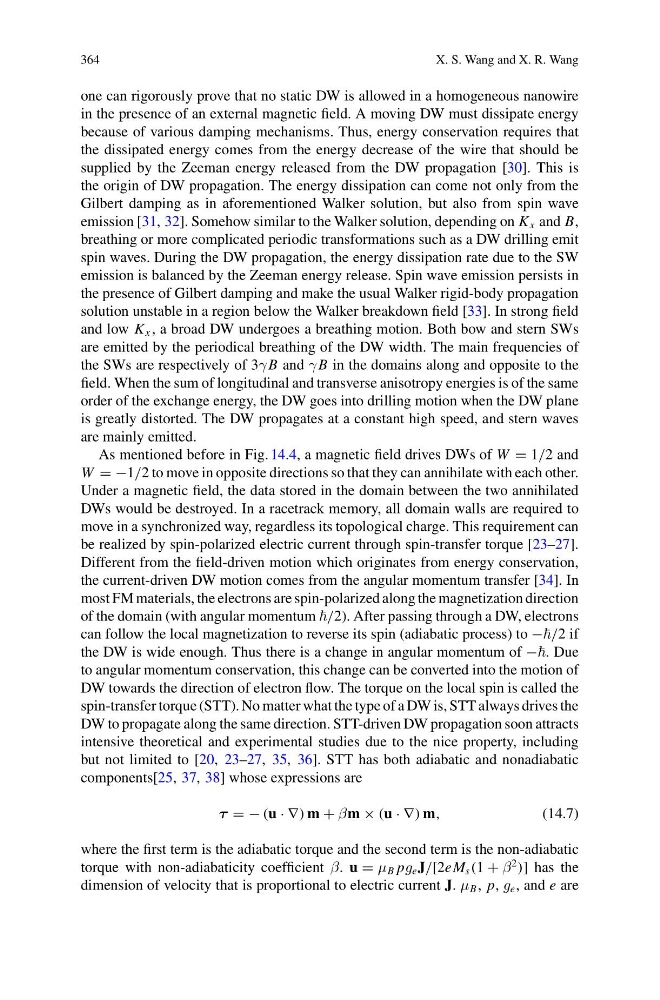
τ = − (u · ∇) m + βm × (u · ∇) m,
(14.7)
where the first term is the adiabatic torque and the second term is the non-adiabatic
torque with non-adiabaticity coefficient β. u = μ B pg e J/[2eM s (1 + β
2
)] has the
dimension of velocity that is proportional to electric current J. μ B , p, g e , and e are
X. S. Wang and X. R. Wang
one can rigorously prove that no static DW is allowed in a homogeneous nanowire
in the presence of an external magnetic field. A moving DW must dissipate energy
because of various damping mechanisms. Thus, energy conservation requires that
the dissipated energy comes from the energy decrease of the wire that should be
supplied by the Zeeman energy released from the DW propagation [30]. This is
the origin of DW propagation. The energy dissipation can come not only from the
Gilbert damping as in aforementioned Walker solution, but also from spin wave
emission [31, 32]. Somehow similar to the Walker solution, depending on K x and B,
breathing or more complicated periodic transformations such as a DW drilling emit
spin waves. During the DW propagation, the energy dissipation rate due to the SW
emission is balanced by the Zeeman energy release. Spin wave emission persists in
the presence of Gilbert damping and make the usual Walker rigid-body propagation
solution unstable in a region below the Walker breakdown field [33]. In strong field
and low K x , a broad DW undergoes a breathing motion. Both bow and stern SWs
are emitted by the periodical breathing of the DW width. The main frequencies of
the SWs are respectively of 3γ B and γ B in the domains along and opposite to the
field. When the sum of longitudinal and transverse anisotropy energies is of the same
order of the exchange energy, the DW goes into drilling motion when the DW plane
is greatly distorted. The DW propagates at a constant high speed, and stern waves
are mainly emitted.
As mentioned before in Fig. 14.4, a magnetic field drives DWs of W = 1/2 and
W = −1/2 to move in opposite directions so that they can annihilate with each other.
Under a magnetic field, the data stored in the domain between the two annihilated
DWs would be destroyed. In a racetrack memory, all domain walls are required to
move in a synchronized way, regardless its topological charge. This requirement can
be realized by spin-polarized electric current through spin-transfer torque [23–27].
Different from the field-driven motion which originates from energy conservation,
the current-driven DW motion comes from the angular momentum transfer [34]. In
most FM materials, the electrons are spin-polarized along the magnetization direction
of the domain (with angular momentum /2). After passing through a DW, electrons
can follow the local magnetization to reverse its spin (adiabatic process) to −/2 if
the DW is wide enough. Thus there is a change in angular momentum of −. Due
to angular momentum conservation, this change can be converted into the motion of
DW towards the direction of electron flow. The torque on the local spin is called the
spin-transfer torque (STT). No matter what the type of a DW is, STT always drives the
DW to propagate along the same direction. STT-driven DW propagation soon attracts
intensive theoretical and experimental studies due to the nice property, including
but not limited to [20, 23–27, 35, 36]. STT has both adiabatic and nonadiabatic
components[25, 37, 38] whose expressions are
τ = − (u · ∇) m + βm × (u · ∇) m,
(14.7)
where the first term is the adiabatic torque and the second term is the non-adiabatic
torque with non-adiabaticity coefficient β. u = μ B pg e J/[2eM s (1 + β
2
)] has the
dimension of velocity that is proportional to electric current J. μ B , p, g e , and e are