

14 Topology in Magnetism
363
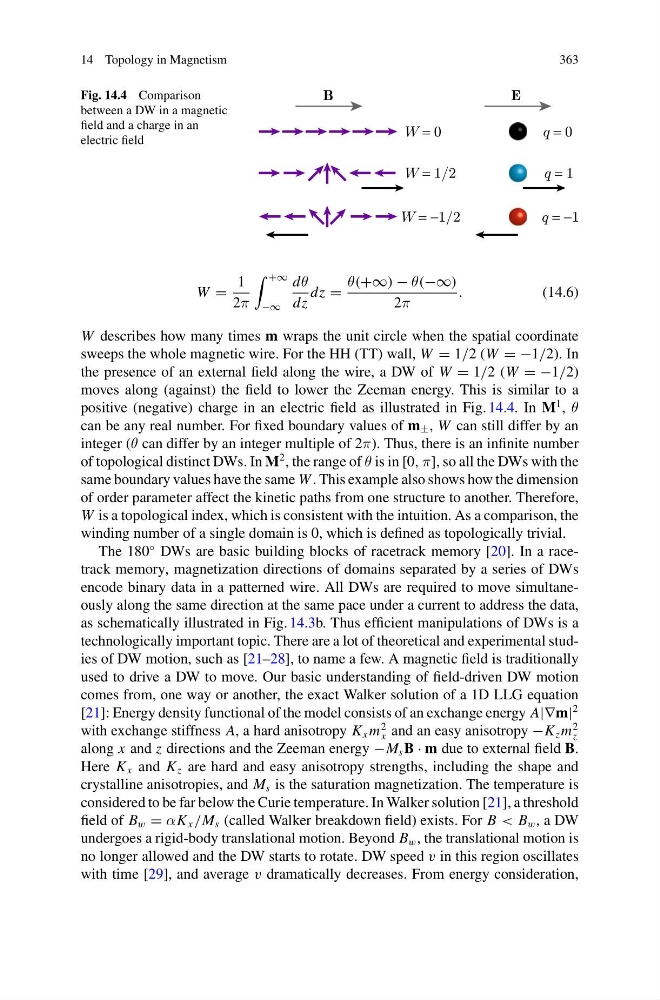
Fig. 14.4 Comparison
between a DW in a magnetic
field and a charge in an
electric field
W =
1
2π
+∞
−∞
dθ
dz
dz =
θ(+∞) − θ(−∞)
2π
.
(14.6)
W describes how many times m wraps the unit circle when the spatial coordinate
sweeps the whole magnetic wire. For the HH (TT) wall, W = 1/2 (W = −1/2). In
the presence of an external field along the wire, a DW of W = 1/2 (W = −1/2)
moves along (against) the field to lower the Zeeman energy. This is similar to a
positive (negative) charge in an electric field as illustrated in Fig. 14.4. In M
1 , θ
can be any real number. For fixed boundary values of m ± , W can still differ by an
integer (θ can differ by an integer multiple of 2π). Thus, there is an infinite number
of topological distinct DWs. In M
2 , the range of θ is in [0, π], so all the DWs with the
same boundary values have the same W . This example also shows how the dimension
of order parameter affect the kinetic paths from one structure to another. Therefore,
W is a topological index, which is consistent with the intuition. As a comparison, the
winding number of a single domain is 0, which is defined as topologically trivial.
The 180
◦ DWs are basic building blocks of racetrack memory [20]. In a racetrack memory, magnetization directions of domains separated by a series of DWs
encode binary data in a patterned wire. All DWs are required to move simultaneously along the same direction at the same pace under a current to address the data,
as schematically illustrated in Fig. 14.3b. Thus efficient manipulations of DWs is a
technologically important topic. There are a lot of theoretical and experimental studies of DW motion, such as [21–28], to name a few. A magnetic field is traditionally
used to drive a DW to move. Our basic understanding of field-driven DW motion
comes from, one way or another, the exact Walker solution of a 1D LLG equation
[21]: Energy density functional of the model consists of an exchange energy A|∇m|
2
with exchange stiffness A, a hard anisotropy K x m
2
x and an easy anisotropy −K z m
2
z
along x and z directions and the Zeeman energy −M s B · m due to external field B.
Here K x and K z are hard and easy anisotropy strengths, including the shape and
crystalline anisotropies, and M s is the saturation magnetization. The temperature is
considered to be far below the Curie temperature. In Walker solution [21], a threshold
field of B w = αK x /M s (called Walker breakdown field) exists. For B < B w , a DW
undergoes a rigid-body translational motion. Beyond B w , the translational motion is
no longer allowed and the DW starts to rotate. DW speed v in this region oscillates
with time [29], and average v dramatically decreases. From energy consideration,
363
Fig. 14.4 Comparison
between a DW in a magnetic
field and a charge in an
electric field
W =
1
2π
+∞
−∞
dθ
dz
dz =
θ(+∞) − θ(−∞)
2π
.
(14.6)
W describes how many times m wraps the unit circle when the spatial coordinate
sweeps the whole magnetic wire. For the HH (TT) wall, W = 1/2 (W = −1/2). In
the presence of an external field along the wire, a DW of W = 1/2 (W = −1/2)
moves along (against) the field to lower the Zeeman energy. This is similar to a
positive (negative) charge in an electric field as illustrated in Fig. 14.4. In M
1 , θ
can be any real number. For fixed boundary values of m ± , W can still differ by an
integer (θ can differ by an integer multiple of 2π). Thus, there is an infinite number
of topological distinct DWs. In M
2 , the range of θ is in [0, π], so all the DWs with the
same boundary values have the same W . This example also shows how the dimension
of order parameter affect the kinetic paths from one structure to another. Therefore,
W is a topological index, which is consistent with the intuition. As a comparison, the
winding number of a single domain is 0, which is defined as topologically trivial.
The 180
◦ DWs are basic building blocks of racetrack memory [20]. In a racetrack memory, magnetization directions of domains separated by a series of DWs
encode binary data in a patterned wire. All DWs are required to move simultaneously along the same direction at the same pace under a current to address the data,
as schematically illustrated in Fig. 14.3b. Thus efficient manipulations of DWs is a
technologically important topic. There are a lot of theoretical and experimental studies of DW motion, such as [21–28], to name a few. A magnetic field is traditionally
used to drive a DW to move. Our basic understanding of field-driven DW motion
comes from, one way or another, the exact Walker solution of a 1D LLG equation
[21]: Energy density functional of the model consists of an exchange energy A|∇m|
2
with exchange stiffness A, a hard anisotropy K x m
2
x and an easy anisotropy −K z m
2
z
along x and z directions and the Zeeman energy −M s B · m due to external field B.
Here K x and K z are hard and easy anisotropy strengths, including the shape and
crystalline anisotropies, and M s is the saturation magnetization. The temperature is
considered to be far below the Curie temperature. In Walker solution [21], a threshold
field of B w = αK x /M s (called Walker breakdown field) exists. For B < B w , a DW
undergoes a rigid-body translational motion. Beyond B w , the translational motion is
no longer allowed and the DW starts to rotate. DW speed v in this region oscillates
with time [29], and average v dramatically decreases. From energy consideration,