

16
T. Yu and G. E. W. Bauer
tions antiparallel to that of the wire to maximize the effect [28, 29]. The calculated
additional damping of nanowire Kittel dynamics is then δα Co = δ ˜
κ k z =0 /(2 ˜
ω k z =0 ) =
3.1 × 10
−2 , which is one order of magnitude larger than the intrinsic Gilbert damping
coefficient α Co = 2.4 × 10
−3 [59].
Almost perfect chiral pumping by a nanowire array has been observed by the
microwave transmission and Brillouin light scattering in [7]. We here focus on the
new features in the broadband non-local excitation-detection by two nanowires. The
magnetic order in two nanowires located at r 1 = R 1 ˆ
y and r 2 = R 2 ˆ
y act as transducers
for microwaves that are emitted or absorbed by local microwave (normal metal)
antennas such as coplanar wave guides. The observable is the scattering matrix of
the microwaves with excitation (input) at R 1 and the detection (output) at R 2 , which
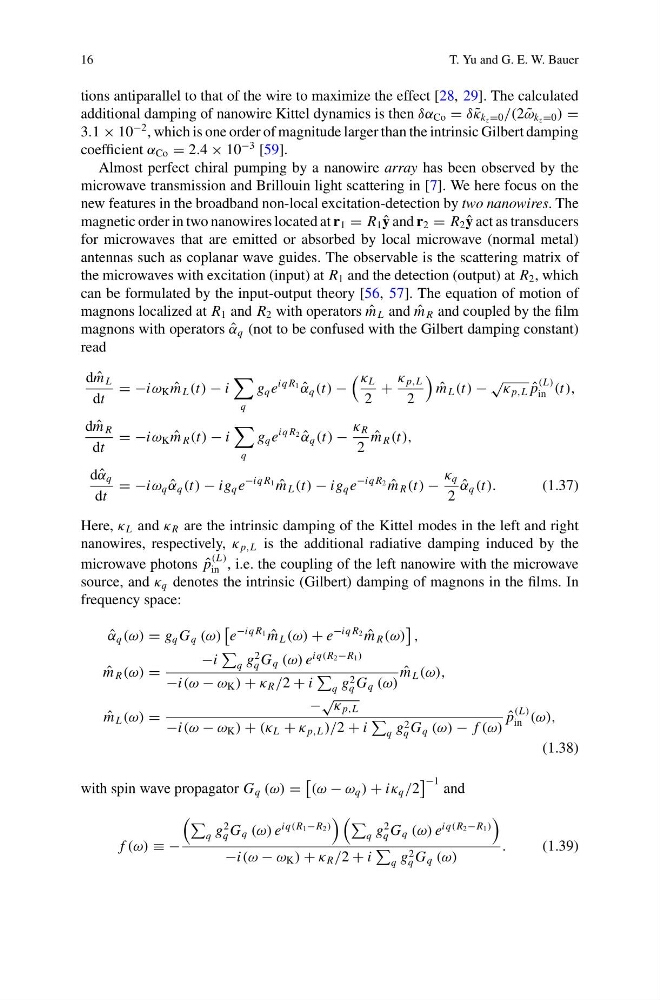
can be formulated by the input-output theory [56, 57]. The equation of motion of
magnons localized at R 1 and R 2 with operators ˆ
m L and ˆ
m R and coupled by the film
magnons with operators ˆ
α q (not to be confused with the Gilbert damping constant)
read
d ˆ
m L
dt
= −iω K ˆ
m L (t) − i
q
g q e
iq R 1 ˆ
α q (t) −
κ L
2
+
κ p,L
2
ˆ
m L (t) −
√ κ p,L ˆ
p
(L)
in (t),
d ˆ
m R
dt
= −iω K ˆ
m R (t) − i
q
g q e
iq R 2 ˆ
α q (t) −
κ R
2
ˆ
m R (t),
d ˆ
α q
dt
= −iω q ˆ
α q (t) − ig q e
−iq R 1 ˆ
m L (t) − ig q e
−iq R 2 ˆ
m R (t) −
κ q
2
ˆ
α q (t).
(1.37)
Here, κ L and κ R are the intrinsic damping of the Kittel modes in the left and right
nanowires, respectively, κ p,L is the additional radiative damping induced by the
microwave photons ˆ
p
(L)
in , i.e. the coupling of the left nanowire with the microwave
source, and κ q denotes the intrinsic (Gilbert) damping of magnons in the films. In
frequency space:
ˆ
α q (ω) = g q G q (ω)
e
−iq R 1 ˆ
m L (ω) + e
−iq R 2 ˆ
m R (ω)
,
ˆ
m R (ω) =
−i
q g
2
q G q (ω) e
iq(R 2 −R 1 )
−i(ω − ω K ) + κ R /2 + i
q g 2
q G q (ω)
ˆ
m L (ω),
ˆ
m L (ω) =
−
√ κ p,L
−i(ω − ω K ) + (κ L + κ p,L )/2 + i
q g 2
q G q (ω) − f (ω)
ˆ
p
(L)
in (ω),
(1.38)
with spin wave propagator G q (ω) =
(ω − ω q ) + iκ q /2
−1 and
f (ω) ≡ −
q g
2
q G q (ω) e
iq(R 1 −R 2 )
q g
2
q G q (ω) e
iq(R 2 −R 1 )
−i(ω − ω K ) + κ R /2 + i
q g 2
q G q (ω)
.
(1.39)
T. Yu and G. E. W. Bauer
tions antiparallel to that of the wire to maximize the effect [28, 29]. The calculated
additional damping of nanowire Kittel dynamics is then δα Co = δ ˜
κ k z =0 /(2 ˜
ω k z =0 ) =
3.1 × 10
−2 , which is one order of magnitude larger than the intrinsic Gilbert damping
coefficient α Co = 2.4 × 10
−3 [59].
Almost perfect chiral pumping by a nanowire array has been observed by the
microwave transmission and Brillouin light scattering in [7]. We here focus on the
new features in the broadband non-local excitation-detection by two nanowires. The
magnetic order in two nanowires located at r 1 = R 1 ˆ
y and r 2 = R 2 ˆ
y act as transducers
for microwaves that are emitted or absorbed by local microwave (normal metal)
antennas such as coplanar wave guides. The observable is the scattering matrix of
the microwaves with excitation (input) at R 1 and the detection (output) at R 2 , which
can be formulated by the input-output theory [56, 57]. The equation of motion of
magnons localized at R 1 and R 2 with operators ˆ
m L and ˆ
m R and coupled by the film
magnons with operators ˆ
α q (not to be confused with the Gilbert damping constant)
read
d ˆ
m L
dt
= −iω K ˆ
m L (t) − i
q
g q e
iq R 1 ˆ
α q (t) −
κ L
2
+
κ p,L
2
ˆ
m L (t) −
√ κ p,L ˆ
p
(L)
in (t),
d ˆ
m R
dt
= −iω K ˆ
m R (t) − i
q
g q e
iq R 2 ˆ
α q (t) −
κ R
2
ˆ
m R (t),
d ˆ
α q
dt
= −iω q ˆ
α q (t) − ig q e
−iq R 1 ˆ
m L (t) − ig q e
−iq R 2 ˆ
m R (t) −
κ q
2
ˆ
α q (t).
(1.37)
Here, κ L and κ R are the intrinsic damping of the Kittel modes in the left and right
nanowires, respectively, κ p,L is the additional radiative damping induced by the
microwave photons ˆ
p
(L)
in , i.e. the coupling of the left nanowire with the microwave
source, and κ q denotes the intrinsic (Gilbert) damping of magnons in the films. In
frequency space:
ˆ
α q (ω) = g q G q (ω)
e
−iq R 1 ˆ
m L (ω) + e
−iq R 2 ˆ
m R (ω)
,
ˆ
m R (ω) =
−i
q g
2
q G q (ω) e
iq(R 2 −R 1 )
−i(ω − ω K ) + κ R /2 + i
q g 2
q G q (ω)
ˆ
m L (ω),
ˆ
m L (ω) =
−
√ κ p,L
−i(ω − ω K ) + (κ L + κ p,L )/2 + i
q g 2
q G q (ω) − f (ω)
ˆ
p
(L)
in (ω),
(1.38)
with spin wave propagator G q (ω) =
(ω − ω q ) + iκ q /2
−1 and
f (ω) ≡ −
q g
2
q G q (ω) e
iq(R 1 −R 2 )
q g
2
q G q (ω) e
iq(R 2 −R 1 )
−i(ω − ω K ) + κ R /2 + i
q g 2
q G q (ω)
.
(1.39)