

1 Chiral Coupling to Magnetodipolar Radiation
15
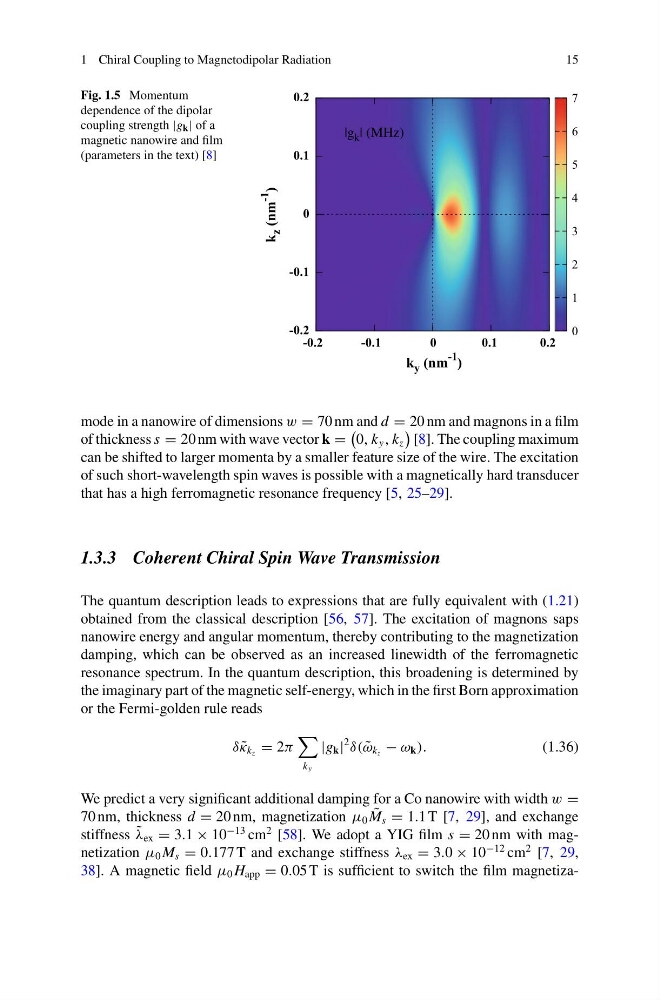
Fig. 1.5 Momentum
dependence of the dipolar
coupling strength |g k | of a
magnetic nanowire and film
(parameters in the text) [8]
|g k | (MHz)
-0.2
-0.1
0
0.1
0.2
k y (nm
-1
)
-0.2
-0.1
0
0.1
0.2
k
z (nm
-1
)
0
1
2
3
4
5
6
7
mode in a nanowire of dimensions w = 70 nm and d = 20 nm and magnons in a film
of thickness s = 20 nm with wave vector k =
0, k y , k z
[8]. The coupling maximum
can be shifted to larger momenta by a smaller feature size of the wire. The excitation
of such short-wavelength spin waves is possible with a magnetically hard transducer
that has a high ferromagnetic resonance frequency [5, 25–29].
1.3.3 Coherent Chiral Spin Wave Transmission
The quantum description leads to expressions that are fully equivalent with (1.21)
obtained from the classical description [56, 57]. The excitation of magnons saps
nanowire energy and angular momentum, thereby contributing to the magnetization
damping, which can be observed as an increased linewidth of the ferromagnetic
resonance spectrum. In the quantum description, this broadening is determined by
the imaginary part of the magnetic self-energy, which in the first Born approximation
or the Fermi-golden rule reads
δ ˜
κ k z = 2π
k y
|g k |
2
δ( ˜
ω k z − ω k ).
(1.36)
We predict a very significant additional damping for a Co nanowire with width w =
70 nm, thickness d = 20 nm, magnetization μ 0 ˜
M s = 1.1 T [7, 29], and exchange
stiffness ˜
λ ex = 3.1 × 10
−13 cm
2 [58]. We adopt a YIG film s = 20 nm with magnetization μ 0 M s = 0.177 T and exchange stiffness λ ex = 3.0 × 10
−12 cm
2 [7, 29,
38]. A magnetic field μ 0 H app = 0.05 T is sufficient to switch the film magnetiza-
15
Fig. 1.5 Momentum
dependence of the dipolar
coupling strength |g k | of a
magnetic nanowire and film
(parameters in the text) [8]
|g k | (MHz)
-0.2
-0.1
0
0.1
0.2
k y (nm
-1
)
-0.2
-0.1
0
0.1
0.2
k
z (nm
-1
)
0
1
2
3
4
5
6
7
mode in a nanowire of dimensions w = 70 nm and d = 20 nm and magnons in a film
of thickness s = 20 nm with wave vector k =
0, k y , k z
[8]. The coupling maximum
can be shifted to larger momenta by a smaller feature size of the wire. The excitation
of such short-wavelength spin waves is possible with a magnetically hard transducer
that has a high ferromagnetic resonance frequency [5, 25–29].
1.3.3 Coherent Chiral Spin Wave Transmission
The quantum description leads to expressions that are fully equivalent with (1.21)
obtained from the classical description [56, 57]. The excitation of magnons saps
nanowire energy and angular momentum, thereby contributing to the magnetization
damping, which can be observed as an increased linewidth of the ferromagnetic
resonance spectrum. In the quantum description, this broadening is determined by
the imaginary part of the magnetic self-energy, which in the first Born approximation
or the Fermi-golden rule reads
δ ˜
κ k z = 2π
k y
|g k |
2
δ( ˜
ω k z − ω k ).
(1.36)
We predict a very significant additional damping for a Co nanowire with width w =
70 nm, thickness d = 20 nm, magnetization μ 0 ˜
M s = 1.1 T [7, 29], and exchange
stiffness ˜
λ ex = 3.1 × 10
−13 cm
2 [58]. We adopt a YIG film s = 20 nm with magnetization μ 0 M s = 0.177 T and exchange stiffness λ ex = 3.0 × 10
−12 cm
2 [7, 29,
38]. A magnetic field μ 0 H app = 0.05 T is sufficient to switch the film magnetiza-