

13 Theoretical Generalization of the Optical Chirality to Arbitrary Optical Media
335
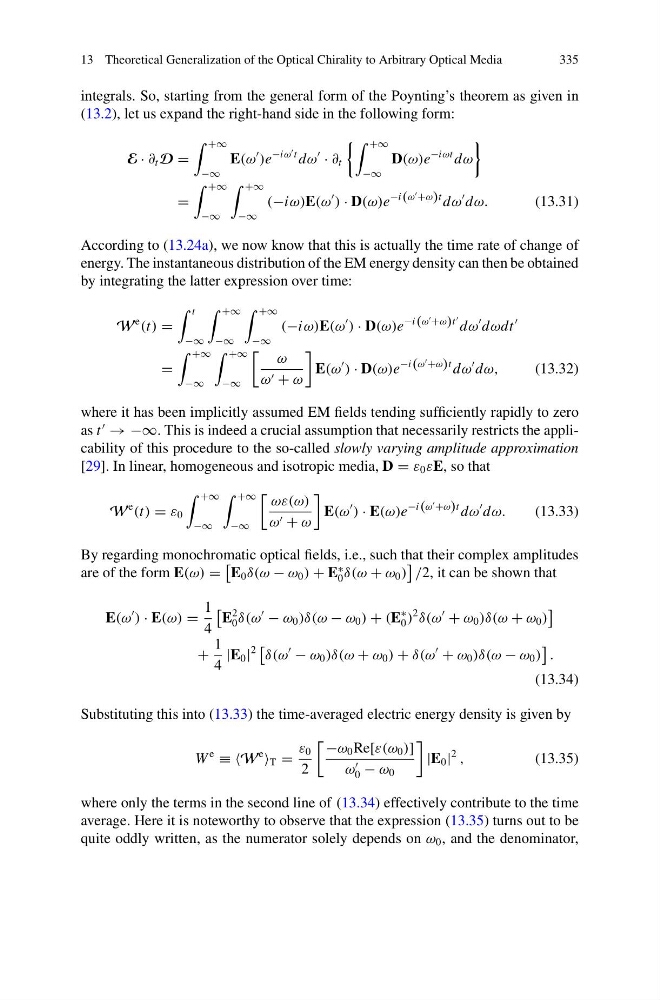
integrals. So, starting from the general form of the Poynting’s theorem as given in
(13.2), let us expand the right-hand side in the following form:
E · ∂ t D =
+∞
−∞
E(ω
)e
−iω
t dω
· ∂ t
+∞
−∞
D(ω)e
−iωt dω
=
+∞
−∞
+∞
−∞
(−iω)E(ω
) · D(ω)e
−i(ω
+ω)t dω
dω.
(13.31)
According to (13.24a), we now know that this is actually the time rate of change of
energy. The instantaneous distribution of the EM energy density can then be obtained
by integrating the latter expression over time:
W
e
(t) =
t
−∞
+∞
−∞
+∞
−∞
(−iω)E(ω
) · D(ω)e
−i(ω
+ω)t
dω
dωdt
=
+∞
−∞
+∞
−∞
ω
ω + ω
E(ω
) · D(ω)e
−i(ω
+ω)t dω
dω,
(13.32)
where it has been implicitly assumed EM fields tending sufficiently rapidly to zero
as t
→ −∞. This is indeed a crucial assumption that necessarily restricts the applicability of this procedure to the so-called slowly varying amplitude approximation
[29]. In linear, homogeneous and isotropic media, D = ε 0 εE, so that
W
e
(t) = ε 0
+∞
−∞
+∞
−∞
ωε(ω)
ω + ω
E(ω
) · E(ω)e
−i(ω
+ω)t dω
dω.
(13.33)
By regarding monochromatic optical fields, i.e., such that their complex amplitudes
are of the form E(ω) =
E 0 δ(ω − ω 0 ) + E
∗
0 δ(ω + ω 0 )
/2, it can be shown that
E(ω
) · E(ω) =
1
4
E
2
0 δ(ω
− ω 0 )δ(ω − ω 0 ) + (E
∗
0 )
2
δ(ω
+ ω 0 )δ(ω + ω 0 )
+
1
4
|E 0 |
2
δ(ω
− ω 0 )δ(ω + ω 0 ) + δ(ω
+ ω 0 )δ(ω − ω 0 )
.
(13.34)
Substituting this into (13.33) the time-averaged electric energy density is given by
W
e
≡ ≡W
e
T =
ε 0
2
−ω 0 Re[ε(ω 0 )]
ω
0 − ω 0
|E 0 |
2
,
(13.35)
where only the terms in the second line of (13.34) effectively contribute to the time
average. Here it is noteworthy to observe that the expression (13.35) turns out to be
quite oddly written, as the numerator solely depends on ω 0 , and the denominator,
335
integrals. So, starting from the general form of the Poynting’s theorem as given in
(13.2), let us expand the right-hand side in the following form:
E · ∂ t D =
+∞
−∞
E(ω
)e
−iω
t dω
· ∂ t
+∞
−∞
D(ω)e
−iωt dω
=
+∞
−∞
+∞
−∞
(−iω)E(ω
) · D(ω)e
−i(ω
+ω)t dω
dω.
(13.31)
According to (13.24a), we now know that this is actually the time rate of change of
energy. The instantaneous distribution of the EM energy density can then be obtained
by integrating the latter expression over time:
W
e
(t) =
t
−∞
+∞
−∞
+∞
−∞
(−iω)E(ω
) · D(ω)e
−i(ω
+ω)t
dω
dωdt
=
+∞
−∞
+∞
−∞
ω
ω + ω
E(ω
) · D(ω)e
−i(ω
+ω)t dω
dω,
(13.32)
where it has been implicitly assumed EM fields tending sufficiently rapidly to zero
as t
→ −∞. This is indeed a crucial assumption that necessarily restricts the applicability of this procedure to the so-called slowly varying amplitude approximation
[29]. In linear, homogeneous and isotropic media, D = ε 0 εE, so that
W
e
(t) = ε 0
+∞
−∞
+∞
−∞
ωε(ω)
ω + ω
E(ω
) · E(ω)e
−i(ω
+ω)t dω
dω.
(13.33)
By regarding monochromatic optical fields, i.e., such that their complex amplitudes
are of the form E(ω) =
E 0 δ(ω − ω 0 ) + E
∗
0 δ(ω + ω 0 )
/2, it can be shown that
E(ω
) · E(ω) =
1
4
E
2
0 δ(ω
− ω 0 )δ(ω − ω 0 ) + (E
∗
0 )
2
δ(ω
+ ω 0 )δ(ω + ω 0 )
+
1
4
|E 0 |
2
δ(ω
− ω 0 )δ(ω + ω 0 ) + δ(ω
+ ω 0 )δ(ω − ω 0 )
.
(13.34)
Substituting this into (13.33) the time-averaged electric energy density is given by
W
e
≡ ≡W
e
T =
ε 0
2
−ω 0 Re[ε(ω 0 )]
ω
0 − ω 0
|E 0 |
2
,
(13.35)
where only the terms in the second line of (13.34) effectively contribute to the time
average. Here it is noteworthy to observe that the expression (13.35) turns out to be
quite oddly written, as the numerator solely depends on ω 0 , and the denominator,