

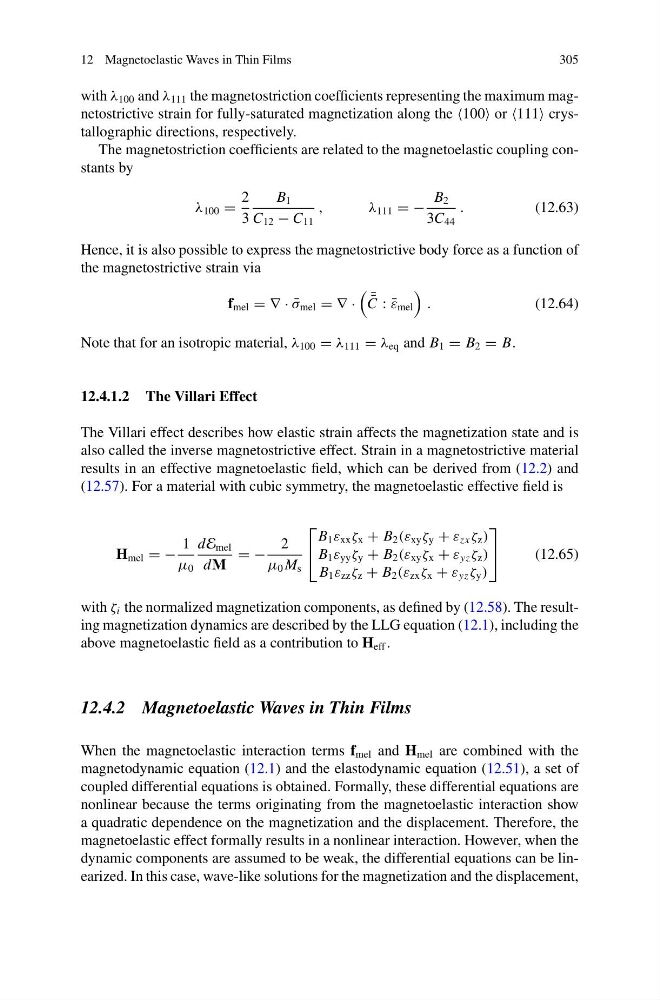
12 Magnetoelastic Waves in Thin Films
305
with λ 100 and λ 111 the magnetostriction coefficients representing the maximum magnetostrictive strain for fully-saturated magnetization along the 100 or 111 crystallographic directions, respectively.
The magnetostriction coefficients are related to the magnetoelastic coupling constants by
λ 100 =
2
3
B 1
C 12 − C 11
,
λ 111 = −
B 2
3C 44
.
(12.63)
Hence, it is also possible to express the magnetostrictive body force as a function of
the magnetostrictive strain via
f mel = ∇ · ¯
σ mel = ∇ ·
¯ ¯
C : ¯
ε mel
.
(12.64)
Note that for an isotropic material, λ 100 = λ 111 = λ eq and B 1 = B 2 = B.
12.4.1.2 The Villari Effect
The Villari effect describes how elastic strain affects the magnetization state and is
also called the inverse magnetostrictive effect. Strain in a magnetostrictive material
results in an effective magnetoelastic field, which can be derived from (12.2) and
(12.57). For a material with cubic symmetry, the magnetoelastic effective field is
H mel = −
1
μ 0
dE mel
dM
= −
2
μ 0 M s
⎡
⎣
B 1 ε xx ζ x + B 2 (ε xy ζ y + ε zx ζ z )
B 1 ε yy ζ y + B 2 (ε xy ζ x + ε yz ζ z )
B 1 ε zz ζ z + B 2 (ε zx ζ x + ε yz ζ y )
⎤
⎦
(12.65)
with ζ i the normalized magnetization components, as defined by (12.58). The resulting magnetization dynamics are described by the LLG equation (12.1), including the
above magnetoelastic field as a contribution to H eff .
12.4.2 Magnetoelastic Waves in Thin Films
When the magnetoelastic interaction terms f mel and H mel are combined with the
magnetodynamic equation (12.1) and the elastodynamic equation (12.51), a set of
coupled differential equations is obtained. Formally, these differential equations are
nonlinear because the terms originating from the magnetoelastic interaction show
a quadratic dependence on the magnetization and the displacement. Therefore, the
magnetoelastic effect formally results in a nonlinear interaction. However, when the
dynamic components are assumed to be weak, the differential equations can be linearized. In this case, wave-like solutions for the magnetization and the displacement,
305
with λ 100 and λ 111 the magnetostriction coefficients representing the maximum magnetostrictive strain for fully-saturated magnetization along the 100 or 111 crystallographic directions, respectively.
The magnetostriction coefficients are related to the magnetoelastic coupling constants by
λ 100 =
2
3
B 1
C 12 − C 11
,
λ 111 = −
B 2
3C 44
.
(12.63)
Hence, it is also possible to express the magnetostrictive body force as a function of
the magnetostrictive strain via
f mel = ∇ · ¯
σ mel = ∇ ·
¯ ¯
C : ¯
ε mel
.
(12.64)
Note that for an isotropic material, λ 100 = λ 111 = λ eq and B 1 = B 2 = B.
12.4.1.2 The Villari Effect
The Villari effect describes how elastic strain affects the magnetization state and is
also called the inverse magnetostrictive effect. Strain in a magnetostrictive material
results in an effective magnetoelastic field, which can be derived from (12.2) and
(12.57). For a material with cubic symmetry, the magnetoelastic effective field is
H mel = −
1
μ 0
dE mel
dM
= −
2
μ 0 M s
⎡
⎣
B 1 ε xx ζ x + B 2 (ε xy ζ y + ε zx ζ z )
B 1 ε yy ζ y + B 2 (ε xy ζ x + ε yz ζ z )
B 1 ε zz ζ z + B 2 (ε zx ζ x + ε yz ζ y )
⎤
⎦
(12.65)
with ζ i the normalized magnetization components, as defined by (12.58). The resulting magnetization dynamics are described by the LLG equation (12.1), including the
above magnetoelastic field as a contribution to H eff .
12.4.2 Magnetoelastic Waves in Thin Films
When the magnetoelastic interaction terms f mel and H mel are combined with the
magnetodynamic equation (12.1) and the elastodynamic equation (12.51), a set of
coupled differential equations is obtained. Formally, these differential equations are
nonlinear because the terms originating from the magnetoelastic interaction show
a quadratic dependence on the magnetization and the displacement. Therefore, the
magnetoelastic effect formally results in a nonlinear interaction. However, when the
dynamic components are assumed to be weak, the differential equations can be linearized. In this case, wave-like solutions for the magnetization and the displacement,