

270
M. Sato
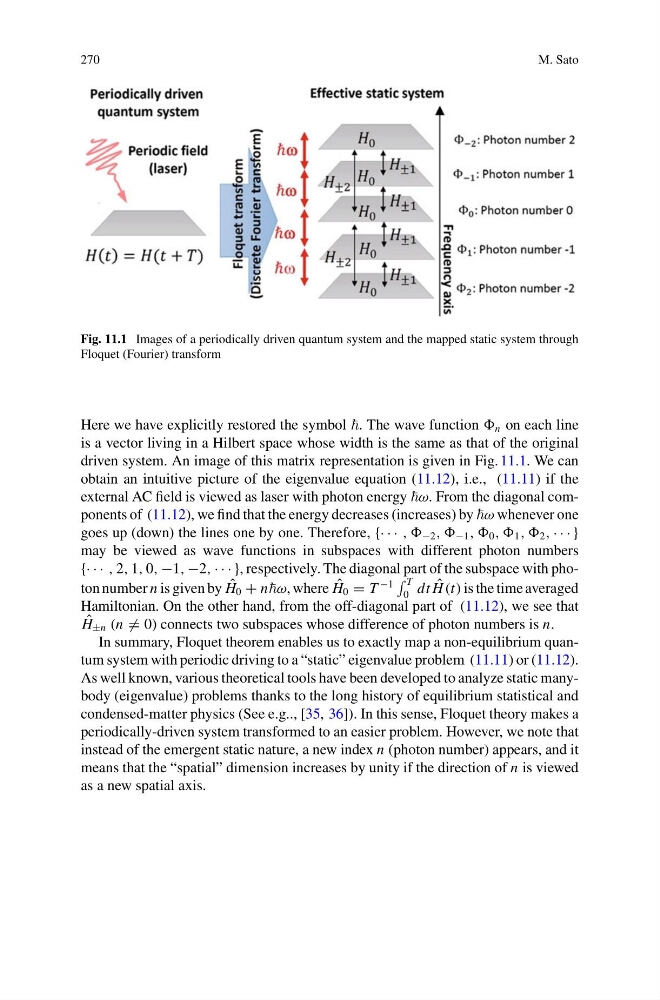
Fig. 11.1 Images of a periodically driven quantum system and the mapped static system through
Floquet (Fourier) transform
Here we have explicitly restored the symbol . The wave function n on each line
is a vector living in a Hilbert space whose width is the same as that of the original
driven system. An image of this matrix representation is given in Fig. 11.1. We can
obtain an intuitive picture of the eigenvalue equation (11.12), i.e., (11.11) if the
external AC field is viewed as laser with photon energy ω. From the diagonal components of (11.12), we find that the energy decreases (increases) by ω whenever one
goes up (down) the lines one by one. Therefore, {· · · , , −2 , , −1 , , 0 , , 1 , , 2 , · · · }
may be viewed as wave functions in subspaces with different photon numbers
{· · · , 2, 1, 0, −1, −2, · · · }, respectively. The diagonal part of the subspace with photon number n is given by ˆ
H 0 + nω, where ˆ
H 0 = T
−1
T
0 dt ˆ
H (t) is the time averaged
Hamiltonian. On the other hand, from the off-diagonal part of (11.12), we see that
ˆ
H ±n (n = 0) connects two subspaces whose difference of photon numbers is n.
In summary, Floquet theorem enables us to exactly map a non-equilibrium quantum system with periodic driving to a “static” eigenvalue problem (11.11) or (11.12).
As well known, various theoretical tools have been developed to analyze static manybody (eigenvalue) problems thanks to the long history of equilibrium statistical and
condensed-matter physics (See e.g.., [35, 36]). In this sense, Floquet theory makes a
periodically-driven system transformed to an easier problem. However, we note that
instead of the emergent static nature, a new index n (photon number) appears, and it
means that the “spatial” dimension increases by unity if the direction of n is viewed
as a new spatial axis.
M. Sato
Fig. 11.1 Images of a periodically driven quantum system and the mapped static system through
Floquet (Fourier) transform
Here we have explicitly restored the symbol . The wave function n on each line
is a vector living in a Hilbert space whose width is the same as that of the original
driven system. An image of this matrix representation is given in Fig. 11.1. We can
obtain an intuitive picture of the eigenvalue equation (11.12), i.e., (11.11) if the
external AC field is viewed as laser with photon energy ω. From the diagonal components of (11.12), we find that the energy decreases (increases) by ω whenever one
goes up (down) the lines one by one. Therefore, {· · · , , −2 , , −1 , , 0 , , 1 , , 2 , · · · }
may be viewed as wave functions in subspaces with different photon numbers
{· · · , 2, 1, 0, −1, −2, · · · }, respectively. The diagonal part of the subspace with photon number n is given by ˆ
H 0 + nω, where ˆ
H 0 = T
−1
T
0 dt ˆ
H (t) is the time averaged
Hamiltonian. On the other hand, from the off-diagonal part of (11.12), we see that
ˆ
H ±n (n = 0) connects two subspaces whose difference of photon numbers is n.
In summary, Floquet theorem enables us to exactly map a non-equilibrium quantum system with periodic driving to a “static” eigenvalue problem (11.11) or (11.12).
As well known, various theoretical tools have been developed to analyze static manybody (eigenvalue) problems thanks to the long history of equilibrium statistical and
condensed-matter physics (See e.g.., [35, 36]). In this sense, Floquet theory makes a
periodically-driven system transformed to an easier problem. However, we note that
instead of the emergent static nature, a new index n (photon number) appears, and it
means that the “spatial” dimension increases by unity if the direction of n is viewed
as a new spatial axis.