

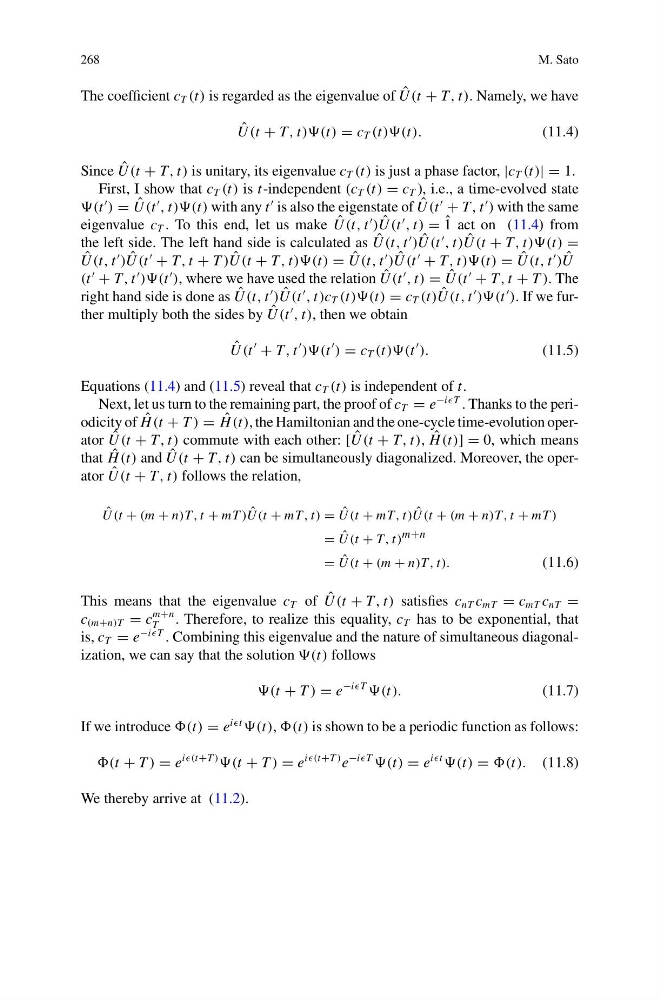
268
M. Sato
The coefficient c T (t) is regarded as the eigenvalue of ˆ
U (t + T, t). Namely, we have
ˆ
U (t + T, t))(t) = c T (t))(t).
(11.4)
Since ˆ
U (t + T, t) is unitary, its eigenvalue c T (t) is just a phase factor, |c T (t)| = 1.
First, I show that c T (t) is t-independent (c T (t) = c T ), i.e., a time-evolved state
(t
) = ˆ
U (t
, t))(t) with any t
is also the eigenstate of ˆ
U (t
+ T, t
) with the same
eigenvalue c T . To this end, let us make ˆ
U (t, t
) ˆ
U (t
, t) = ˆ
1 act on (11.4) from
the left side. The left hand side is calculated as ˆ
U (t, t
) ˆ
U (t
, t) ˆ
U (t + T, t))(t) =
ˆ
U (t, t
) ˆ
U (t
+ T, t + T ) ˆ
U (t + T, t))(t) = ˆ
U (t, t
) ˆ
U (t
+ T, t))(t) = ˆ
U (t, t
) ˆ
U
(t
+ T, t
))(t
), where we have used the relation ˆ
U (t
, t) = ˆ
U (t
+ T, t + T ). The
right hand side is done as ˆ
U (t, t
) ˆ
U (t
, t)c T (t))(t) = c T (t) ˆ
U (t, t
))(t
). If we further multiply both the sides by ˆ
U (t
, t), then we obtain
ˆ
U (t
+ T, t
))(t
) = c T (t))(t
).
(11.5)
Equations (11.4) and (11.5) reveal that c T (t) is independent of t.
Next, let us turn to the remaining part, the proof of c T = e
−iT . Thanks to the periodicity of ˆ
H (t + T ) = ˆ
H (t), the Hamiltonian and the one-cycle time-evolution operator ˆ
U (t + T, t) commute with each other: [ ˆ
U (t + T, t), ˆ
H (t)] = 0, which means
that ˆ
H (t) and ˆ
U (t + T, t) can be simultaneously diagonalized. Moreover, the operator ˆ
U (t + T, t) follows the relation,
ˆ
U (t + (m + n)T, t + mT ) ˆ
U (t + mT, t) = ˆ
U (t + mT, t) ˆ
U (t + (m + n)T, t + mT )
= ˆ
U (t + T, t) m+n
= ˆ
U (t + (m + n)T, t).
(11.6)
This means that the eigenvalue c T of ˆ
U (t + T, t) satisfies c nT c mT = c mT c nT =
c (m+n)T = c
m+n
T
. Therefore, to realize this equality, c T has to be exponential, that
is, c T = e
−iT . Combining this eigenvalue and the nature of simultaneous diagonalization, we can say that the solution (t) follows
(t + T ) = e
−iT
(t).
(11.7)
If we introduce (t) = e
it
(t), (t) is shown to be a periodic function as follows:
(t + T ) = e
i(t+T )
(t + T ) = e
i(t+T ) e
−iT
(t) = e
it
(t) = (t). (11.8)
We thereby arrive at (11.2).
M. Sato
The coefficient c T (t) is regarded as the eigenvalue of ˆ
U (t + T, t). Namely, we have
ˆ
U (t + T, t))(t) = c T (t))(t).
(11.4)
Since ˆ
U (t + T, t) is unitary, its eigenvalue c T (t) is just a phase factor, |c T (t)| = 1.
First, I show that c T (t) is t-independent (c T (t) = c T ), i.e., a time-evolved state
(t
) = ˆ
U (t
, t))(t) with any t
is also the eigenstate of ˆ
U (t
+ T, t
) with the same
eigenvalue c T . To this end, let us make ˆ
U (t, t
) ˆ
U (t
, t) = ˆ
1 act on (11.4) from
the left side. The left hand side is calculated as ˆ
U (t, t
) ˆ
U (t
, t) ˆ
U (t + T, t))(t) =
ˆ
U (t, t
) ˆ
U (t
+ T, t + T ) ˆ
U (t + T, t))(t) = ˆ
U (t, t
) ˆ
U (t
+ T, t))(t) = ˆ
U (t, t
) ˆ
U
(t
+ T, t
))(t
), where we have used the relation ˆ
U (t
, t) = ˆ
U (t
+ T, t + T ). The
right hand side is done as ˆ
U (t, t
) ˆ
U (t
, t)c T (t))(t) = c T (t) ˆ
U (t, t
))(t
). If we further multiply both the sides by ˆ
U (t
, t), then we obtain
ˆ
U (t
+ T, t
))(t
) = c T (t))(t
).
(11.5)
Equations (11.4) and (11.5) reveal that c T (t) is independent of t.
Next, let us turn to the remaining part, the proof of c T = e
−iT . Thanks to the periodicity of ˆ
H (t + T ) = ˆ
H (t), the Hamiltonian and the one-cycle time-evolution operator ˆ
U (t + T, t) commute with each other: [ ˆ
U (t + T, t), ˆ
H (t)] = 0, which means
that ˆ
H (t) and ˆ
U (t + T, t) can be simultaneously diagonalized. Moreover, the operator ˆ
U (t + T, t) follows the relation,
ˆ
U (t + (m + n)T, t + mT ) ˆ
U (t + mT, t) = ˆ
U (t + mT, t) ˆ
U (t + (m + n)T, t + mT )
= ˆ
U (t + T, t) m+n
= ˆ
U (t + (m + n)T, t).
(11.6)
This means that the eigenvalue c T of ˆ
U (t + T, t) satisfies c nT c mT = c mT c nT =
c (m+n)T = c
m+n
T
. Therefore, to realize this equality, c T has to be exponential, that
is, c T = e
−iT . Combining this eigenvalue and the nature of simultaneous diagonalization, we can say that the solution (t) follows
(t + T ) = e
−iT
(t).
(11.7)
If we introduce (t) = e
it
(t), (t) is shown to be a periodic function as follows:
(t + T ) = e
i(t+T )
(t + T ) = e
i(t+T ) e
−iT
(t) = e
it
(t) = (t). (11.8)
We thereby arrive at (11.2).