

250
Y. Yang et al.
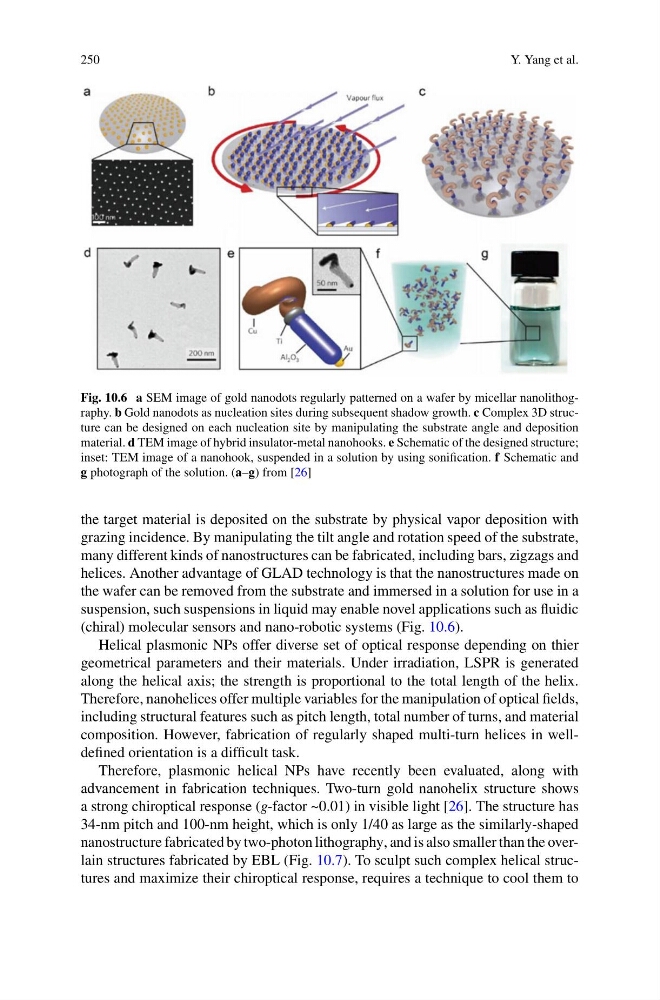
Fig. 10.6 a SEM image of gold nanodots regularly patterned on a wafer by micellar nanolithography. b Gold nanodots as nucleation sites during subsequent shadow growth. c Complex 3D structure can be designed on each nucleation site by manipulating the substrate angle and deposition
material. d TEM image of hybrid insulator-metal nanohooks. e Schematic of the designed structure;
inset: TEM image of a nanohook, suspended in a solution by using sonification. f Schematic and
g photograph of the solution. (a–g) from [26]
the target material is deposited on the substrate by physical vapor deposition with
grazing incidence. By manipulating the tilt angle and rotation speed of the substrate,
many different kinds of nanostructures can be fabricated, including bars, zigzags and
helices. Another advantage of GLAD technology is that the nanostructures made on
the wafer can be removed from the substrate and immersed in a solution for use in a
suspension, such suspensions in liquid may enable novel applications such as fluidic
(chiral) molecular sensors and nano-robotic systems (Fig. 10.6).
Helical plasmonic NPs offer diverse set of optical response depending on thier
geometrical parameters and their materials. Under irradiation, LSPR is generated
along the helical axis; the strength is proportional to the total length of the helix.
Therefore, nanohelices offer multiple variables for the manipulation of optical fields,
including structural features such as pitch length, total number of turns, and material
composition. However, fabrication of regularly shaped multi-turn helices in welldefined orientation is a difficult task.
Therefore, plasmonic helical NPs have recently been evaluated, along with
advancement in fabrication techniques. Two-turn gold nanohelix structure shows
a strong chiroptical response (g-factor ~0.01) in visible light [26]. The structure has
34-nm pitch and 100-nm height, which is only 1/40 as large as the similarly-shaped
nanostructure fabricated by two-photon lithography, and is also smaller than the overlain structures fabricated by EBL (Fig. 10.7). To sculpt such complex helical structures and maximize their chiroptical response, requires a technique to cool them to
Y. Yang et al.
Fig. 10.6 a SEM image of gold nanodots regularly patterned on a wafer by micellar nanolithography. b Gold nanodots as nucleation sites during subsequent shadow growth. c Complex 3D structure can be designed on each nucleation site by manipulating the substrate angle and deposition
material. d TEM image of hybrid insulator-metal nanohooks. e Schematic of the designed structure;
inset: TEM image of a nanohook, suspended in a solution by using sonification. f Schematic and
g photograph of the solution. (a–g) from [26]
the target material is deposited on the substrate by physical vapor deposition with
grazing incidence. By manipulating the tilt angle and rotation speed of the substrate,
many different kinds of nanostructures can be fabricated, including bars, zigzags and
helices. Another advantage of GLAD technology is that the nanostructures made on
the wafer can be removed from the substrate and immersed in a solution for use in a
suspension, such suspensions in liquid may enable novel applications such as fluidic
(chiral) molecular sensors and nano-robotic systems (Fig. 10.6).
Helical plasmonic NPs offer diverse set of optical response depending on thier
geometrical parameters and their materials. Under irradiation, LSPR is generated
along the helical axis; the strength is proportional to the total length of the helix.
Therefore, nanohelices offer multiple variables for the manipulation of optical fields,
including structural features such as pitch length, total number of turns, and material
composition. However, fabrication of regularly shaped multi-turn helices in welldefined orientation is a difficult task.
Therefore, plasmonic helical NPs have recently been evaluated, along with
advancement in fabrication techniques. Two-turn gold nanohelix structure shows
a strong chiroptical response (g-factor ~0.01) in visible light [26]. The structure has
34-nm pitch and 100-nm height, which is only 1/40 as large as the similarly-shaped
nanostructure fabricated by two-photon lithography, and is also smaller than the overlain structures fabricated by EBL (Fig. 10.7). To sculpt such complex helical structures and maximize their chiroptical response, requires a technique to cool them to