

236
I. Proskurin and R. L. Stamps
9.5 Conclusions
We have discussed how symmetry analysis can help to bring new ideas from optics
to antiferromagnetic spintronics. Our discussion started with an observation that a
formal similarity between the electromagnetic field and spin waves in an antiferromagnetic insulator allows to find a generalization of optical chirality. This forms
a background for establishing a link between optics of chiral metamaterials and
magnonics. For example, spin wave absorption in chiral antiferromagnets can be
described in the same terms as the electromagnetic energy dissipation in metamaterials. Moreover, in antiferromagnets a pure spin current can provide a chiral symmetry
breaking in a controllable way through the spin torque mechanism.
Fundamentally, this follows from the fact that spin currents are truly chiral; they
have the same PT transformation properties as e.g. optical chirality density. The
latter suggests that chiral electromagnetic fields can be used for magnon spin current
generation. We discussed that a direct magnon spin current appears as a second-order
response to the circularly polarized microwave field, which frequency is near the
antiferromagnetic resonance. The direction of the current is determined by helicity
of light that makes it similar to the circular photogalvanic effect in metals.
Lastly, we discuss how magnon spin currents in antiferromagnets have an interesting dynamics that can come into play for photo-excitation. Besides the transport
terms proportional to the group velocity of the spin waves, there is a contribution
from the trembling motion of magnons, which can be identified by analogy with
motion of ultra-relativistic particles. Although these fast oscillating terms can be
safely omitted in some applications, they contribute to the photo-excitation process.
Acknowledgements R.L.S. acknowledges the support of the Natural Sciences and Engineering
Research Council of Canada (NSERC) RGPIN 05011-18.
Appendix: Magnon Spin Current Definition from the
Antiferromagnetic Lagrangian
Let us consider a classical spin model for an antiferromagnet with two sublattices
S A and S B with the energy given by
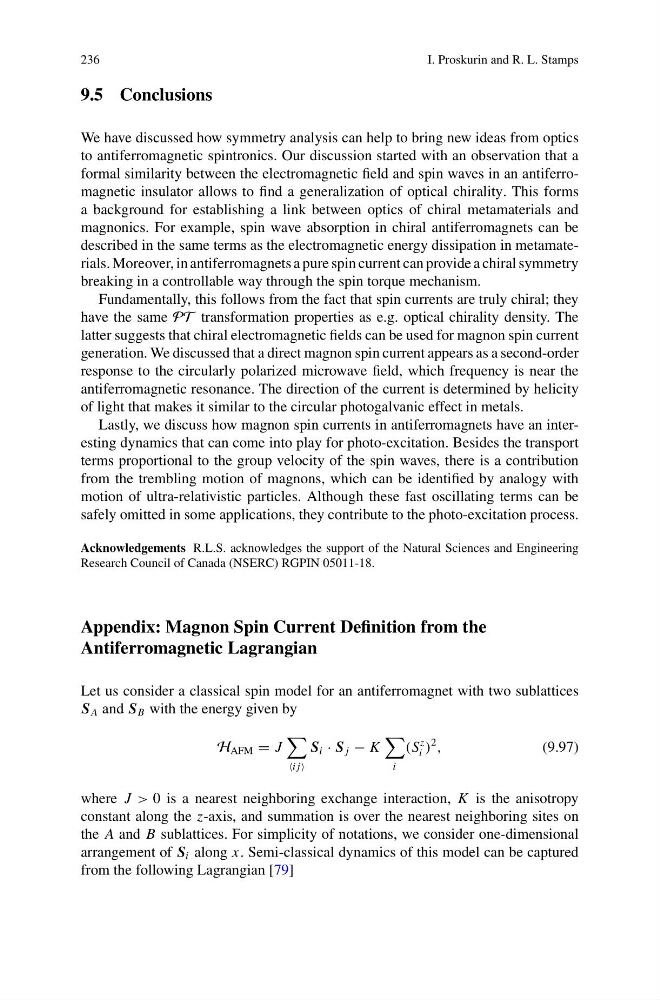
H AFM = J
i j
S i · S j − K
i
(S
z
i )
2
,
(9.97)
where J > 0 is a nearest neighboring exchange interaction, K is the anisotropy
constant along the z-axis, and summation is over the nearest neighboring sites on
the A and B sublattices. For simplicity of notations, we consider one-dimensional
arrangement of S i along x. Semi-classical dynamics of this model can be captured
from the following Lagrangian [79]
I. Proskurin and R. L. Stamps
9.5 Conclusions
We have discussed how symmetry analysis can help to bring new ideas from optics
to antiferromagnetic spintronics. Our discussion started with an observation that a
formal similarity between the electromagnetic field and spin waves in an antiferromagnetic insulator allows to find a generalization of optical chirality. This forms
a background for establishing a link between optics of chiral metamaterials and
magnonics. For example, spin wave absorption in chiral antiferromagnets can be
described in the same terms as the electromagnetic energy dissipation in metamaterials. Moreover, in antiferromagnets a pure spin current can provide a chiral symmetry
breaking in a controllable way through the spin torque mechanism.
Fundamentally, this follows from the fact that spin currents are truly chiral; they
have the same PT transformation properties as e.g. optical chirality density. The
latter suggests that chiral electromagnetic fields can be used for magnon spin current
generation. We discussed that a direct magnon spin current appears as a second-order
response to the circularly polarized microwave field, which frequency is near the
antiferromagnetic resonance. The direction of the current is determined by helicity
of light that makes it similar to the circular photogalvanic effect in metals.
Lastly, we discuss how magnon spin currents in antiferromagnets have an interesting dynamics that can come into play for photo-excitation. Besides the transport
terms proportional to the group velocity of the spin waves, there is a contribution
from the trembling motion of magnons, which can be identified by analogy with
motion of ultra-relativistic particles. Although these fast oscillating terms can be
safely omitted in some applications, they contribute to the photo-excitation process.
Acknowledgements R.L.S. acknowledges the support of the Natural Sciences and Engineering
Research Council of Canada (NSERC) RGPIN 05011-18.
Appendix: Magnon Spin Current Definition from the
Antiferromagnetic Lagrangian
Let us consider a classical spin model for an antiferromagnet with two sublattices
S A and S B with the energy given by
H AFM = J
i j
S i · S j − K
i
(S
z
i )
2
,
(9.97)
where J > 0 is a nearest neighboring exchange interaction, K is the anisotropy
constant along the z-axis, and summation is over the nearest neighboring sites on
the A and B sublattices. For simplicity of notations, we consider one-dimensional
arrangement of S i along x. Semi-classical dynamics of this model can be captured
from the following Lagrangian [79]