

230
I. Proskurin and R. L. Stamps
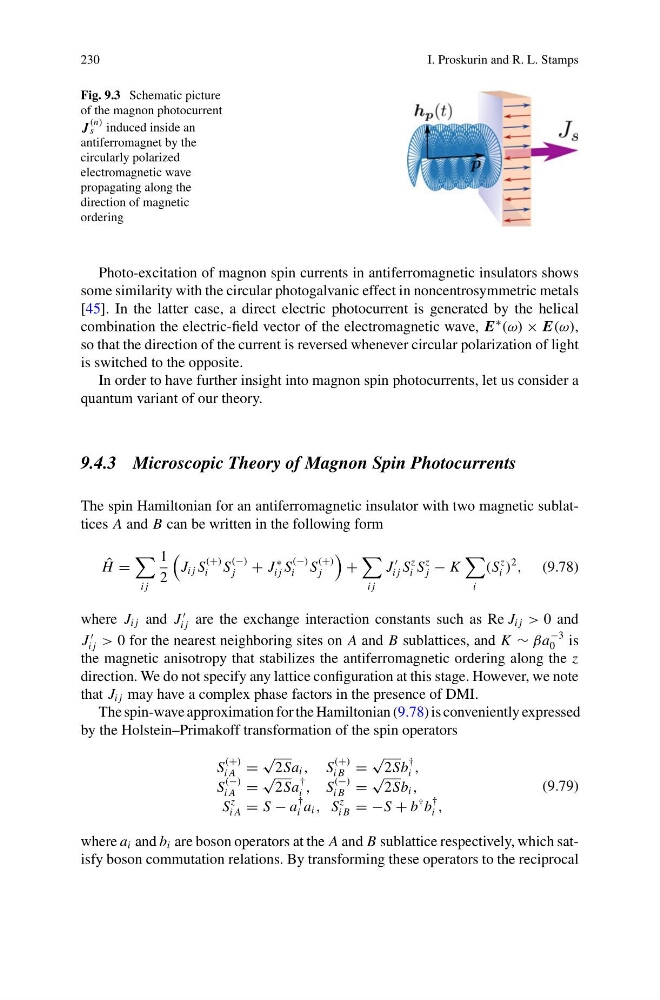
Fig. 9.3 Schematic picture
of the magnon photocurrent
J
(n)
s induced inside an
antiferromagnet by the
circularly polarized
electromagnetic wave
propagating along the
direction of magnetic
ordering
Photo-excitation of magnon spin currents in antiferromagnetic insulators shows
some similarity with the circular photogalvanic effect in noncentrosymmetric metals
[45]. In the latter case, a direct electric photocurrent is generated by the helical
combination the electric-field vector of the electromagnetic wave, E
∗
(ω) × E(ω),
so that the direction of the current is reversed whenever circular polarization of light
is switched to the opposite.
In order to have further insight into magnon spin photocurrents, let us consider a
quantum variant of our theory.
9.4.3 Microscopic Theory of Magnon Spin Photocurrents
The spin Hamiltonian for an antiferromagnetic insulator with two magnetic sublattices A and B can be written in the following form
ˆ
H =
i j
1
2
J i j S
(+)
i S
(−)
j
+ J
∗
i j S
(−)
i S
(+)
j
+
i j
J
i j S
z
i S
z
j − K
i
(S
z
i )
2
, (9.78)
where J i j and J
i j are the exchange interaction constants such as Re J i j > 0 and
J
i j > 0 for the nearest neighboring sites on A and B sublattices, and K ∼ βa
−3
0 is
the magnetic anisotropy that stabilizes the antiferromagnetic ordering along the z
direction. We do not specify any lattice configuration at this stage. However, we note
that J i j may have a complex phase factors in the presence of DMI.
The spin-wave approximation for the Hamiltonian (9.78) is conveniently expressed
by the Holstein–Primakoff transformation of the spin operators
S
(+)
i A =
√
2Sa i , S
(+)
i B =
√
2Sb
†
i ,
S
(−)
i A =
√
2Sa
†
i , S
(−)
i B =
√
2Sb i ,
S
z
i A = S − a
†
i a i , S
z
i B = −S + b
† b
†
i ,
(9.79)
where a i and b i are boson operators at the A and B sublattice respectively, which satisfy boson commutation relations. By transforming these operators to the reciprocal
I. Proskurin and R. L. Stamps
Fig. 9.3 Schematic picture
of the magnon photocurrent
J
(n)
s induced inside an
antiferromagnet by the
circularly polarized
electromagnetic wave
propagating along the
direction of magnetic
ordering
Photo-excitation of magnon spin currents in antiferromagnetic insulators shows
some similarity with the circular photogalvanic effect in noncentrosymmetric metals
[45]. In the latter case, a direct electric photocurrent is generated by the helical
combination the electric-field vector of the electromagnetic wave, E
∗
(ω) × E(ω),
so that the direction of the current is reversed whenever circular polarization of light
is switched to the opposite.
In order to have further insight into magnon spin photocurrents, let us consider a
quantum variant of our theory.
9.4.3 Microscopic Theory of Magnon Spin Photocurrents
The spin Hamiltonian for an antiferromagnetic insulator with two magnetic sublattices A and B can be written in the following form
ˆ
H =
i j
1
2
J i j S
(+)
i S
(−)
j
+ J
∗
i j S
(−)
i S
(+)
j
+
i j
J
i j S
z
i S
z
j − K
i
(S
z
i )
2
, (9.78)
where J i j and J
i j are the exchange interaction constants such as Re J i j > 0 and
J
i j > 0 for the nearest neighboring sites on A and B sublattices, and K ∼ βa
−3
0 is
the magnetic anisotropy that stabilizes the antiferromagnetic ordering along the z
direction. We do not specify any lattice configuration at this stage. However, we note
that J i j may have a complex phase factors in the presence of DMI.
The spin-wave approximation for the Hamiltonian (9.78) is conveniently expressed
by the Holstein–Primakoff transformation of the spin operators
S
(+)
i A =
√
2Sa i , S
(+)
i B =
√
2Sb
†
i ,
S
(−)
i A =
√
2Sa
†
i , S
(−)
i B =
√
2Sb i ,
S
z
i A = S − a
†
i a i , S
z
i B = −S + b
† b
†
i ,
(9.79)
where a i and b i are boson operators at the A and B sublattice respectively, which satisfy boson commutation relations. By transforming these operators to the reciprocal