

8 Microwave-Driven Dynamics of Magnetic Skyrmions …
195
=0
=30
=15
(a)
(b)
Im
mm
(arb. units)
FMR
0.1
0.02
0.06
=0
=30
=15
-2
-1
0
0
-0.5
0.5
x (nm)
(e)
~
D0+ D(t)
x
y
z
Hex
t=0
t=8 10
3
t=24 10
3
(c)
E
||z
H ex
x
y
z
0.1
0.02
0.06
Im
em
(arb. units)
H ex
x
y
z
H
||z
(d)
Rotation mode (CCW)
B re at hi ng m od e
Rotation
mode
(CW)
y
(nm)
=30
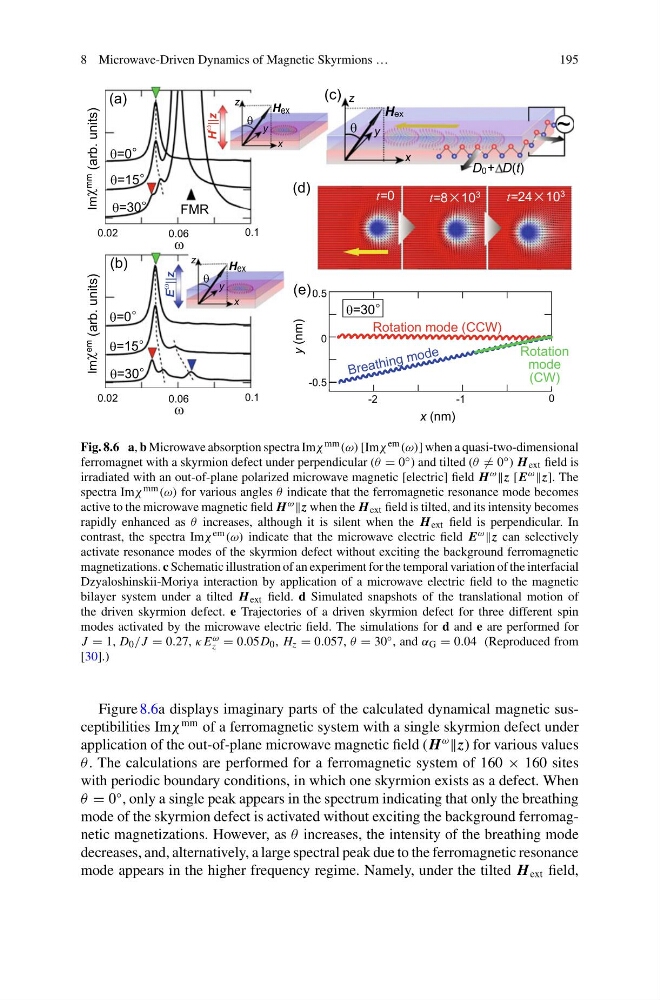
Fig. 8.6 a, b Microwave absorption spectra Imχ mm (ω) [Imχ em (ω)] when a quasi-two-dimensional
ferromagnet with a skyrmion defect under perpendicular (θ = 0 ◦ ) and tilted (θ = 0 ◦ ) H ext field is
irradiated with an out-of-plane polarized microwave magnetic [electric] field H ω [E ω The
spectra Imχ mm (ω) for various angles θ indicate that the ferromagnetic resonance mode becomes
active to the microwave magnetic field H ω when the H ext field is tilted, and its intensity becomes
rapidly enhanced as θ increases, although it is silent when the H ext field is perpendicular. In
contrast, the spectra Imχ em (ω) indicate that the microwave electric field E ω can selectively
activate resonance modes of the skyrmion defect without exciting the background ferromagnetic
magnetizations. c Schematic illustration of an experiment for the temporal variation of the interfacial
Dzyaloshinskii-Moriya interaction by application of a microwave electric field to the magnetic
bilayer system under a tilted H ext field. d Simulated snapshots of the translational motion of
the driven skyrmion defect. e Trajectories of a driven skyrmion defect for three different spin
modes activated by the microwave electric field. The simulations for d and e are performed for
J = 1, D 0 /J = 0.27, κ E ω
z = 0.05D 0 , H z = 0.057, θ = 30 ◦ , and α G = 0.04 (Reproduced from
[30].)
Figure 8.6a displays imaginary parts of the calculated dynamical magnetic susceptibilities Imχ
mm of a ferromagnetic system with a single skyrmion defect under
application of the out-of-plane microwave magnetic field (H
ω
for various values
θ . The calculations are performed for a ferromagnetic system of 160 × 160 sites
with periodic boundary conditions, in which one skyrmion exists as a defect. When
θ = 0
◦ , only a single peak appears in the spectrum indicating that only the breathing
mode of the skyrmion defect is activated without exciting the background ferromagnetic magnetizations. However, as θ increases, the intensity of the breathing mode
decreases, and, alternatively, a large spectral peak due to the ferromagnetic resonance
mode appears in the higher frequency regime. Namely, under the tilted H ext field,
195
=0
=30
=15
(a)
(b)
Im
mm
(arb. units)
FMR
0.1
0.02
0.06
=0
=30
=15
-2
-1
0
0
-0.5
0.5
x (nm)
(e)
~
D0+ D(t)
x
y
z
Hex
t=0
t=8 10
3
t=24 10
3
(c)
E
||z
H ex
x
y
z
0.1
0.02
0.06
Im
em
(arb. units)
H ex
x
y
z
H
||z
(d)
Rotation mode (CCW)
B re at hi ng m od e
Rotation
mode
(CW)
y
(nm)
=30
Fig. 8.6 a, b Microwave absorption spectra Imχ mm (ω) [Imχ em (ω)] when a quasi-two-dimensional
ferromagnet with a skyrmion defect under perpendicular (θ = 0 ◦ ) and tilted (θ = 0 ◦ ) H ext field is
irradiated with an out-of-plane polarized microwave magnetic [electric] field H ω [E ω The
spectra Imχ mm (ω) for various angles θ indicate that the ferromagnetic resonance mode becomes
active to the microwave magnetic field H ω when the H ext field is tilted, and its intensity becomes
rapidly enhanced as θ increases, although it is silent when the H ext field is perpendicular. In
contrast, the spectra Imχ em (ω) indicate that the microwave electric field E ω can selectively
activate resonance modes of the skyrmion defect without exciting the background ferromagnetic
magnetizations. c Schematic illustration of an experiment for the temporal variation of the interfacial
Dzyaloshinskii-Moriya interaction by application of a microwave electric field to the magnetic
bilayer system under a tilted H ext field. d Simulated snapshots of the translational motion of
the driven skyrmion defect. e Trajectories of a driven skyrmion defect for three different spin
modes activated by the microwave electric field. The simulations for d and e are performed for
J = 1, D 0 /J = 0.27, κ E ω
z = 0.05D 0 , H z = 0.057, θ = 30 ◦ , and α G = 0.04 (Reproduced from
[30].)
Figure 8.6a displays imaginary parts of the calculated dynamical magnetic susceptibilities Imχ
mm of a ferromagnetic system with a single skyrmion defect under
application of the out-of-plane microwave magnetic field (H
ω
for various values
θ . The calculations are performed for a ferromagnetic system of 160 × 160 sites
with periodic boundary conditions, in which one skyrmion exists as a defect. When
θ = 0
◦ , only a single peak appears in the spectrum indicating that only the breathing
mode of the skyrmion defect is activated without exciting the background ferromagnetic magnetizations. However, as θ increases, the intensity of the breathing mode
decreases, and, alternatively, a large spectral peak due to the ferromagnetic resonance
mode appears in the higher frequency regime. Namely, under the tilted H ext field,