

194
M. Mochizuki
excite a vast majority of background ferromagnetic magnetizations, which hinders
the resonance modes of the skyrmion defects.
To solve this problem, it was recently proposed theoretically that isolated magnetic
skyrmions can be selectively activated using microwave electric fields without exciting ferromagnetic resonances, in contrast to conventional methods using microwave
magnetic fields. It was also demonstrated by numerical simulations that the selective
activation of a skyrmion can efficiently drive its translational motion in a ferromagnetic nanotrack under application of a tilted H ext field.
We consider a magnetic bilayer system with a ferromagnetic layer fabricated on
top of a heavy-metal layer with strong spin-orbit interaction, where the
Dzyaloshinskii-Moriya interaction becomes active at their interface due to the spatial inversion asymmetry to form Neel-type skyrmions. A tilted magnetic field
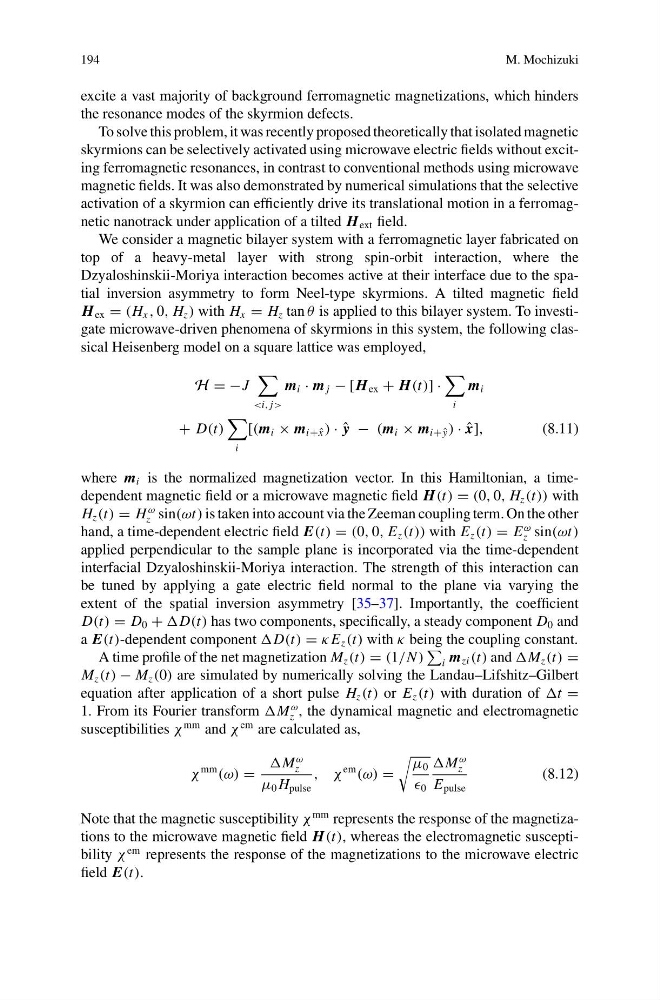
H ex = (H x , 0, H z ) with H x = H z tan θ is applied to this bilayer system. To investigate microwave-driven phenomena of skyrmions in this system, the following classical Heisenberg model on a square lattice was employed,
H = −J
m i · m j − [H ex + H(t)] ·
i
m i
+ D(t)
i
[(m i × m i+ ˆ
x ) · ˆ y − (m i × m i+ ˆ
y ) · ˆ
x],
(8.11)
where m i is the normalized magnetization vector. In this Hamiltonian, a timedependent magnetic field or a microwave magnetic field H(t) = (0, 0, H z (t)) with
H z (t) = H
ω
z sin(ωt) is taken into account via the Zeeman coupling term. On the other
hand, a time-dependent electric field E(t) = (0, 0, E z (t)) with E z (t) = E
ω
z sin(ωt)
applied perpendicular to the sample plane is incorporated via the time-dependent
interfacial Dzyaloshinskii-Moriya interaction. The strength of this interaction can
be tuned by applying a gate electric field normal to the plane via varying the
extent of the spatial inversion asymmetry [35–37]. Importantly, the coefficient
D(t) = D 0 + D(t) has two components, specifically, a steady component D 0 and
a E(t)-dependent component D(t) = κ E z (t) with κ being the coupling constant.
A time profile of the net magnetization M z (t) = (1/N )
i m zi (t) and M z (t) =
M z (t) − M z (0) are simulated by numerically solving the Landau–Lifshitz–Gilbert
equation after application of a short pulse H z (t) or E z (t) with duration of t =
1. From its Fourier transform M
ω
z , the dynamical magnetic and electromagnetic
susceptibilities χ
mm and χ
em are calculated as,
χ
mm
(ω) =
M
ω
z
μ 0 H pulse
, χ
em
(ω) =
μ 0
0
M
ω
z
E pulse
(8.12)
Note that the magnetic susceptibility χ
mm represents the response of the magnetizations to the microwave magnetic field H(t), whereas the electromagnetic susceptibility χ
em represents the response of the magnetizations to the microwave electric
field E(t).
M. Mochizuki
excite a vast majority of background ferromagnetic magnetizations, which hinders
the resonance modes of the skyrmion defects.
To solve this problem, it was recently proposed theoretically that isolated magnetic
skyrmions can be selectively activated using microwave electric fields without exciting ferromagnetic resonances, in contrast to conventional methods using microwave
magnetic fields. It was also demonstrated by numerical simulations that the selective
activation of a skyrmion can efficiently drive its translational motion in a ferromagnetic nanotrack under application of a tilted H ext field.
We consider a magnetic bilayer system with a ferromagnetic layer fabricated on
top of a heavy-metal layer with strong spin-orbit interaction, where the
Dzyaloshinskii-Moriya interaction becomes active at their interface due to the spatial inversion asymmetry to form Neel-type skyrmions. A tilted magnetic field
H ex = (H x , 0, H z ) with H x = H z tan θ is applied to this bilayer system. To investigate microwave-driven phenomena of skyrmions in this system, the following classical Heisenberg model on a square lattice was employed,
H = −J
m i · m j − [H ex + H(t)] ·
i
m i
+ D(t)
i
[(m i × m i+ ˆ
x ) · ˆ y − (m i × m i+ ˆ
y ) · ˆ
x],
(8.11)
where m i is the normalized magnetization vector. In this Hamiltonian, a timedependent magnetic field or a microwave magnetic field H(t) = (0, 0, H z (t)) with
H z (t) = H
ω
z sin(ωt) is taken into account via the Zeeman coupling term. On the other
hand, a time-dependent electric field E(t) = (0, 0, E z (t)) with E z (t) = E
ω
z sin(ωt)
applied perpendicular to the sample plane is incorporated via the time-dependent
interfacial Dzyaloshinskii-Moriya interaction. The strength of this interaction can
be tuned by applying a gate electric field normal to the plane via varying the
extent of the spatial inversion asymmetry [35–37]. Importantly, the coefficient
D(t) = D 0 + D(t) has two components, specifically, a steady component D 0 and
a E(t)-dependent component D(t) = κ E z (t) with κ being the coupling constant.
A time profile of the net magnetization M z (t) = (1/N )
i m zi (t) and M z (t) =
M z (t) − M z (0) are simulated by numerically solving the Landau–Lifshitz–Gilbert
equation after application of a short pulse H z (t) or E z (t) with duration of t =
1. From its Fourier transform M
ω
z , the dynamical magnetic and electromagnetic
susceptibilities χ
mm and χ
em are calculated as,
χ
mm
(ω) =
M
ω
z
μ 0 H pulse
, χ
em
(ω) =
μ 0
0
M
ω
z
E pulse
(8.12)
Note that the magnetic susceptibility χ
mm represents the response of the magnetizations to the microwave magnetic field H(t), whereas the electromagnetic susceptibility χ
em represents the response of the magnetizations to the microwave electric
field E(t).