

162
J. Masell and K. Everschor-Sitte
of Bloch lines are also known to lead to more complex behavior [27]. However, these
effects go beyond the scope of this introduction.
7.5.2.1 Domain Wall Motion Due to Spin-Transfer Torques
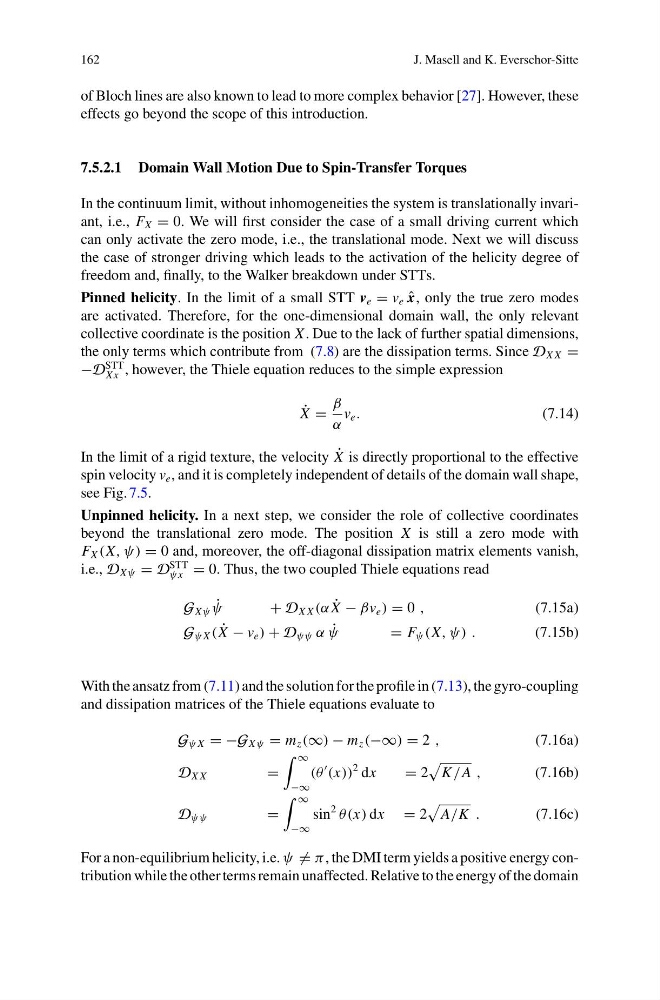
In the continuum limit, without inhomogeneities the system is translationally invariant, i.e., F X = 0. We will first consider the case of a small driving current which
can only activate the zero mode, i.e., the translational mode. Next we will discuss
the case of stronger driving which leads to the activation of the helicity degree of
freedom and, finally, to the Walker breakdown under STTs.
Pinned helicity. In the limit of a small STT v e = v e ˆ
x, only the true zero modes
are activated. Therefore, for the one-dimensional domain wall, the only relevant
collective coordinate is the position X . Due to the lack of further spatial dimensions,
the only terms which contribute from (7.8) are the dissipation terms. Since D X X =
−D
STT
X x , however, the Thiele equation reduces to the simple expression
˙
X =
β
α
v e .
(7.14)
In the limit of a rigid texture, the velocity ˙
X is directly proportional to the effective
spin velocity v e , and it is completely independent of details of the domain wall shape,
see Fig. 7.5.
Unpinned helicity. In a next step, we consider the role of collective coordinates
beyond the translational zero mode. The position X is still a zero mode with
F X (X, ψ) = 0 and, moreover, the off-diagonal dissipation matrix elements vanish,
i.e., D X ψ = D
STT
ψ x = 0. Thus, the two coupled Thiele equations read
G X ψ ˙
ψ
+ D X X (α ˙
X − βv e ) = 0 ,
(7.15a)
G ψ X ( ˙
X − v e ) + D ψψ α ˙
ψ
= F ψ (X, ψ) .
(7.15b)
With the ansatz from (7.11) and the solution for the profile in (7.13), the gyro-coupling
and dissipation matrices of the Thiele equations evaluate to
G ψ X = −G X ψ = m z (∞) − m z (−∞) = 2 ,
(7.16a)
D X X
=
∞
−∞
(θ
(x))
2 dx
= 2
K /A ,
(7.16b)
D ψψ
=
∞
−∞
sin
2
θ(x) dx = 2
A/K .
(7.16c)
For a non-equilibrium helicity, i.e. ψ = π , the DMI term yields a positive energy contribution while the other terms remain unaffected. Relative to the energy of the domain
J. Masell and K. Everschor-Sitte
of Bloch lines are also known to lead to more complex behavior [27]. However, these
effects go beyond the scope of this introduction.
7.5.2.1 Domain Wall Motion Due to Spin-Transfer Torques
In the continuum limit, without inhomogeneities the system is translationally invariant, i.e., F X = 0. We will first consider the case of a small driving current which
can only activate the zero mode, i.e., the translational mode. Next we will discuss
the case of stronger driving which leads to the activation of the helicity degree of
freedom and, finally, to the Walker breakdown under STTs.
Pinned helicity. In the limit of a small STT v e = v e ˆ
x, only the true zero modes
are activated. Therefore, for the one-dimensional domain wall, the only relevant
collective coordinate is the position X . Due to the lack of further spatial dimensions,
the only terms which contribute from (7.8) are the dissipation terms. Since D X X =
−D
STT
X x , however, the Thiele equation reduces to the simple expression
˙
X =
β
α
v e .
(7.14)
In the limit of a rigid texture, the velocity ˙
X is directly proportional to the effective
spin velocity v e , and it is completely independent of details of the domain wall shape,
see Fig. 7.5.
Unpinned helicity. In a next step, we consider the role of collective coordinates
beyond the translational zero mode. The position X is still a zero mode with
F X (X, ψ) = 0 and, moreover, the off-diagonal dissipation matrix elements vanish,
i.e., D X ψ = D
STT
ψ x = 0. Thus, the two coupled Thiele equations read
G X ψ ˙
ψ
+ D X X (α ˙
X − βv e ) = 0 ,
(7.15a)
G ψ X ( ˙
X − v e ) + D ψψ α ˙
ψ
= F ψ (X, ψ) .
(7.15b)
With the ansatz from (7.11) and the solution for the profile in (7.13), the gyro-coupling
and dissipation matrices of the Thiele equations evaluate to
G ψ X = −G X ψ = m z (∞) − m z (−∞) = 2 ,
(7.16a)
D X X
=
∞
−∞
(θ
(x))
2 dx
= 2
K /A ,
(7.16b)
D ψψ
=
∞
−∞
sin
2
θ(x) dx = 2
A/K .
(7.16c)
For a non-equilibrium helicity, i.e. ψ = π , the DMI term yields a positive energy contribution while the other terms remain unaffected. Relative to the energy of the domain