

7 Current-Induced Dynamics of Chiral Magnetic Structures
149
7.2 Continuum Model for the Magnetization
In this section, we present the continuum description of magnets and their interplay
with electric currents, which in a simplified form is known as the micromagnetic
model.
7.2.1 Magnetization Statics
The static properties of any magnet are well determined by an energy functional
whose form depends strongly on the symmetries of the system. The precise determination of this energy functional in all its components is a very hard task. For
sufficiently simple systems, the spin wave dispersion can be calculated with ab initio
methods and then be fitted to a model of localized magnetic moments {S i }. Such
treatments are very successful in describing magnetism on the atomic scale, which
often requires exchange interactions S i · S j beyond nearest neighbors and, potentially, also more exotic interactions between multiple spins [15].
The magnetization in most chiral ferromagnets is, however, smooth, i.e., it is
polarized on the length scale of the atomic lattice and varies only on much larger
length scales. In this limit, the magnetic system can be well described by a phenomenological Ginzburg-Landau theory where an effective energy functional for the
magnetization M is derived as a series expansion in powers of M and spatial derivatives ∂ α . Moreover, for temperatures far below the Curie temperature the magnetic
system is in an ordered state and the local magnitude of the magnetization corresponds to the saturation magnetization M s . The resulting energy functional can then
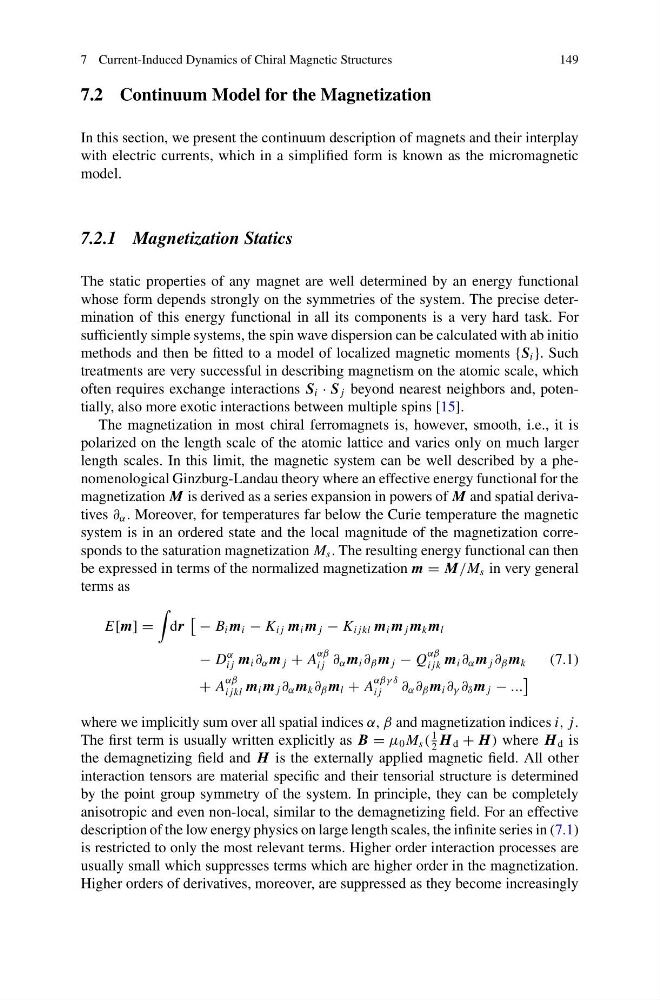
be expressed in terms of the normalized magnetization m = M/M s in very general
terms as
E[m] =
dr
− B i m i − K i j m i m j − K i jkl m i m j m k m l
− D
α
i j m i ∂ α m j + A
αβ
i j ∂ α m i ∂ β m j − Q
αβ
i jk m i ∂ α m j ∂ β m k
(7.1)
+ A
αβ
i jkl m i m j ∂ α m k ∂ β m l + A
αβγ δ
i j
∂ α ∂ β m i ∂ γ ∂ δ m j − ...
where we implicitly sum over all spatial indices α, β and magnetization indices i, j.
The first term is usually written explicitly as B = μ 0 M s (
1
2
H d + H) where H d is
the demagnetizing field and H is the externally applied magnetic field. All other
interaction tensors are material specific and their tensorial structure is determined
by the point group symmetry of the system. In principle, they can be completely
anisotropic and even non-local, similar to the demagnetizing field. For an effective
description of the low energy physics on large length scales, the infinite series in (7.1)
is restricted to only the most relevant terms. Higher order interaction processes are
usually small which suppresses terms which are higher order in the magnetization.
Higher orders of derivatives, moreover, are suppressed as they become increasingly
149
7.2 Continuum Model for the Magnetization
In this section, we present the continuum description of magnets and their interplay
with electric currents, which in a simplified form is known as the micromagnetic
model.
7.2.1 Magnetization Statics
The static properties of any magnet are well determined by an energy functional
whose form depends strongly on the symmetries of the system. The precise determination of this energy functional in all its components is a very hard task. For
sufficiently simple systems, the spin wave dispersion can be calculated with ab initio
methods and then be fitted to a model of localized magnetic moments {S i }. Such
treatments are very successful in describing magnetism on the atomic scale, which
often requires exchange interactions S i · S j beyond nearest neighbors and, potentially, also more exotic interactions between multiple spins [15].
The magnetization in most chiral ferromagnets is, however, smooth, i.e., it is
polarized on the length scale of the atomic lattice and varies only on much larger
length scales. In this limit, the magnetic system can be well described by a phenomenological Ginzburg-Landau theory where an effective energy functional for the
magnetization M is derived as a series expansion in powers of M and spatial derivatives ∂ α . Moreover, for temperatures far below the Curie temperature the magnetic
system is in an ordered state and the local magnitude of the magnetization corresponds to the saturation magnetization M s . The resulting energy functional can then
be expressed in terms of the normalized magnetization m = M/M s in very general
terms as
E[m] =
dr
− B i m i − K i j m i m j − K i jkl m i m j m k m l
− D
α
i j m i ∂ α m j + A
αβ
i j ∂ α m i ∂ β m j − Q
αβ
i jk m i ∂ α m j ∂ β m k
(7.1)
+ A
αβ
i jkl m i m j ∂ α m k ∂ β m l + A
αβγ δ
i j
∂ α ∂ β m i ∂ γ ∂ δ m j − ...
where we implicitly sum over all spatial indices α, β and magnetization indices i, j.
The first term is usually written explicitly as B = μ 0 M s (
1
2
H d + H) where H d is
the demagnetizing field and H is the externally applied magnetic field. All other
interaction tensors are material specific and their tensorial structure is determined
by the point group symmetry of the system. In principle, they can be completely
anisotropic and even non-local, similar to the demagnetizing field. For an effective
description of the low energy physics on large length scales, the infinite series in (7.1)
is restricted to only the most relevant terms. Higher order interaction processes are
usually small which suppresses terms which are higher order in the magnetization.
Higher orders of derivatives, moreover, are suppressed as they become increasingly