

148
J. Masell and K. Everschor-Sitte
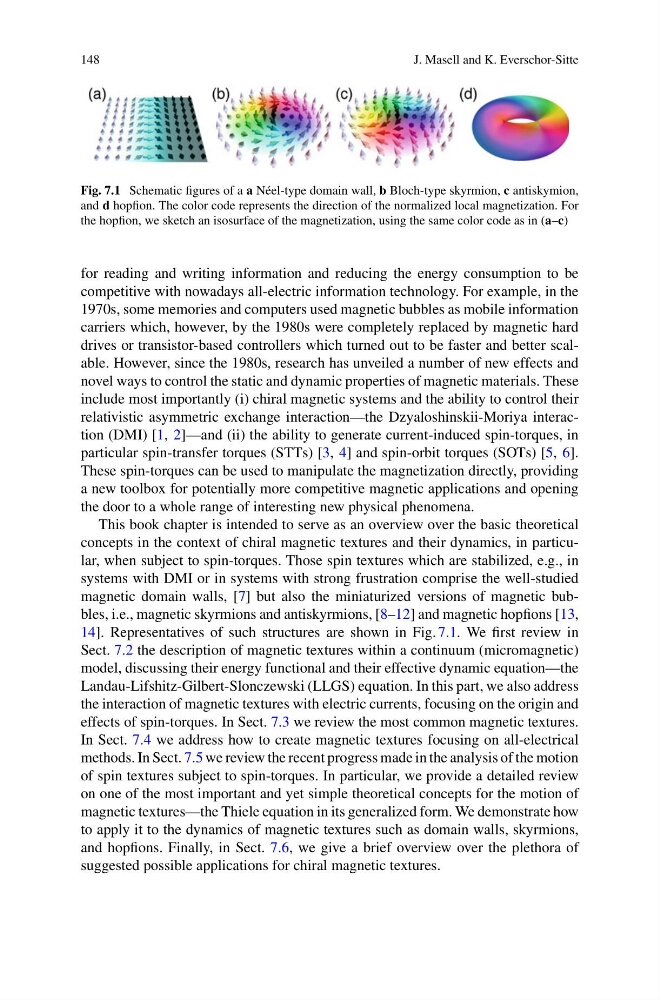
Fig. 7.1 Schematic figures of a a Néel-type domain wall, b Bloch-type skyrmion, c antiskymion,
and d hopfion. The color code represents the direction of the normalized local magnetization. For
the hopfion, we sketch an isosurface of the magnetization, using the same color code as in (a–c)
for reading and writing information and reducing the energy consumption to be
competitive with nowadays all-electric information technology. For example, in the
1970s, some memories and computers used magnetic bubbles as mobile information
carriers which, however, by the 1980s were completely replaced by magnetic hard
drives or transistor-based controllers which turned out to be faster and better scalable. However, since the 1980s, research has unveiled a number of new effects and
novel ways to control the static and dynamic properties of magnetic materials. These
include most importantly (i) chiral magnetic systems and the ability to control their
relativistic asymmetric exchange interaction—the Dzyaloshinskii-Moriya interaction (DMI) [1, 2]—and (ii) the ability to generate current-induced spin-torques, in
particular spin-transfer torques (STTs) [3, 4] and spin-orbit torques (SOTs) [5, 6].
These spin-torques can be used to manipulate the magnetization directly, providing
a new toolbox for potentially more competitive magnetic applications and opening
the door to a whole range of interesting new physical phenomena.
This book chapter is intended to serve as an overview over the basic theoretical
concepts in the context of chiral magnetic textures and their dynamics, in particular, when subject to spin-torques. Those spin textures which are stabilized, e.g., in
systems with DMI or in systems with strong frustration comprise the well-studied
magnetic domain walls, [7] but also the miniaturized versions of magnetic bubbles, i.e., magnetic skyrmions and antiskyrmions, [8–12] and magnetic hopfions [13,
14]. Representatives of such structures are shown in Fig. 7.1. We first review in
Sect. 7.2 the description of magnetic textures within a continuum (micromagnetic)
model, discussing their energy functional and their effective dynamic equation—the
Landau-Lifshitz-Gilbert-Slonczewski (LLGS) equation. In this part, we also address
the interaction of magnetic textures with electric currents, focusing on the origin and
effects of spin-torques. In Sect. 7.3 we review the most common magnetic textures.
In Sect. 7.4 we address how to create magnetic textures focusing on all-electrical
methods. In Sect. 7.5 we review the recent progress made in the analysis of the motion
of spin textures subject to spin-torques. In particular, we provide a detailed review
on one of the most important and yet simple theoretical concepts for the motion of
magnetic textures—the Thiele equation in its generalized form. We demonstrate how
to apply it to the dynamics of magnetic textures such as domain walls, skyrmions,
and hopfions. Finally, in Sect. 7.6, we give a brief overview over the plethora of
suggested possible applications for chiral magnetic textures.
J. Masell and K. Everschor-Sitte
Fig. 7.1 Schematic figures of a a Néel-type domain wall, b Bloch-type skyrmion, c antiskymion,
and d hopfion. The color code represents the direction of the normalized local magnetization. For
the hopfion, we sketch an isosurface of the magnetization, using the same color code as in (a–c)
for reading and writing information and reducing the energy consumption to be
competitive with nowadays all-electric information technology. For example, in the
1970s, some memories and computers used magnetic bubbles as mobile information
carriers which, however, by the 1980s were completely replaced by magnetic hard
drives or transistor-based controllers which turned out to be faster and better scalable. However, since the 1980s, research has unveiled a number of new effects and
novel ways to control the static and dynamic properties of magnetic materials. These
include most importantly (i) chiral magnetic systems and the ability to control their
relativistic asymmetric exchange interaction—the Dzyaloshinskii-Moriya interaction (DMI) [1, 2]—and (ii) the ability to generate current-induced spin-torques, in
particular spin-transfer torques (STTs) [3, 4] and spin-orbit torques (SOTs) [5, 6].
These spin-torques can be used to manipulate the magnetization directly, providing
a new toolbox for potentially more competitive magnetic applications and opening
the door to a whole range of interesting new physical phenomena.
This book chapter is intended to serve as an overview over the basic theoretical
concepts in the context of chiral magnetic textures and their dynamics, in particular, when subject to spin-torques. Those spin textures which are stabilized, e.g., in
systems with DMI or in systems with strong frustration comprise the well-studied
magnetic domain walls, [7] but also the miniaturized versions of magnetic bubbles, i.e., magnetic skyrmions and antiskyrmions, [8–12] and magnetic hopfions [13,
14]. Representatives of such structures are shown in Fig. 7.1. We first review in
Sect. 7.2 the description of magnetic textures within a continuum (micromagnetic)
model, discussing their energy functional and their effective dynamic equation—the
Landau-Lifshitz-Gilbert-Slonczewski (LLGS) equation. In this part, we also address
the interaction of magnetic textures with electric currents, focusing on the origin and
effects of spin-torques. In Sect. 7.3 we review the most common magnetic textures.
In Sect. 7.4 we address how to create magnetic textures focusing on all-electrical
methods. In Sect. 7.5 we review the recent progress made in the analysis of the motion
of spin textures subject to spin-torques. In particular, we provide a detailed review
on one of the most important and yet simple theoretical concepts for the motion of
magnetic textures—the Thiele equation in its generalized form. We demonstrate how
to apply it to the dynamics of magnetic textures such as domain walls, skyrmions,
and hopfions. Finally, in Sect. 7.6, we give a brief overview over the plethora of
suggested possible applications for chiral magnetic textures.