

90
K. Huang
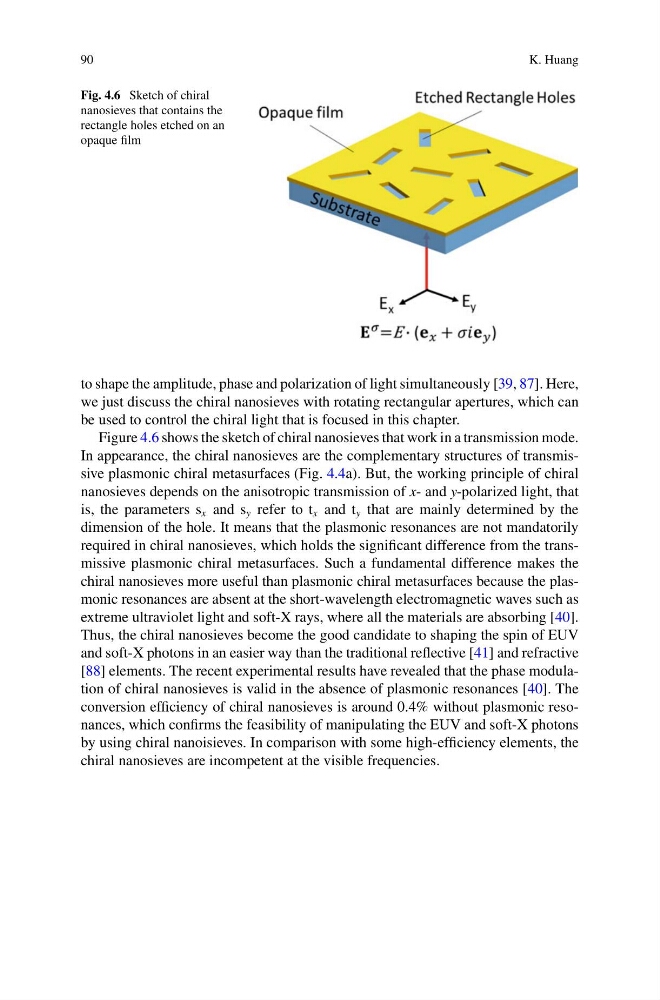
Fig. 4.6 Sketch of chiral
nanosieves that contains the
rectangle holes etched on an
opaque film
to shape the amplitude, phase and polarization of light simultaneously [39, 87]. Here,
we just discuss the chiral nanosieves with rotating rectangular apertures, which can
be used to control the chiral light that is focused in this chapter.
Figure 4.6 shows the sketch of chiral nanosieves that work in a transmission mode.
In appearance, the chiral nanosieves are the complementary structures of transmissive plasmonic chiral metasurfaces (Fig. 4.4a). But, the working principle of chiral
nanosieves depends on the anisotropic transmission of x- and y-polarized light, that
is, the parameters s x and s y refer to t x and t y that are mainly determined by the
dimension of the hole. It means that the plasmonic resonances are not mandatorily
required in chiral nanosieves, which holds the significant difference from the transmissive plasmonic chiral metasurfaces. Such a fundamental difference makes the
chiral nanosieves more useful than plasmonic chiral metasurfaces because the plasmonic resonances are absent at the short-wavelength electromagnetic waves such as
extreme ultraviolet light and soft-X rays, where all the materials are absorbing [40].
Thus, the chiral nanosieves become the good candidate to shaping the spin of EUV
and soft-X photons in an easier way than the traditional reflective [41] and refractive
[88] elements. The recent experimental results have revealed that the phase modulation of chiral nanosieves is valid in the absence of plasmonic resonances [40]. The
conversion efficiency of chiral nanosieves is around 0.4% without plasmonic resonances, which confirms the feasibility of manipulating the EUV and soft-X photons
by using chiral nanoisieves. In comparison with some high-efficiency elements, the
chiral nanosieves are incompetent at the visible frequencies.
K. Huang
Fig. 4.6 Sketch of chiral
nanosieves that contains the
rectangle holes etched on an
opaque film
to shape the amplitude, phase and polarization of light simultaneously [39, 87]. Here,
we just discuss the chiral nanosieves with rotating rectangular apertures, which can
be used to control the chiral light that is focused in this chapter.
Figure 4.6 shows the sketch of chiral nanosieves that work in a transmission mode.
In appearance, the chiral nanosieves are the complementary structures of transmissive plasmonic chiral metasurfaces (Fig. 4.4a). But, the working principle of chiral
nanosieves depends on the anisotropic transmission of x- and y-polarized light, that
is, the parameters s x and s y refer to t x and t y that are mainly determined by the
dimension of the hole. It means that the plasmonic resonances are not mandatorily
required in chiral nanosieves, which holds the significant difference from the transmissive plasmonic chiral metasurfaces. Such a fundamental difference makes the
chiral nanosieves more useful than plasmonic chiral metasurfaces because the plasmonic resonances are absent at the short-wavelength electromagnetic waves such as
extreme ultraviolet light and soft-X rays, where all the materials are absorbing [40].
Thus, the chiral nanosieves become the good candidate to shaping the spin of EUV
and soft-X photons in an easier way than the traditional reflective [41] and refractive
[88] elements. The recent experimental results have revealed that the phase modulation of chiral nanosieves is valid in the absence of plasmonic resonances [40]. The
conversion efficiency of chiral nanosieves is around 0.4% without plasmonic resonances, which confirms the feasibility of manipulating the EUV and soft-X photons
by using chiral nanoisieves. In comparison with some high-efficiency elements, the
chiral nanosieves are incompetent at the visible frequencies.