

88
K. Huang
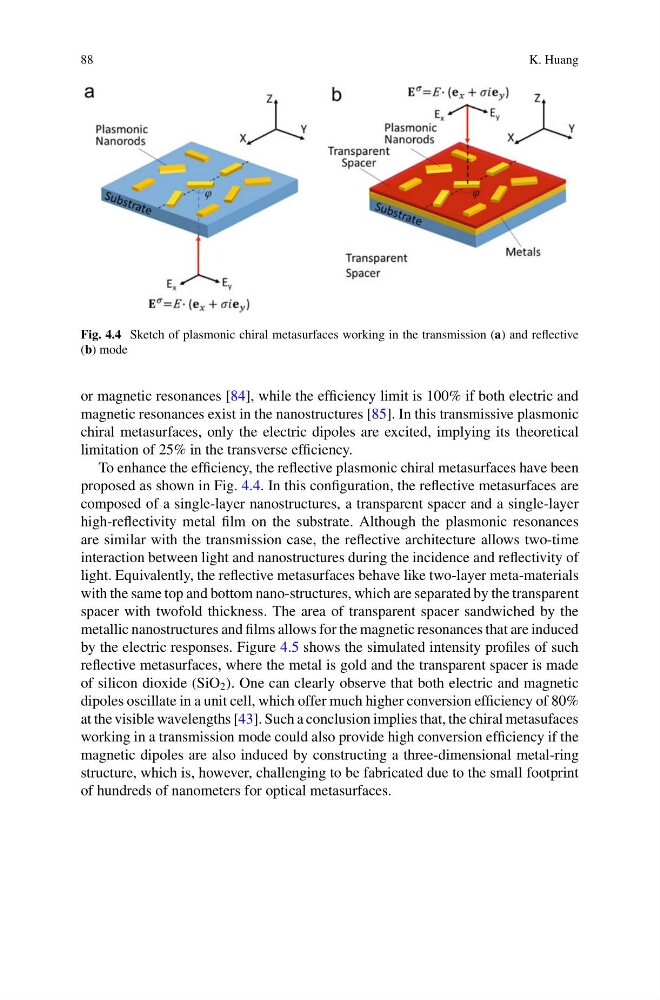
Fig. 4.4 Sketch of plasmonic chiral metasurfaces working in the transmission (a) and reflective
(b) mode
or magnetic resonances [84], while the efficiency limit is 100% if both electric and
magnetic resonances exist in the nanostructures [85]. In this transmissive plasmonic
chiral metasurfaces, only the electric dipoles are excited, implying its theoretical
limitation of 25% in the transverse efficiency.
To enhance the efficiency, the reflective plasmonic chiral metasurfaces have been
proposed as shown in Fig. 4.4. In this configuration, the reflective metasurfaces are
composed of a single-layer nanostructures, a transparent spacer and a single-layer
high-reflectivity metal film on the substrate. Although the plasmonic resonances
are similar with the transmission case, the reflective architecture allows two-time
interaction between light and nanostructures during the incidence and reflectivity of
light. Equivalently, the reflective metasurfaces behave like two-layer meta-materials
with the same top and bottom nano-structures, which are separated by the transparent
spacer with twofold thickness. The area of transparent spacer sandwiched by the
metallic nanostructures and films allows for the magnetic resonances that are induced
by the electric responses. Figure 4.5 shows the simulated intensity profiles of such
reflective metasurfaces, where the metal is gold and the transparent spacer is made
of silicon dioxide (SiO 2 ). One can clearly observe that both electric and magnetic
dipoles oscillate in a unit cell, which offer much higher conversion efficiency of 80%
at the visible wavelengths [43]. Such a conclusion implies that, the chiral metasufaces
working in a transmission mode could also provide high conversion efficiency if the
magnetic dipoles are also induced by constructing a three-dimensional metal-ring
structure, which is, however, challenging to be fabricated due to the small footprint
of hundreds of nanometers for optical metasurfaces.
K. Huang
Fig. 4.4 Sketch of plasmonic chiral metasurfaces working in the transmission (a) and reflective
(b) mode
or magnetic resonances [84], while the efficiency limit is 100% if both electric and
magnetic resonances exist in the nanostructures [85]. In this transmissive plasmonic
chiral metasurfaces, only the electric dipoles are excited, implying its theoretical
limitation of 25% in the transverse efficiency.
To enhance the efficiency, the reflective plasmonic chiral metasurfaces have been
proposed as shown in Fig. 4.4. In this configuration, the reflective metasurfaces are
composed of a single-layer nanostructures, a transparent spacer and a single-layer
high-reflectivity metal film on the substrate. Although the plasmonic resonances
are similar with the transmission case, the reflective architecture allows two-time
interaction between light and nanostructures during the incidence and reflectivity of
light. Equivalently, the reflective metasurfaces behave like two-layer meta-materials
with the same top and bottom nano-structures, which are separated by the transparent
spacer with twofold thickness. The area of transparent spacer sandwiched by the
metallic nanostructures and films allows for the magnetic resonances that are induced
by the electric responses. Figure 4.5 shows the simulated intensity profiles of such
reflective metasurfaces, where the metal is gold and the transparent spacer is made
of silicon dioxide (SiO 2 ). One can clearly observe that both electric and magnetic
dipoles oscillate in a unit cell, which offer much higher conversion efficiency of 80%
at the visible wavelengths [43]. Such a conclusion implies that, the chiral metasufaces
working in a transmission mode could also provide high conversion efficiency if the
magnetic dipoles are also induced by constructing a three-dimensional metal-ring
structure, which is, however, challenging to be fabricated due to the small footprint
of hundreds of nanometers for optical metasurfaces.