

84
K. Huang
than the incident light due to the enhancement of local electric fields, leading to a
larger C than σ εkω
2 u
2 . Such a phenomena is named as superchiral, which is also
found in the standing waves generated by the interference between two beams with
the equal amplitude and opposite propagating directions. Although the superchiral
phenomena can enhance the CD response, the value of CD is still located at the level
of micro-degrees when the CP light is used to detect the molecules. The possible
reason might come from the mismatch between the dimension of molecules and the
operating wavelength of light. In contrast, the interaction between the CP light and
the subwavelength structures in optical metasurfaces is quite strong so that it can
be used to induce the giant spin Hall effects of light [13] or demonstrate the spindependent meta-optics [44] (see more details in Sect. 4.2). In addition, it has been
recently discovered that the topological structure of the CP light plays an important
role in enhancing the CD responses because the symmetry of the beam is changed
when the optical vortices with helical wavefronts are introduced [75].
4.2.2 Optical Vortices and Orbital Angular Momentum
Beams carrying a helical wavefront exhibit the vortex-like energy flow, alike the case
of vortices in water, and therefore are called optical vortex beam. The paraxial vortex
beams such as Laguerre-Gaussian and Bessel beams have the singularities at their
centers. Along the arbitrary closed curve containing the singularity, the accumulated
phase difference divided by 2π is an integer of l, which is the topological charge of
optical vortices and corresponds to the topological feature such as the self-healing
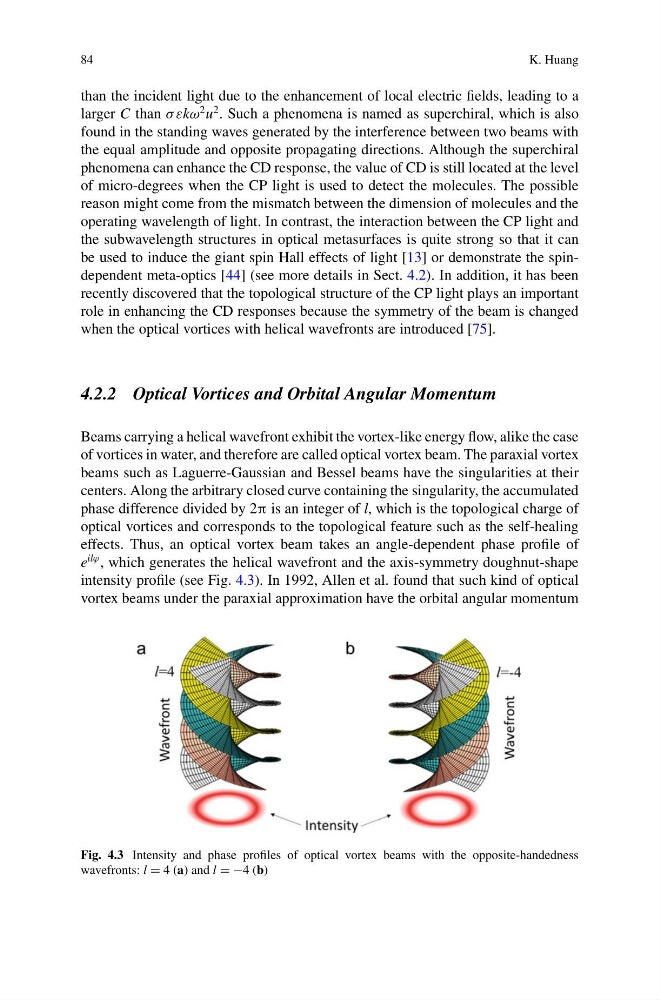
effects. Thus, an optical vortex beam takes an angle-dependent phase profile of
e
ilϕ , which generates the helical wavefront and the axis-symmetry doughnut-shape
intensity profile (see Fig. 4.3). In 1992, Allen et al. found that such kind of optical
vortex beams under the paraxial approximation have the orbital angular momentum
Fig. 4.3 Intensity and phase profiles of optical vortex beams with the opposite-handedness
wavefronts: l = 4 (a) and l = −4 (b)
K. Huang
than the incident light due to the enhancement of local electric fields, leading to a
larger C than σ εkω
2 u
2 . Such a phenomena is named as superchiral, which is also
found in the standing waves generated by the interference between two beams with
the equal amplitude and opposite propagating directions. Although the superchiral
phenomena can enhance the CD response, the value of CD is still located at the level
of micro-degrees when the CP light is used to detect the molecules. The possible
reason might come from the mismatch between the dimension of molecules and the
operating wavelength of light. In contrast, the interaction between the CP light and
the subwavelength structures in optical metasurfaces is quite strong so that it can
be used to induce the giant spin Hall effects of light [13] or demonstrate the spindependent meta-optics [44] (see more details in Sect. 4.2). In addition, it has been
recently discovered that the topological structure of the CP light plays an important
role in enhancing the CD responses because the symmetry of the beam is changed
when the optical vortices with helical wavefronts are introduced [75].
4.2.2 Optical Vortices and Orbital Angular Momentum
Beams carrying a helical wavefront exhibit the vortex-like energy flow, alike the case
of vortices in water, and therefore are called optical vortex beam. The paraxial vortex
beams such as Laguerre-Gaussian and Bessel beams have the singularities at their
centers. Along the arbitrary closed curve containing the singularity, the accumulated
phase difference divided by 2π is an integer of l, which is the topological charge of
optical vortices and corresponds to the topological feature such as the self-healing
effects. Thus, an optical vortex beam takes an angle-dependent phase profile of
e
ilϕ , which generates the helical wavefront and the axis-symmetry doughnut-shape
intensity profile (see Fig. 4.3). In 1992, Allen et al. found that such kind of optical
vortex beams under the paraxial approximation have the orbital angular momentum
Fig. 4.3 Intensity and phase profiles of optical vortex beams with the opposite-handedness
wavefronts: l = 4 (a) and l = −4 (b)