

4 Chirality and Antiferromagnetism in Optical Metasurfaces
83
E = iωA + ∇
c
2
iω
∇ · A
=
iωue x − σ ωue y + c
∂u
∂ x
+ σ i
∂u
∂ y
e z
exp[i(kz − ωt),
(4.2)
and
B = ∇ × A =
−iσ
∂u
∂z
+ iku
e x +
∂u
∂z
+ iku
e y +
σ i
∂u
∂ x
−
∂u
∂ y
e z
exp[i(kz − ωt),
(4.3)
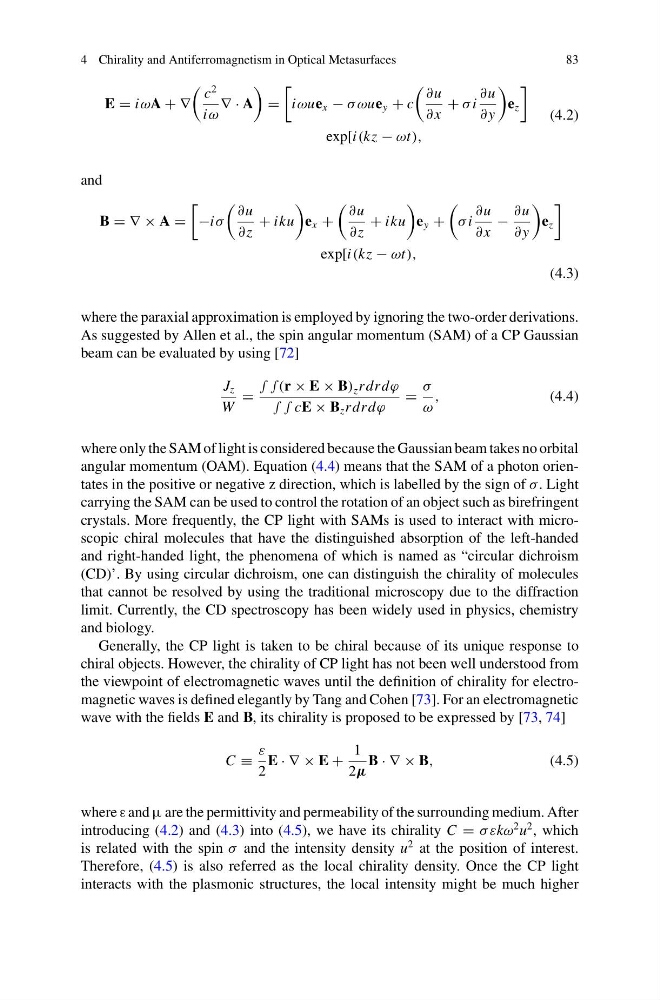
where the paraxial approximation is employed by ignoring the two-order derivations.
As suggested by Allen et al., the spin angular momentum (SAM) of a CP Gaussian
beam can be evaluated by using [72]
J z
W
=
∫ ∫(r × E × B) z rdrdϕ
∫ ∫ cE × B z rdrdϕ
=
σ
ω
,
(4.4)
where only the SAM of light is considered because the Gaussian beam takes no orbital
angular momentum (OAM). Equation (4.4) means that the SAM of a photon orientates in the positive or negative z direction, which is labelled by the sign of σ. Light
carrying the SAM can be used to control the rotation of an object such as birefringent
crystals. More frequently, the CP light with SAMs is used to interact with microscopic chiral molecules that have the distinguished absorption of the left-handed
and right-handed light, the phenomena of which is named as “circular dichroism
(CD)’. By using circular dichroism, one can distinguish the chirality of molecules
that cannot be resolved by using the traditional microscopy due to the diffraction
limit. Currently, the CD spectroscopy has been widely used in physics, chemistry
and biology.
Generally, the CP light is taken to be chiral because of its unique response to
chiral objects. However, the chirality of CP light has not been well understood from
the viewpoint of electromagnetic waves until the definition of chirality for electromagnetic waves is defined elegantly by Tang and Cohen [73]. For an electromagnetic
wave with the fields E and B, its chirality is proposed to be expressed by [73, 74]
C ≡
ε
2
E · ∇ × E +
1
2µ
B · ∇ × B,
(4.5)
where ε and μ are the permittivity and permeability of the surrounding medium. After
introducing (4.2) and (4.3) into (4.5), we have its chirality C = σ εkω
2 u
2 , which
is related with the spin σ and the intensity density u
2 at the position of interest.
Therefore, (4.5) is also referred as the local chirality density. Once the CP light
interacts with the plasmonic structures, the local intensity might be much higher
83
E = iωA + ∇
c
2
iω
∇ · A
=
iωue x − σ ωue y + c
∂u
∂ x
+ σ i
∂u
∂ y
e z
exp[i(kz − ωt),
(4.2)
and
B = ∇ × A =
−iσ
∂u
∂z
+ iku
e x +
∂u
∂z
+ iku
e y +
σ i
∂u
∂ x
−
∂u
∂ y
e z
exp[i(kz − ωt),
(4.3)
where the paraxial approximation is employed by ignoring the two-order derivations.
As suggested by Allen et al., the spin angular momentum (SAM) of a CP Gaussian
beam can be evaluated by using [72]
J z
W
=
∫ ∫(r × E × B) z rdrdϕ
∫ ∫ cE × B z rdrdϕ
=
σ
ω
,
(4.4)
where only the SAM of light is considered because the Gaussian beam takes no orbital
angular momentum (OAM). Equation (4.4) means that the SAM of a photon orientates in the positive or negative z direction, which is labelled by the sign of σ. Light
carrying the SAM can be used to control the rotation of an object such as birefringent
crystals. More frequently, the CP light with SAMs is used to interact with microscopic chiral molecules that have the distinguished absorption of the left-handed
and right-handed light, the phenomena of which is named as “circular dichroism
(CD)’. By using circular dichroism, one can distinguish the chirality of molecules
that cannot be resolved by using the traditional microscopy due to the diffraction
limit. Currently, the CD spectroscopy has been widely used in physics, chemistry
and biology.
Generally, the CP light is taken to be chiral because of its unique response to
chiral objects. However, the chirality of CP light has not been well understood from
the viewpoint of electromagnetic waves until the definition of chirality for electromagnetic waves is defined elegantly by Tang and Cohen [73]. For an electromagnetic
wave with the fields E and B, its chirality is proposed to be expressed by [73, 74]
C ≡
ε
2
E · ∇ × E +
1
2µ
B · ∇ × B,
(4.5)
where ε and μ are the permittivity and permeability of the surrounding medium. After
introducing (4.2) and (4.3) into (4.5), we have its chirality C = σ εkω
2 u
2 , which
is related with the spin σ and the intensity density u
2 at the position of interest.
Therefore, (4.5) is also referred as the local chirality density. Once the CP light
interacts with the plasmonic structures, the local intensity might be much higher