

304
ENPs may interact with membrane-bound cellular receptors like growth factor
receptors and integrins to induce proliferation, differentiation, and migration.
In microbes, ENPs are accumulated either in the cells or adhere near the cell wall
as electron dense structures (Feng et al. 2000). Accumulation of inorganic nanoparticles mostly occurs in the cytoplasm. This leads to the damage of bacterial membrane and create the access of NPs easy leading to the modification in cell by
intracellular potassium leakage (Navarro et al. 2008). It must also be noted that
surface coatings comprising of simple or complex organic moieties can act as carbon source for bacteria.
Further, plants also regularly encounter nanoparticles in environmental matrix.
While atmospheric nanoparticles are shown to be adhered to leaves and other aerial
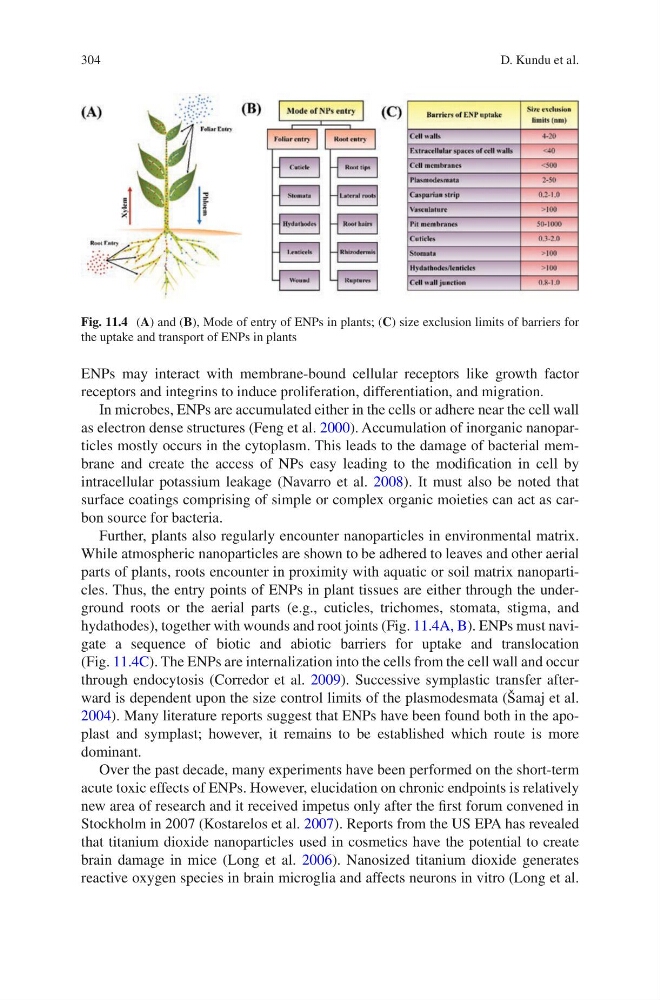
parts of plants, roots encounter in proximity with aquatic or soil matrix nanoparticles. Thus, the entry points of ENPs in plant tissues are either through the underground roots or the aerial parts (e.g., cuticles, trichomes, stomata, stigma, and
hydathodes), together with wounds and root joints (Fig. 11.4A, B). ENPs must navigate a sequence of biotic and abiotic barriers for uptake and translocation
(Fig. 11.4C). The ENPs are internalization into the cells from the cell wall and occur
through endocytosis (Corredor et al. 2009). Successive symplastic transfer afterward is dependent upon the size control limits of the plasmodesmata (Šamaj et al.
2004). Many literature reports suggest that ENPs have been found both in the apoplast and symplast; however, it remains to be established which route is more
dominant.
Over the past decade, many experiments have been performed on the short-term
acute toxic effects of ENPs. However, elucidation on chronic endpoints is relatively
new area of research and it received impetus only after the first forum convened in
Stockholm in 2007 (Kostarelos et al. 2007). Reports from the US EPA has revealed
that titanium dioxide nanoparticles used in cosmetics have the potential to create
brain damage in mice (Long et al. 2006). Nanosized titanium dioxide generates
reactive oxygen species in brain microglia and affects neurons in vitro (Long et al.
Fig. 11.4 (A) and (B), Mode of entry of ENPs in plants; (C) size exclusion limits of barriers for
the uptake and transport of ENPs in plants
D. Kundu et al.
ENPs may interact with membrane-bound cellular receptors like growth factor
receptors and integrins to induce proliferation, differentiation, and migration.
In microbes, ENPs are accumulated either in the cells or adhere near the cell wall
as electron dense structures (Feng et al. 2000). Accumulation of inorganic nanoparticles mostly occurs in the cytoplasm. This leads to the damage of bacterial membrane and create the access of NPs easy leading to the modification in cell by
intracellular potassium leakage (Navarro et al. 2008). It must also be noted that
surface coatings comprising of simple or complex organic moieties can act as carbon source for bacteria.
Further, plants also regularly encounter nanoparticles in environmental matrix.
While atmospheric nanoparticles are shown to be adhered to leaves and other aerial
parts of plants, roots encounter in proximity with aquatic or soil matrix nanoparticles. Thus, the entry points of ENPs in plant tissues are either through the underground roots or the aerial parts (e.g., cuticles, trichomes, stomata, stigma, and
hydathodes), together with wounds and root joints (Fig. 11.4A, B). ENPs must navigate a sequence of biotic and abiotic barriers for uptake and translocation
(Fig. 11.4C). The ENPs are internalization into the cells from the cell wall and occur
through endocytosis (Corredor et al. 2009). Successive symplastic transfer afterward is dependent upon the size control limits of the plasmodesmata (Šamaj et al.
2004). Many literature reports suggest that ENPs have been found both in the apoplast and symplast; however, it remains to be established which route is more
dominant.
Over the past decade, many experiments have been performed on the short-term
acute toxic effects of ENPs. However, elucidation on chronic endpoints is relatively
new area of research and it received impetus only after the first forum convened in
Stockholm in 2007 (Kostarelos et al. 2007). Reports from the US EPA has revealed
that titanium dioxide nanoparticles used in cosmetics have the potential to create
brain damage in mice (Long et al. 2006). Nanosized titanium dioxide generates
reactive oxygen species in brain microglia and affects neurons in vitro (Long et al.
Fig. 11.4 (A) and (B), Mode of entry of ENPs in plants; (C) size exclusion limits of barriers for
the uptake and transport of ENPs in plants
D. Kundu et al.