

303
11.7 Toxicity and Environmental Impact of Nanoparticles
Eventually, most of the ENPs are considered to be xenobiotic in nature and their
potential release and fate pattern remain poorly understood (Mraz 2005; Oberdörster
et al. 2005). Toxic NPs generate reactive oxygen species (ROS) that causes damages
to membrane stabilization, protein damage and oxidation, nucleic acids degradation,
release of harmful and toxic components, etc. (Klaine et al. 2008). Since ENPs are
extensively used in biological applications, variable doses of ENPs should be administered in vivo to evaluate the ecotoxicological aspects of ENPs (Kunzmann et al. 2011).
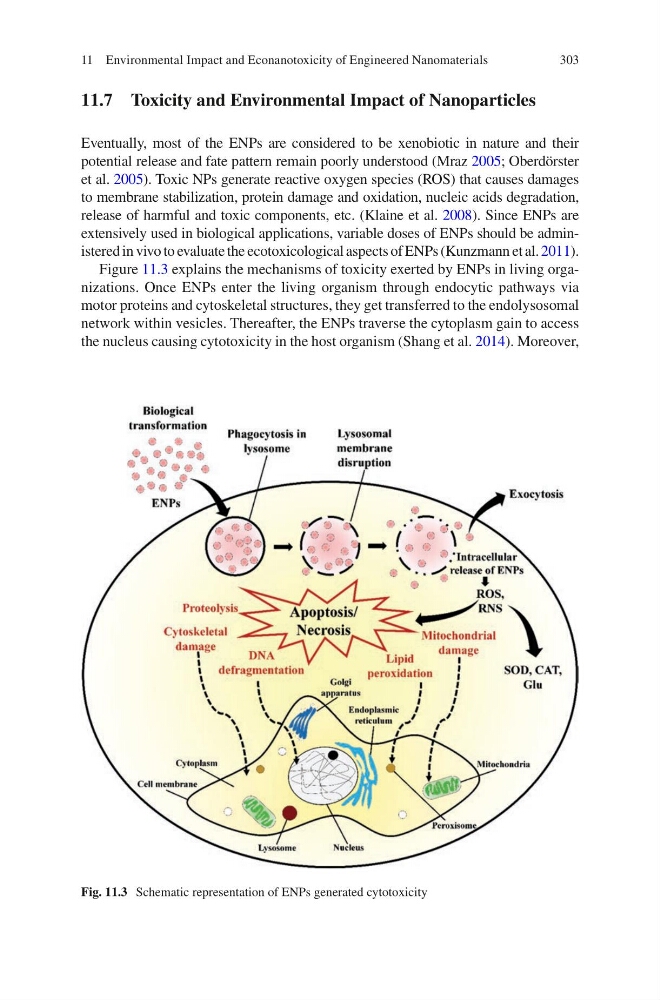
Figure 11.3 explains the mechanisms of toxicity exerted by ENPs in living organizations. Once ENPs enter the living organism through endocytic pathways via
motor proteins and cytoskeletal structures, they get transferred to the endolysosomal
network within vesicles. Thereafter, the ENPs traverse the cytoplasm gain to access
the nucleus causing cytotoxicity in the host organism (Shang et al. 2014). Moreover,
Fig. 11.3 Schematic representation of ENPs generated cytotoxicity
11 Environmental Impact and Econanotoxicity of Engineered Nanomaterials
11.7 Toxicity and Environmental Impact of Nanoparticles
Eventually, most of the ENPs are considered to be xenobiotic in nature and their
potential release and fate pattern remain poorly understood (Mraz 2005; Oberdörster
et al. 2005). Toxic NPs generate reactive oxygen species (ROS) that causes damages
to membrane stabilization, protein damage and oxidation, nucleic acids degradation,
release of harmful and toxic components, etc. (Klaine et al. 2008). Since ENPs are
extensively used in biological applications, variable doses of ENPs should be administered in vivo to evaluate the ecotoxicological aspects of ENPs (Kunzmann et al. 2011).
Figure 11.3 explains the mechanisms of toxicity exerted by ENPs in living organizations. Once ENPs enter the living organism through endocytic pathways via
motor proteins and cytoskeletal structures, they get transferred to the endolysosomal
network within vesicles. Thereafter, the ENPs traverse the cytoplasm gain to access
the nucleus causing cytotoxicity in the host organism (Shang et al. 2014). Moreover,
Fig. 11.3 Schematic representation of ENPs generated cytotoxicity
11 Environmental Impact and Econanotoxicity of Engineered Nanomaterials