

299
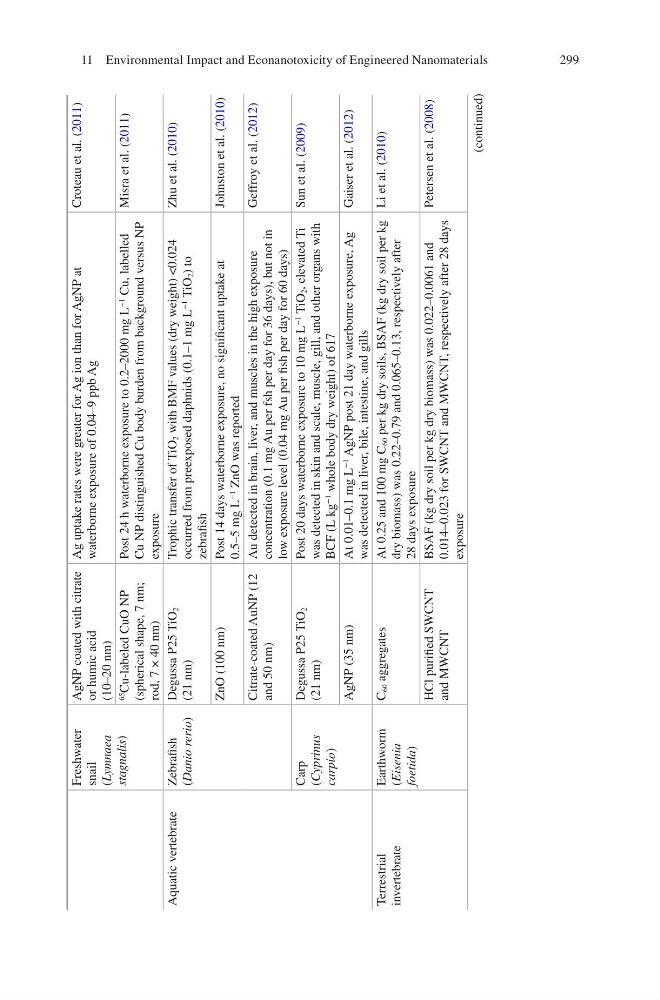
Category
Organism
ENP
Salient findings
References
Freshwater
snail
(Lymnaea
stagnalis)
AgNP coated with citrate
or humic acid
(10–20 nm)
Ag uptake rates were greater for Ag ion than for AgNP at
waterborne exposure of 0.04–9 ppb Ag
Croteau et al. (2011)
65
Cu-labeled CuO NP
(spherical shape, 7 nm;
rod, 7 × 40 nm)
Post 24 h waterborne exposure to 0.2–2000 mg L
−1
Cu, labelled
Cu NP distinguished Cu body burden from background versus NP
exposure
Misra et al. (2011)
Aquatic vertebrate
Zebrafish
(Danio rerio)
Degussa P25 TiO
2
(21 nm)
Trophic transfer of TiO
2 with BMF values (dry weight) <0.024
occurred from preexposed daphnids (0.1–1 mg L
−1
TiO
2 ) to
zebrafish
Zhu et al. (2010)
ZnO (100 nm)
Post 14 days waterborne exposure, no significant uptake at
0.5–5 mg L
−1
ZnO was reported
Johnston et al. (2010)
Citrate-coated AuNP (12
and 50 nm)
Au detected in brain, liver, and muscles in the high exposure
concentration (0.1 mg Au per fsh per day for 36 days), but not in
low exposure level (0.04 mg Au per fish per day for 60 days)
Geffroy et al. (2012)
Carp
(Cyprinus
carpio)
Degussa P25 TiO
2
(21 nm)
Post 20 days waterborne exposure to 10 mg L
−1
TiO
2 , elevated Ti
was detected in skin and scale, muscle, gill, and other organs with
BCF (L kg
−1
whole body dry weight) of 617
Sun et al. (2009)
AgNP (35 nm)
At 0.01–0.1 mg L
−1
AgNP post 21 day waterborne exposure, Ag
was detected in liver, bile, intestine, and gills
Gaiser et al. (2012)
Terrestrial
invertebrate
Earthworm
(Eisenia
foetida)
C
60 aggregates
At 0.25 and 100 mg C
60 per kg dry soils, BSAF (kg dry soil per kg
dry biomass) was 0.22–0.79 and 0.065–0.13, respectively after
28 days exposure
Li et al. (2010)
HCl purified SWCNT
and MWCNT
BSAF (kg dry soil per kg dry biomass) was 0.022–0.0061 and
0.014–0.023 for SWCNT and MWCNT, respectively after 28 days
exposure
Petersen et al. (2008)
(continued)
11 Environmental Impact and Econanotoxicity of Engineered Nanomaterials
Category
Organism
ENP
Salient findings
References
Freshwater
snail
(Lymnaea
stagnalis)
AgNP coated with citrate
or humic acid
(10–20 nm)
Ag uptake rates were greater for Ag ion than for AgNP at
waterborne exposure of 0.04–9 ppb Ag
Croteau et al. (2011)
65
Cu-labeled CuO NP
(spherical shape, 7 nm;
rod, 7 × 40 nm)
Post 24 h waterborne exposure to 0.2–2000 mg L
−1
Cu, labelled
Cu NP distinguished Cu body burden from background versus NP
exposure
Misra et al. (2011)
Aquatic vertebrate
Zebrafish
(Danio rerio)
Degussa P25 TiO
2
(21 nm)
Trophic transfer of TiO
2 with BMF values (dry weight) <0.024
occurred from preexposed daphnids (0.1–1 mg L
−1
TiO
2 ) to
zebrafish
Zhu et al. (2010)
ZnO (100 nm)
Post 14 days waterborne exposure, no significant uptake at
0.5–5 mg L
−1
ZnO was reported
Johnston et al. (2010)
Citrate-coated AuNP (12
and 50 nm)
Au detected in brain, liver, and muscles in the high exposure
concentration (0.1 mg Au per fsh per day for 36 days), but not in
low exposure level (0.04 mg Au per fish per day for 60 days)
Geffroy et al. (2012)
Carp
(Cyprinus
carpio)
Degussa P25 TiO
2
(21 nm)
Post 20 days waterborne exposure to 10 mg L
−1
TiO
2 , elevated Ti
was detected in skin and scale, muscle, gill, and other organs with
BCF (L kg
−1
whole body dry weight) of 617
Sun et al. (2009)
AgNP (35 nm)
At 0.01–0.1 mg L
−1
AgNP post 21 day waterborne exposure, Ag
was detected in liver, bile, intestine, and gills
Gaiser et al. (2012)
Terrestrial
invertebrate
Earthworm
(Eisenia
foetida)
C
60 aggregates
At 0.25 and 100 mg C
60 per kg dry soils, BSAF (kg dry soil per kg
dry biomass) was 0.22–0.79 and 0.065–0.13, respectively after
28 days exposure
Li et al. (2010)
HCl purified SWCNT
and MWCNT
BSAF (kg dry soil per kg dry biomass) was 0.022–0.0061 and
0.014–0.023 for SWCNT and MWCNT, respectively after 28 days
exposure
Petersen et al. (2008)
(continued)
11 Environmental Impact and Econanotoxicity of Engineered Nanomaterials