

298
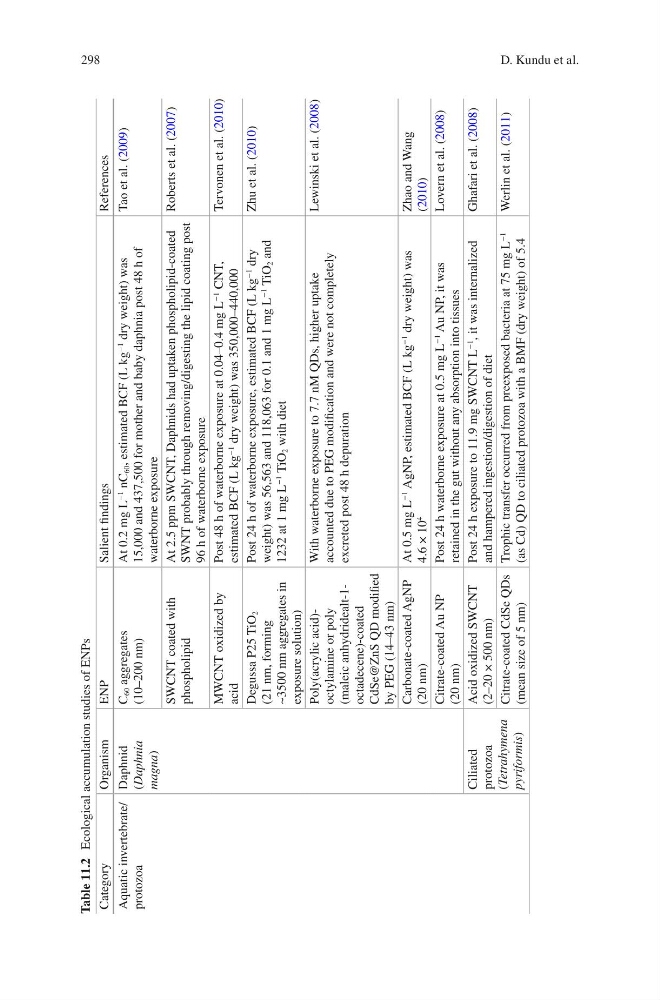
Table 11.2 Ecological accumulation studies of ENPs
Category
Organism
ENP
Salient findings
References
Aquatic invertebrate/
protozoa
Daphnid
(Daphnia
magna)
C
60 aggregates
(10–200 nm)
At 0.2 mg L
−1
nC
60 , estimated BCF (L kg
−1
dry weight) was
15,000 and 437,500 for mother and baby daphnia post 48 h of
waterborne exposure
Tao et al. (2009)
SWCNT coated with
phospholipid
At 2.5 ppm SWCNT, Daphnids had uptaken phospholipid- coated
SWNT probably through removing/digesting the lipid coating post
96 h of waterborne exposure
Roberts et al. (2007)
MWCNT oxidized by
acid
Post 48 h of waterborne exposure at 0.04–0.4 mg L
−1
CNT,
estimated BCF (L kg
−1
dry weight) was 350,000–440,000
Tervonen et al. (2010)
Degussa P25 TiO
2
(21 nm, forming
~3500 nm aggregates in
exposure solution)
Post 24 h of waterborne exposure, estimated BCF (L kg
−1
dry
weight) was 56,563 and 118,063 for 0.1 and 1 mg L
−1
TiO
2 and
1232 at 1 mg L
−1
TiO
2 with diet
Zhu et al. (2010)
Poly(acrylic acid)octylamine or poly
(maleic anhydridealt-1octadecene)-coated
CdSe@ZnS QD modified
by PEG (14–43 nm)
With waterborne exposure to 7.7 nM QDs, higher uptake
accounted due to PEG modification and were not completely
excreted post 48 h depuration
Lewinski et al. (2008)
Carbonate-coated AgNP
(20 nm)
At 0.5 mg L
−1
AgNP, estimated BCF (L kg
−1
dry weight) was
4.6 × 10
4
Zhao and Wang
(2010)
Citrate-coated Au NP
(20 nm)
Post 24 h waterborne exposure at 0.5 mg L
−1
Au NP, it was
retained in the gut without any absorption into tissues
Lovern et al. (2008)
Ciliated
protozoa
(Tetrahymena
pyriformis)
Acid oxidized SWCNT
(2–20 × 500 nm)
Post 24 h exposure to 11.9 mg SWCNT L
−1
, it was internalized
and hampered ingestion/digestion of diet
Ghafari et al. (2008)
Citrate-coated CdSe QDs
(mean size of 5 nm)
Trophic transfer occurred from preexposed bacteria at 75 mg L
−1
(as Cd) QD to ciliated protozoa with a BMF (dry weight) of 5.4
Werlin et al. (2011)
D. Kundu et al.
Table 11.2 Ecological accumulation studies of ENPs
Category
Organism
ENP
Salient findings
References
Aquatic invertebrate/
protozoa
Daphnid
(Daphnia
magna)
C
60 aggregates
(10–200 nm)
At 0.2 mg L
−1
nC
60 , estimated BCF (L kg
−1
dry weight) was
15,000 and 437,500 for mother and baby daphnia post 48 h of
waterborne exposure
Tao et al. (2009)
SWCNT coated with
phospholipid
At 2.5 ppm SWCNT, Daphnids had uptaken phospholipid- coated
SWNT probably through removing/digesting the lipid coating post
96 h of waterborne exposure
Roberts et al. (2007)
MWCNT oxidized by
acid
Post 48 h of waterborne exposure at 0.04–0.4 mg L
−1
CNT,
estimated BCF (L kg
−1
dry weight) was 350,000–440,000
Tervonen et al. (2010)
Degussa P25 TiO
2
(21 nm, forming
~3500 nm aggregates in
exposure solution)
Post 24 h of waterborne exposure, estimated BCF (L kg
−1
dry
weight) was 56,563 and 118,063 for 0.1 and 1 mg L
−1
TiO
2 and
1232 at 1 mg L
−1
TiO
2 with diet
Zhu et al. (2010)
Poly(acrylic acid)octylamine or poly
(maleic anhydridealt-1octadecene)-coated
CdSe@ZnS QD modified
by PEG (14–43 nm)
With waterborne exposure to 7.7 nM QDs, higher uptake
accounted due to PEG modification and were not completely
excreted post 48 h depuration
Lewinski et al. (2008)
Carbonate-coated AgNP
(20 nm)
At 0.5 mg L
−1
AgNP, estimated BCF (L kg
−1
dry weight) was
4.6 × 10
4
Zhao and Wang
(2010)
Citrate-coated Au NP
(20 nm)
Post 24 h waterborne exposure at 0.5 mg L
−1
Au NP, it was
retained in the gut without any absorption into tissues
Lovern et al. (2008)
Ciliated
protozoa
(Tetrahymena
pyriformis)
Acid oxidized SWCNT
(2–20 × 500 nm)
Post 24 h exposure to 11.9 mg SWCNT L
−1
, it was internalized
and hampered ingestion/digestion of diet
Ghafari et al. (2008)
Citrate-coated CdSe QDs
(mean size of 5 nm)
Trophic transfer occurred from preexposed bacteria at 75 mg L
−1
(as Cd) QD to ciliated protozoa with a BMF (dry weight) of 5.4
Werlin et al. (2011)
D. Kundu et al.