

270
photosynthetic rate of plants was decreased. In contrast, Cu(OH) 2 NPs lowered the
rate of photosynthesis at unfavorable conditions, that is, high light, limited nutrient
conditions (Conway et al. 2015). CuO NPs induced chlorosis that ultimately inhibited the growth of maize plants (Wang et al. 2012b).
NPs Altered Plant Maturity and Genetic Constitution
MWCNTs and fullrene C 70 were documented to delay flowering time and maturity
age of rice plants. NPs entered the plant root through cell wall pores and intercellular plasmodesmata. Osmotic and capillary forces were responsible for NPs’ entry
into the roots. NPs aggregated inside the vascular tissues, thus halting the nutrient
and water uptake by plants. The ill effects were more prominent in plants exposed
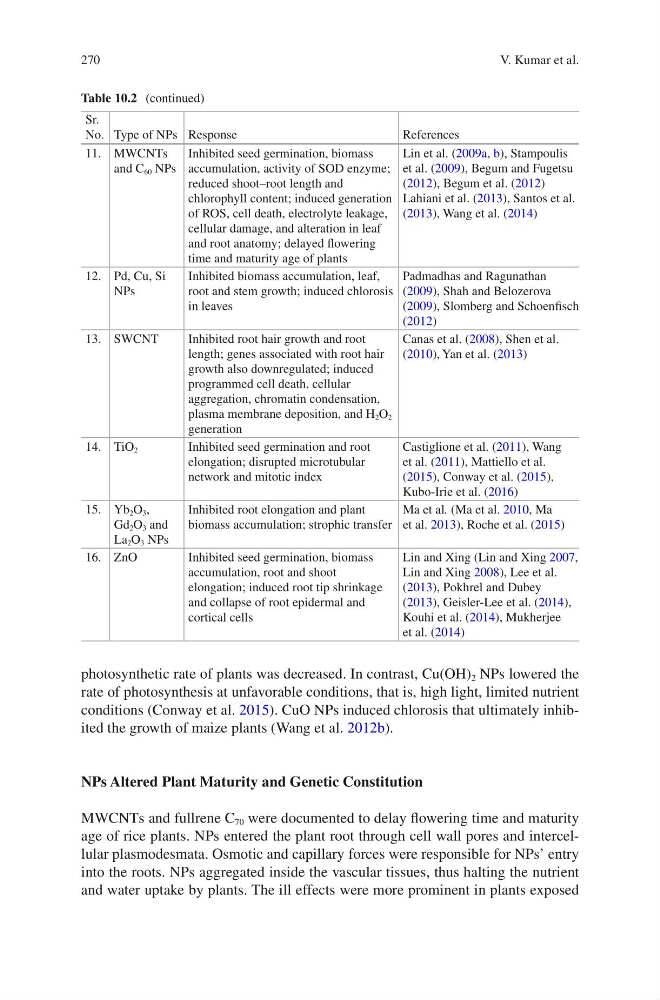
Table 10.2 (continued)
Sr.
No. Type of NPs Response
References
11. MWCNTs
and C 60 NPs
Inhibited seed germination, biomass
accumulation, activity of SOD enzyme;
reduced shoot–root length and
chlorophyll content; induced generation
of ROS, cell death, electrolyte leakage,
cellular damage, and alteration in leaf
and root anatomy; delayed flowering
time and maturity age of plants
Lin et al. (2009a, b), Stampoulis
et al. (2009), Begum and Fugetsu
(2012), Begum et al. (2012)
Lahiani et al. (2013), Santos et al.
(2013), Wang et al. (2014)
12. Pd, Cu, Si
NPs
Inhibited biomass accumulation, leaf,
root and stem growth; induced chlorosis
in leaves
Padmadhas and Ragunathan
(2009), Shah and Belozerova
(2009), Slomberg and Schoenfisch
(2012)
13. SWCNT
Inhibited root hair growth and root
length; genes associated with root hair
growth also downregulated; induced
programmed cell death, cellular
aggregation, chromatin condensation,
plasma membrane deposition, and H 2 O 2
generation
Canas et al. (2008), Shen et al.
(2010), Yan et al. (2013)
14. TiO 2
Inhibited seed germination and root
elongation; disrupted microtubular
network and mitotic index
Castiglione et al. (2011), Wang
et al. (2011), Mattiello et al.
(2015), Conway et al. (2015),
Kubo-Irie et al. (2016)
15. Yb 2 O 3 ,
Gd 2 O 3 and
La 2 O 3 NPs
Inhibited root elongation and plant
biomass accumulation; strophic transfer
Ma et al. (Ma et al. 2010, Ma
et al. 2013), Roche et al. (2015)
16. ZnO
Inhibited seed germination, biomass
accumulation, root and shoot
elongation; induced root tip shrinkage
and collapse of root epidermal and
cortical cells
Lin and Xing (Lin and Xing 2007,
Lin and Xing 2008), Lee et al.
(2013), Pokhrel and Dubey
(2013), Geisler-Lee et al. (2014),
Kouhi et al. (2014), Mukherjee
et al. (2014)
V. Kumar et al.
photosynthetic rate of plants was decreased. In contrast, Cu(OH) 2 NPs lowered the
rate of photosynthesis at unfavorable conditions, that is, high light, limited nutrient
conditions (Conway et al. 2015). CuO NPs induced chlorosis that ultimately inhibited the growth of maize plants (Wang et al. 2012b).
NPs Altered Plant Maturity and Genetic Constitution
MWCNTs and fullrene C 70 were documented to delay flowering time and maturity
age of rice plants. NPs entered the plant root through cell wall pores and intercellular plasmodesmata. Osmotic and capillary forces were responsible for NPs’ entry
into the roots. NPs aggregated inside the vascular tissues, thus halting the nutrient
and water uptake by plants. The ill effects were more prominent in plants exposed
Table 10.2 (continued)
Sr.
No. Type of NPs Response
References
11. MWCNTs
and C 60 NPs
Inhibited seed germination, biomass
accumulation, activity of SOD enzyme;
reduced shoot–root length and
chlorophyll content; induced generation
of ROS, cell death, electrolyte leakage,
cellular damage, and alteration in leaf
and root anatomy; delayed flowering
time and maturity age of plants
Lin et al. (2009a, b), Stampoulis
et al. (2009), Begum and Fugetsu
(2012), Begum et al. (2012)
Lahiani et al. (2013), Santos et al.
(2013), Wang et al. (2014)
12. Pd, Cu, Si
NPs
Inhibited biomass accumulation, leaf,
root and stem growth; induced chlorosis
in leaves
Padmadhas and Ragunathan
(2009), Shah and Belozerova
(2009), Slomberg and Schoenfisch
(2012)
13. SWCNT
Inhibited root hair growth and root
length; genes associated with root hair
growth also downregulated; induced
programmed cell death, cellular
aggregation, chromatin condensation,
plasma membrane deposition, and H 2 O 2
generation
Canas et al. (2008), Shen et al.
(2010), Yan et al. (2013)
14. TiO 2
Inhibited seed germination and root
elongation; disrupted microtubular
network and mitotic index
Castiglione et al. (2011), Wang
et al. (2011), Mattiello et al.
(2015), Conway et al. (2015),
Kubo-Irie et al. (2016)
15. Yb 2 O 3 ,
Gd 2 O 3 and
La 2 O 3 NPs
Inhibited root elongation and plant
biomass accumulation; strophic transfer
Ma et al. (Ma et al. 2010, Ma
et al. 2013), Roche et al. (2015)
16. ZnO
Inhibited seed germination, biomass
accumulation, root and shoot
elongation; induced root tip shrinkage
and collapse of root epidermal and
cortical cells
Lin and Xing (Lin and Xing 2007,
Lin and Xing 2008), Lee et al.
(2013), Pokhrel and Dubey
(2013), Geisler-Lee et al. (2014),
Kouhi et al. (2014), Mukherjee
et al. (2014)
V. Kumar et al.