

264
NPs Enhance Water Uptake
Various reports document enhanced seed germination on NP exposure. CNTs,
fullerenes, and graphene improved the germination of rice seed by increasing their
water intake. Due to better water content, the nanomaterial-treated seedlings were
healthier than the untreated seedlings (Remya et al. 2012). Au NPs were also
reported to improve the water and oxygen permeability of seed capsules that
improved seed germination in B. juncea. Further, increase in light absorption, carbohydrate content, increased gibberellin, and total chlorophyll content was responsible for the enhanced vegetative growth of the plants. Au NP exposure also
improved the antioxidant potential of the treated plants (Arora et al. 2012). Fullerols
increased the water uptake of bitter melon seeds and enhanced their overall productivity in terms of number of fruits (Kole et al. 2013). Fullerenes and CNT treatment
increased the water retention ability of tomato plants. As a result of more water
retention, the treated plants accumulated more cucurbitacin, lycopene, and insulin.
Better water retention was responsible for enhanced vegetative growth and fruit
production of tomato (Husen and Siddiqi 2014).
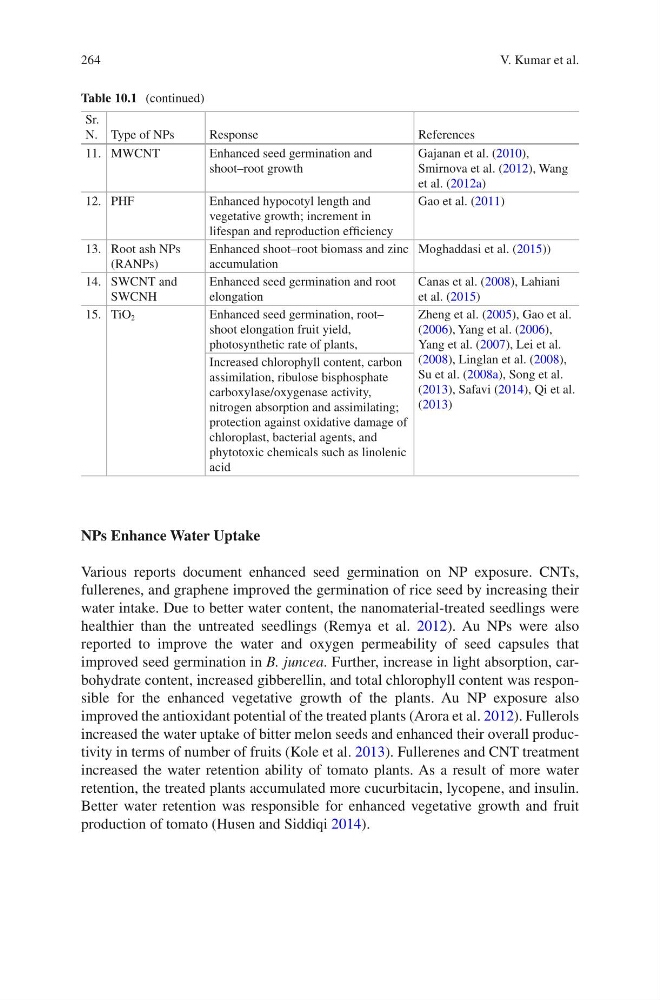
Table 10.1 (continued)
Sr.
N. Type of NPs
Response
References
11. MWCNT
Enhanced seed germination and
shoot–root growth
Gajanan et al. (2010),
Smirnova et al. (2012), Wang
et al. (2012a)
12. PHF
Enhanced hypocotyl length and
vegetative growth; increment in
lifespan and reproduction efficiency
Gao et al. (2011)
13. Root ash NPs
(RANPs)
Enhanced shoot–root biomass and zinc
accumulation
Moghaddasi et al. (2015))
14. SWCNT and
SWCNH
Enhanced seed germination and root
elongation
Canas et al. (2008), Lahiani
et al. (2015)
15. TiO 2
Enhanced seed germination, root–
shoot elongation fruit yield,
photosynthetic rate of plants,
Zheng et al. (2005), Gao et al.
(2006), Yang et al. (2006),
Yang et al. (2007), Lei et al.
(2008), Linglan et al. (2008),
Su et al. (2008a), Song et al.
(2013), Safavi (2014), Qi et al.
(2013)
Increased chlorophyll content, carbon
assimilation, ribulose bisphosphate
carboxylase/oxygenase activity,
nitrogen absorption and assimilating;
protection against oxidative damage of
chloroplast, bacterial agents, and
phytotoxic chemicals such as linolenic
acid
V. Kumar et al.
NPs Enhance Water Uptake
Various reports document enhanced seed germination on NP exposure. CNTs,
fullerenes, and graphene improved the germination of rice seed by increasing their
water intake. Due to better water content, the nanomaterial-treated seedlings were
healthier than the untreated seedlings (Remya et al. 2012). Au NPs were also
reported to improve the water and oxygen permeability of seed capsules that
improved seed germination in B. juncea. Further, increase in light absorption, carbohydrate content, increased gibberellin, and total chlorophyll content was responsible for the enhanced vegetative growth of the plants. Au NP exposure also
improved the antioxidant potential of the treated plants (Arora et al. 2012). Fullerols
increased the water uptake of bitter melon seeds and enhanced their overall productivity in terms of number of fruits (Kole et al. 2013). Fullerenes and CNT treatment
increased the water retention ability of tomato plants. As a result of more water
retention, the treated plants accumulated more cucurbitacin, lycopene, and insulin.
Better water retention was responsible for enhanced vegetative growth and fruit
production of tomato (Husen and Siddiqi 2014).
Table 10.1 (continued)
Sr.
N. Type of NPs
Response
References
11. MWCNT
Enhanced seed germination and
shoot–root growth
Gajanan et al. (2010),
Smirnova et al. (2012), Wang
et al. (2012a)
12. PHF
Enhanced hypocotyl length and
vegetative growth; increment in
lifespan and reproduction efficiency
Gao et al. (2011)
13. Root ash NPs
(RANPs)
Enhanced shoot–root biomass and zinc
accumulation
Moghaddasi et al. (2015))
14. SWCNT and
SWCNH
Enhanced seed germination and root
elongation
Canas et al. (2008), Lahiani
et al. (2015)
15. TiO 2
Enhanced seed germination, root–
shoot elongation fruit yield,
photosynthetic rate of plants,
Zheng et al. (2005), Gao et al.
(2006), Yang et al. (2006),
Yang et al. (2007), Lei et al.
(2008), Linglan et al. (2008),
Su et al. (2008a), Song et al.
(2013), Safavi (2014), Qi et al.
(2013)
Increased chlorophyll content, carbon
assimilation, ribulose bisphosphate
carboxylase/oxygenase activity,
nitrogen absorption and assimilating;
protection against oxidative damage of
chloroplast, bacterial agents, and
phytotoxic chemicals such as linolenic
acid
V. Kumar et al.