

220
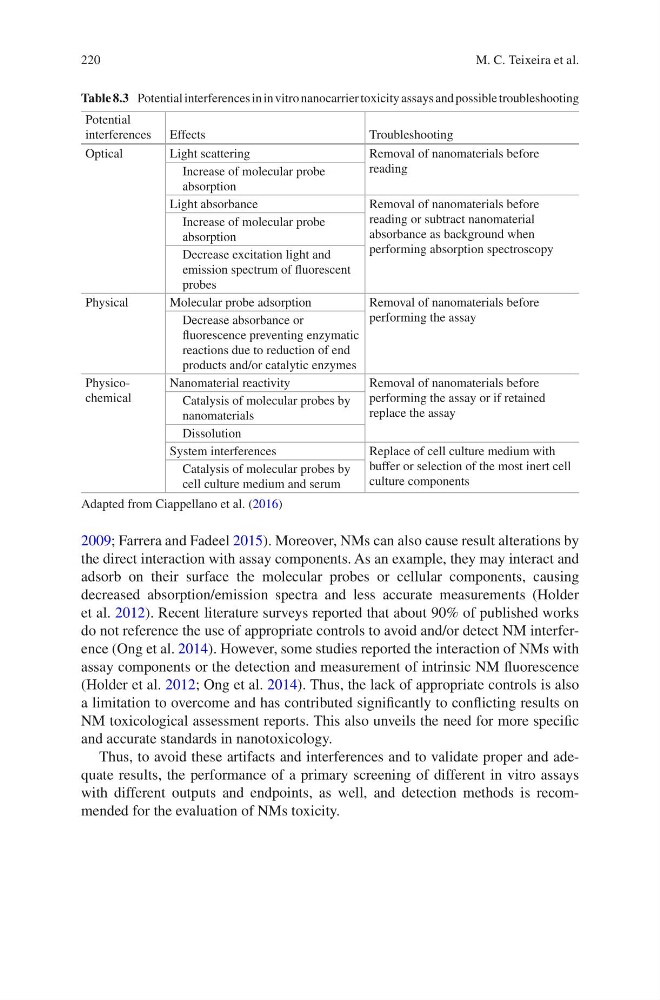
2009; Farrera and Fadeel 2015). Moreover, NMs can also cause result alterations by
the direct interaction with assay components. As an example, they may interact and
adsorb on their surface the molecular probes or cellular components, causing
decreased absorption/emission spectra and less accurate measurements (Holder
et al. 2012). Recent literature surveys reported that about 90% of published works
do not reference the use of appropriate controls to avoid and/or detect NM interference (Ong et al. 2014). However, some studies reported the interaction of NMs with
assay components or the detection and measurement of intrinsic NM fluorescence
(Holder et al. 2012; Ong et al. 2014). Thus, the lack of appropriate controls is also
a limitation to overcome and has contributed significantly to conflicting results on
NM toxicological assessment reports. This also unveils the need for more specific
and accurate standards in nanotoxicology.
Thus, to avoid these artifacts and interferences and to validate proper and adequate results, the performance of a primary screening of different in vitro assays
with different outputs and endpoints, as well, and detection methods is recommended for the evaluation of NMs toxicity.
Table 8.3 Potential interferences in in vitro nanocarrier toxicity assays and possible troubleshooting
Potential
interferences Effects
Troubleshooting
Optical
Light scattering
Removal of nanomaterials before
reading
Increase of molecular probe
absorption
Light absorbance
Removal of nanomaterials before
reading or subtract nanomaterial
absorbance as background when
performing absorption spectroscopy
Increase of molecular probe
absorption
Decrease excitation light and
emission spectrum of fluorescent
probes
Physical
Molecular probe adsorption
Removal of nanomaterials before
performing the assay
Decrease absorbance or
fluorescence preventing enzymatic
reactions due to reduction of end
products and/or catalytic enzymes
Physicochemical
Nanomaterial reactivity
Removal of nanomaterials before
performing the assay or if retained
replace the assay
Catalysis of molecular probes by
nanomaterials
Dissolution
System interferences
Replace of cell culture medium with
buffer or selection of the most inert cell
culture components
Catalysis of molecular probes by
cell culture medium and serum
Adapted from Ciappellano et al. (2016)
M. C. Teixeira et al.
2009; Farrera and Fadeel 2015). Moreover, NMs can also cause result alterations by
the direct interaction with assay components. As an example, they may interact and
adsorb on their surface the molecular probes or cellular components, causing
decreased absorption/emission spectra and less accurate measurements (Holder
et al. 2012). Recent literature surveys reported that about 90% of published works
do not reference the use of appropriate controls to avoid and/or detect NM interference (Ong et al. 2014). However, some studies reported the interaction of NMs with
assay components or the detection and measurement of intrinsic NM fluorescence
(Holder et al. 2012; Ong et al. 2014). Thus, the lack of appropriate controls is also
a limitation to overcome and has contributed significantly to conflicting results on
NM toxicological assessment reports. This also unveils the need for more specific
and accurate standards in nanotoxicology.
Thus, to avoid these artifacts and interferences and to validate proper and adequate results, the performance of a primary screening of different in vitro assays
with different outputs and endpoints, as well, and detection methods is recommended for the evaluation of NMs toxicity.
Table 8.3 Potential interferences in in vitro nanocarrier toxicity assays and possible troubleshooting
Potential
interferences Effects
Troubleshooting
Optical
Light scattering
Removal of nanomaterials before
reading
Increase of molecular probe
absorption
Light absorbance
Removal of nanomaterials before
reading or subtract nanomaterial
absorbance as background when
performing absorption spectroscopy
Increase of molecular probe
absorption
Decrease excitation light and
emission spectrum of fluorescent
probes
Physical
Molecular probe adsorption
Removal of nanomaterials before
performing the assay
Decrease absorbance or
fluorescence preventing enzymatic
reactions due to reduction of end
products and/or catalytic enzymes
Physicochemical
Nanomaterial reactivity
Removal of nanomaterials before
performing the assay or if retained
replace the assay
Catalysis of molecular probes by
nanomaterials
Dissolution
System interferences
Replace of cell culture medium with
buffer or selection of the most inert cell
culture components
Catalysis of molecular probes by
cell culture medium and serum
Adapted from Ciappellano et al. (2016)
M. C. Teixeira et al.