

9
and cars, powerful computers and satellites, long-lasting batteries, and better microand nanochips (Asmatulu et al. 2012). Although many nanoproducts are available
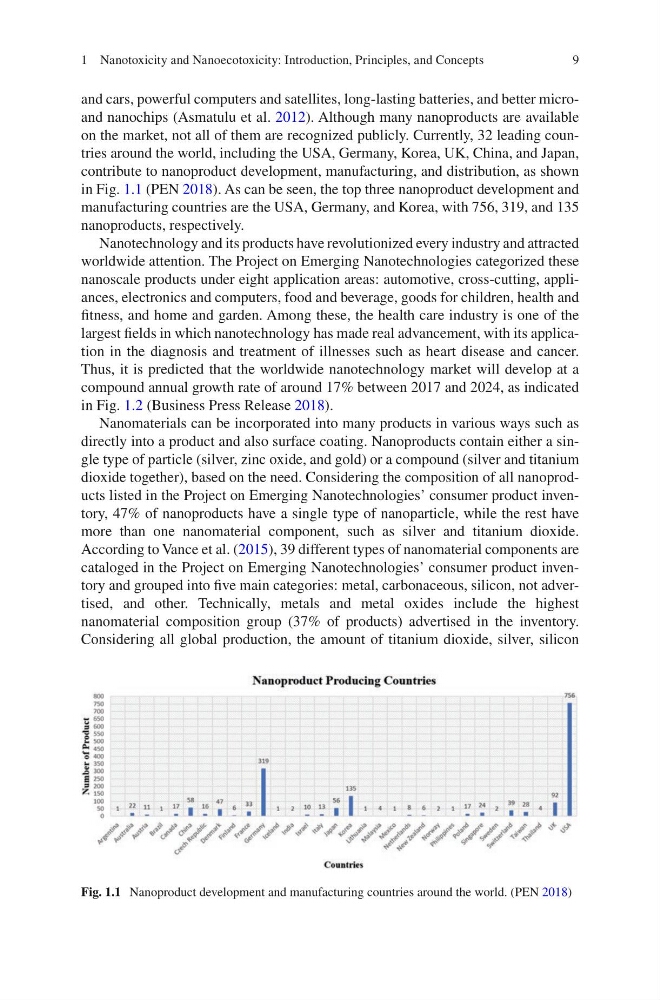
on the market, not all of them are recognized publicly. Currently, 32 leading countries around the world, including the USA, Germany, Korea, UK, China, and Japan,
contribute to nanoproduct development, manufacturing, and distribution, as shown
in Fig. 1.1 (PEN 2018). As can be seen, the top three nanoproduct development and
manufacturing countries are the USA, Germany, and Korea, with 756, 319, and 135
nanoproducts, respectively.
Nanotechnology and its products have revolutionized every industry and attracted
worldwide attention. The Project on Emerging Nanotechnologies categorized these
nanoscale products under eight application areas: automotive, cross-cutting, appliances, electronics and computers, food and beverage, goods for children, health and
fitness, and home and garden. Among these, the health care industry is one of the
largest fields in which nanotechnology has made real advancement, with its application in the diagnosis and treatment of illnesses such as heart disease and cancer.
Thus, it is predicted that the worldwide nanotechnology market will develop at a
compound annual growth rate of around 17% between 2017 and 2024, as indicated
in Fig. 1.2 (Business Press Release 2018).
Nanomaterials can be incorporated into many products in various ways such as
directly into a product and also surface coating. Nanoproducts contain either a single type of particle (silver, zinc oxide, and gold) or a compound (silver and titanium
dioxide together), based on the need. Considering the composition of all nanoproducts listed in the Project on Emerging Nanotechnologies’ consumer product inventory, 47% of nanoproducts have a single type of nanoparticle, while the rest have
more than one nanomaterial component, such as silver and titanium dioxide.
According to Vance et al. (2015), 39 different types of nanomaterial components are
cataloged in the Project on Emerging Nanotechnologies’ consumer product inventory and grouped into five main categories: metal, carbonaceous, silicon, not advertised, and other. Technically, metals and metal oxides include the highest
nanomaterial composition group (37% of products) advertised in the inventory.
Considering all global production, the amount of titanium dioxide, silver, silicon
Fig. 1.1 Nanoproduct development and manufacturing countries around the world. (PEN 2018)
1 Nanotoxicity and Nanoecotoxicity: Introduction, Principles, and Concepts
and cars, powerful computers and satellites, long-lasting batteries, and better microand nanochips (Asmatulu et al. 2012). Although many nanoproducts are available
on the market, not all of them are recognized publicly. Currently, 32 leading countries around the world, including the USA, Germany, Korea, UK, China, and Japan,
contribute to nanoproduct development, manufacturing, and distribution, as shown
in Fig. 1.1 (PEN 2018). As can be seen, the top three nanoproduct development and
manufacturing countries are the USA, Germany, and Korea, with 756, 319, and 135
nanoproducts, respectively.
Nanotechnology and its products have revolutionized every industry and attracted
worldwide attention. The Project on Emerging Nanotechnologies categorized these
nanoscale products under eight application areas: automotive, cross-cutting, appliances, electronics and computers, food and beverage, goods for children, health and
fitness, and home and garden. Among these, the health care industry is one of the
largest fields in which nanotechnology has made real advancement, with its application in the diagnosis and treatment of illnesses such as heart disease and cancer.
Thus, it is predicted that the worldwide nanotechnology market will develop at a
compound annual growth rate of around 17% between 2017 and 2024, as indicated
in Fig. 1.2 (Business Press Release 2018).
Nanomaterials can be incorporated into many products in various ways such as
directly into a product and also surface coating. Nanoproducts contain either a single type of particle (silver, zinc oxide, and gold) or a compound (silver and titanium
dioxide together), based on the need. Considering the composition of all nanoproducts listed in the Project on Emerging Nanotechnologies’ consumer product inventory, 47% of nanoproducts have a single type of nanoparticle, while the rest have
more than one nanomaterial component, such as silver and titanium dioxide.
According to Vance et al. (2015), 39 different types of nanomaterial components are
cataloged in the Project on Emerging Nanotechnologies’ consumer product inventory and grouped into five main categories: metal, carbonaceous, silicon, not advertised, and other. Technically, metals and metal oxides include the highest
nanomaterial composition group (37% of products) advertised in the inventory.
Considering all global production, the amount of titanium dioxide, silver, silicon
Fig. 1.1 Nanoproduct development and manufacturing countries around the world. (PEN 2018)
1 Nanotoxicity and Nanoecotoxicity: Introduction, Principles, and Concepts